Neander Turbodiesel: the rarest and most revolutionary diesel motorcycle of the 2000s
StoriesThursday, 19 March 2026 at 08:06
"The smell of gasoline makes my head spin" is the opening line of a famous song by Jovanotti. Now imagine if he had said the smell of diesel. Gasoline has a pungent, almost aromatic scent, while diesel has a more oily, heavy one.
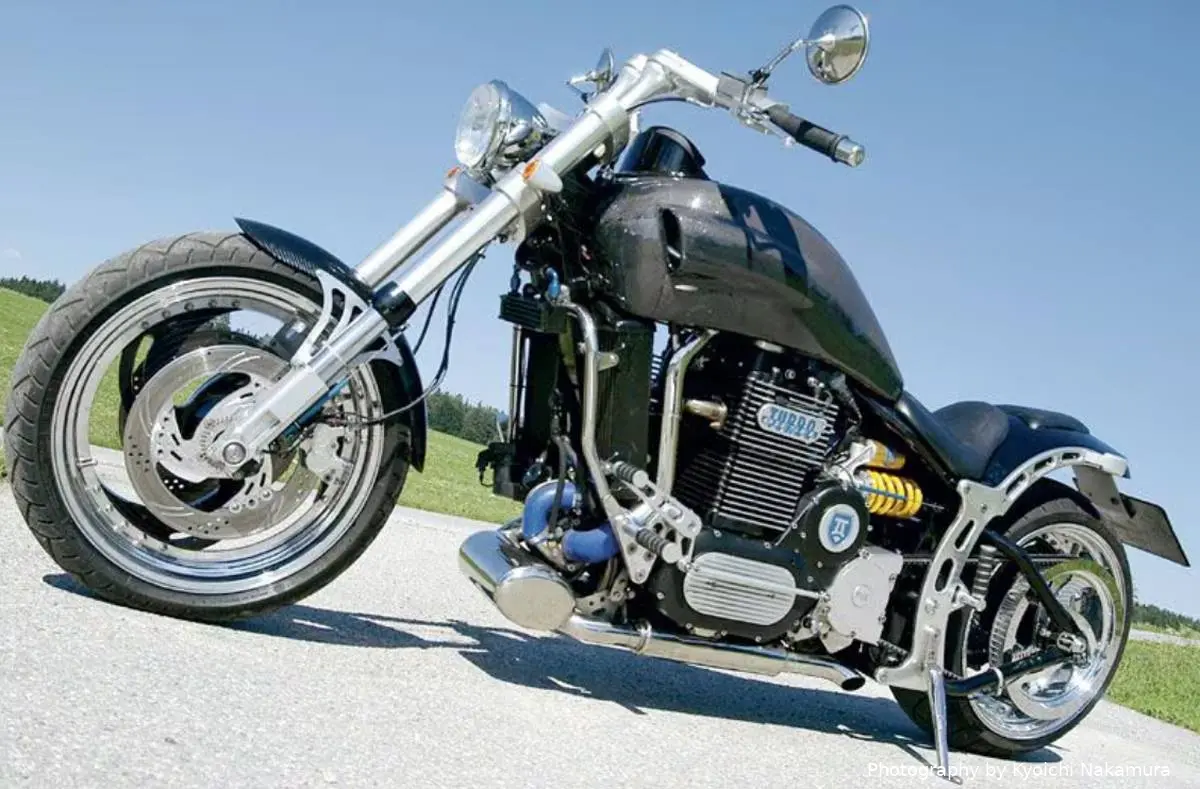
In the world of two wheels, diesel has always been viewed with suspicion, more for cultural reasons than technical ones. Yet one of the strangest and most fascinating motorcycles ever conceived runs on diesel: the Neander Turbodiesel. The project took shape in the early 2000s, but its official presentation and the start of limited production date back to 2007. This machine completely overturned the prejudice that diesel cannot work on a motorcycle, turning it instead into the heart of a cruiser that was technologically beyond any convention.
At the core of this bike was a parallel twin of over 1400 cc, turbocharged, hiding a solution as complex as it was ingenious: two counter-rotating crankshafts connected to each other by gears. Each cylinder worked with two connecting rods, for a total of four, a configuration that almost completely eliminated lateral thrusts on the pistons, reducing friction and wear even with the high compression ratio typical of diesels.
Despite the nature of the fuel, the Neander impressed with the near-total absence of vibrations, both at idle and in motion—an aspect that completely upended the expectations of anyone approaching this bike with the usual diesel preconceptions.
The cylinder head was equally unconventional. It used a radial valve system derived from the studies of Austrian engineer Ludwig Apfelbeck, a solution that arranged intake and exhaust in a crossflow rather than separated layout, improving combustion and efficiency. Air entered vertically at the center of the engine, while the exhaust gases were routed to a Garrett turbocharger that blew assertively, transforming the bike’s character as soon as it passed 2,000 rpm.
The idea of riding a diesel motorcycle conjured images of something slow and clumsy, but just a twist of the throttle was enough to realize how far that perception was from reality. Torque arrived immediately, with force, and spread out almost flat, delivering a steady, meaty shove. It wasn’t the angry explosion of a sportbike, but rather a full, unstoppable surge, accompanied by the hiss of the turbo overlaying the typical metallic clatter of a diesel.
Despite its considerable weight, the bike moved with surprising ease, thanks to a low center of gravity and a chassis more traditional than you’d expect from such an extreme project. The ride was relaxed yet effective, suited both to fast touring and long hauls.
There was, however, one element that divided many: the sound. While the technology made this engine efficient and sophisticated, it couldn’t transform its voice. Under load the noise remained rough, light-years away from the musicality of a gasoline twin.
The Neander Turbodiesel was supposed to be produced in about 250 hand-assembled units, but the actual number was lower—almost like an advanced prototype—due to the project’s complexity and high costs.
The list price in 2007 was around 95,000 euros. This made the Neander an object more to admire than to sell, contributing to its limited commercial success.
Today, finding a Neander Turbodiesel is an almost impossible feat. From time to time they appear at specialized auctions, in private collections, or in sales among niche enthusiasts, and when they do, prices often remain similar to or higher than the original.
Continue reading
You might also like


More news



Popular articles


Loading