Grand Prix Motorcycle Racing Stories: OSSA 250 Monocoque, Spanish ingenuity, magnesium, and a shattered dream
Stories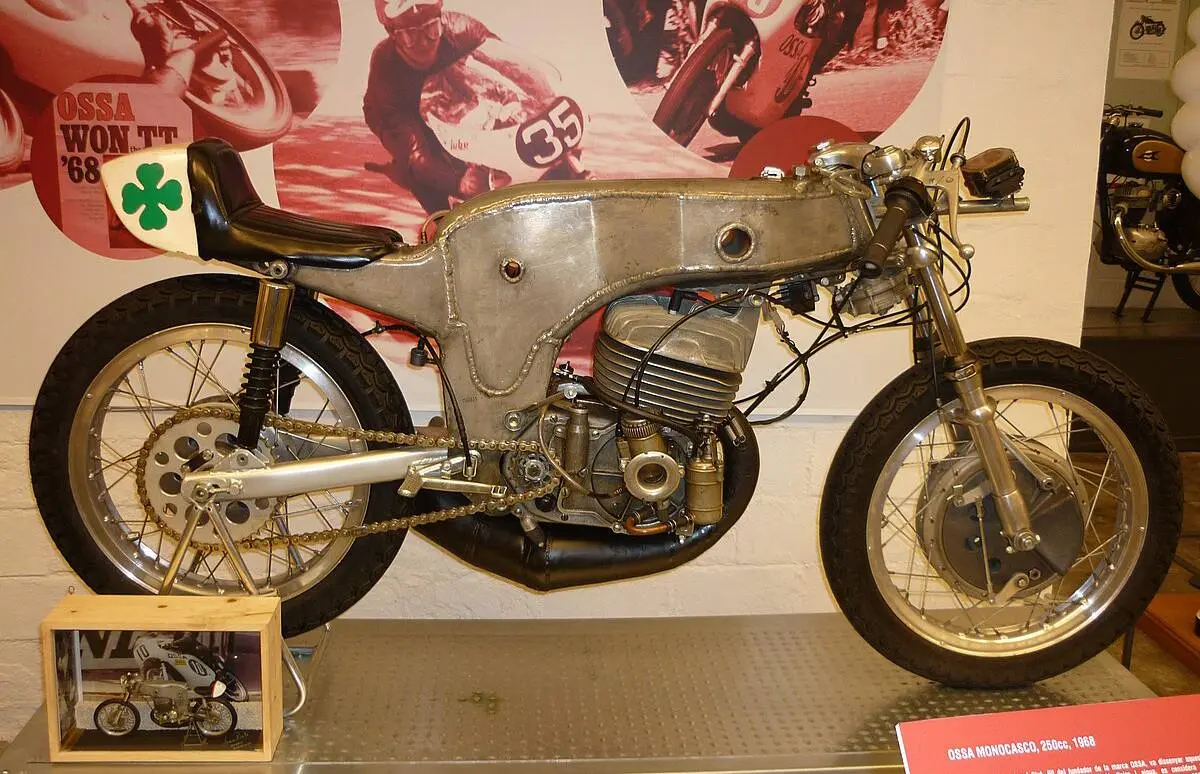
Have you ever heard of OSSA? No, not the ones we all have in our bodies, but OSSA as the acronym for Orpheo Sincronic Sociedad Anónima, a Spanish motorcycle manufacturer that competed in the World Championship with a futuristic 250 for its time.
Founded in 1928, OSSA initially produced projectors for the film industry. Its strength was a device for adding sound to films, which were silent at the time, by coupling it to the projectors. Manuel Giró i Minguella, the owner’s son, preferred the music of engines. A great enthusiast of mechanics and motorcycling from a young age, he owned several prestigious motorcycles, including a Norton. His second great passion was powerboat racing, where he met entrepreneur Ricardo Soriano, with whom he struck a deal. The OSSA workshops in Barcelona thus began producing outboard motors.
To promote the engines, Giró actively took part in powerboating competitions, achieving notable success. His passion for motorcycles and the availability of suitable machinery, however, drove him to involve his family in a new project. In 1935, Giró and his brother Ernest purchased the car factory Nacional Pescara with the intention of producing their own vehicles.
After the war, the company seriously decided to enter the motorcycle market. OSSA launched its first production model in 1951: a 125 cc that was an immediate success. During that period, it adopted its iconic four-leaf clover logo, whose origin is linked to the company’s previous film activity. The use of this symbol was even amicably defended by Manuel Giró against the legal claims of Alfa Romeo, which ultimately dropped the action.
The golden age arrived with the entry of Eduard Giró, Manuel’s son, in the early 1960s. The young and talented engineer understood the need to look beyond Spain. OSSA reached its production peak, exporting en masse to Europe and North America, where its off-road bikes became extremely popular. His dream—indeed, his goal—was the World Championship.
OSSA 250 Monocoque: the motorcycle that anticipated the future
Eduard Giró decided to carry out his graduation project: a 250 cc two-stroke with a rotary valve and chassis solutions that no one in Barcelona had even imagined.
When the prototype first lapped the track, it was clear to everyone that the engine had enormous potential. But the frame did not. Giró then did what innovators do: he took a completely different path. If steel tubes weren’t enough, why not eliminate them altogether? Thus was born the magnesium monocoque. A single shell, ultra-light and extremely rigid, whose raw material was procured through a story that sounds like it came from an industrial adventure novel: U.S. aviation sheets imported via France and smuggled across the Pyrenees.
It was the first Grand Prix motorcycle with a monocoque frame. In Europe, no one even had the capability to weld it: OSSA had to build a dedicated welding machine.
The choice of rider fell on Santiago “Santi” Herrero, from Madrid, a former mechanic of himself, capable of turning the most stubborn motorcycles into docile, fast instruments. Already in 1967, with the first still “tubular” prototype, he won the Spanish Championship. The following year the true monocoque arrived. Santiago “Santi” Herrero and OSSA challenged riders on over-60-horsepower Yamaha V4s and Benelli four-strokes with a single-cylinder making 20 horsepower less, but weighing 20 kilos less.
Victories in the World Championship
In 1969 Herrero started winning right away and kept doing so until he broke an arm in an accident. Despite that, he returned to the saddle with a determination that moved the entire paddock and came to fight for the 250 World Championship at the final GP. A mechanical failure stopped him just a few kilometers from the dream.
1970 seemed written for revenge: consistent results, a new victory in Yugoslavia, and the top of the world standings. The next step was the Isle of Man Tourist Trophy, a race that was then part of the World Championship. There, during the final lap, while fully in the fight, Herrero slipped. The impact was devastating. He did not survive.
The Monocoque not only lost its rider: it lost its reason to exist. OSSA announced its immediate withdrawal from track racing. Giró’s words remained over the years as a tender and tragic epitaph: “We raced for Santi. Without him, we will not race anymore.”
The 250 Monocoque never won a world title; it claimed only four Grands Prix, yet it profoundly influenced motorcycle engineering. Its rotary-valve engine was among the best single-cylinders ever, and its exhaust became an object of worship among technicians of the era. Some of its solutions—such as the cassette gearbox, the steering damper, or the experimental suspension department—seem normal today but were almost science fiction back then.
The OSSA 250 Monocoque represents one of the rare cases in which innovation did not lead to victory but to legend. It was perhaps a motorcycle too bold for its time, ridden by a rider perhaps too pure for an increasingly brutal world championship.
In March 2009, the OSSA brand was saved and relaunched by a new group of entrepreneurs from Girona. With the creation of Ossa Factory, it presented its new trial model, the TR 280i, to the world, marking the return of the House of the Four-Leaf Clover.
Continue reading
You might also like

More news
Popular articles

Loading