Vincent: from pushing the limits to the Black Legend—how the world’s fastest production motorcycle was born
Stories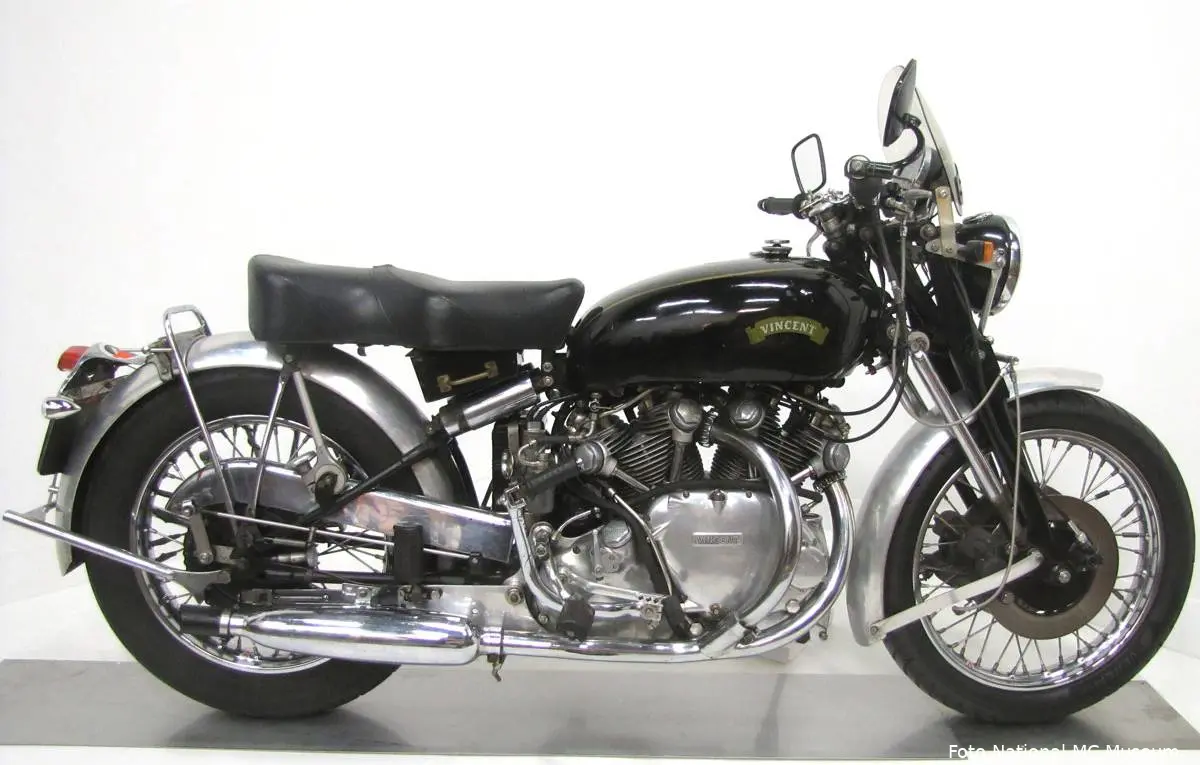
Vincent was not just a motorcycle manufacturer; it was the embodiment of an era when engineering meant pushing the limits of speed.
Founded in 1928 by Philip Vincent, the British company rose from the ashes of HRD Motorcycles, a brand created by racer Howard Raymond Davies. It was Davies himself who brought notoriety to the marque by winning the Senior TT in 1925, but sporting success wasn’t enough to save its finances. When HRD closed, the young Vincent, a university student from a well-off family, acquired the name, moved the headquarters to Stevenage, and gave life to Vincent HRD.
In the early years, production relied on engines supplied by third parties, but the turning point came in 1934, when Australian engineer Philip Irving designed new proprietary 500 and 1,000 cc powerplants for Vincent.
The real jolt to the market came in 1936 with the unveiling of the Rapide at the London Show: a one-liter V-twin with 45 hp and a top speed of over 170 km/h. Impressive figures for the era, but the high price limited its spread: only 78 units were built before the outbreak of World War II.
During the conflict, the company converted to wartime production, manufacturing munitions and marine engines. But the postwar period marked the peak of Vincent’s technical arc.
Vincent Black Shadow: 200 km/h in 1948
In 1948 came the model destined to enter history: the Black Shadow. Derived from the Rapide but boosted to 55 hp, it could reach 200 km/h. This made it, officially, the fastest production motorcycle in the world. Its all-black aesthetic helped build its legend. In the United States, a key market for expansion, the brand dropped the HRD initials to avoid confusion with Harley-Davidson, becoming definitively Vincent.
In 1949 the “C” series arrived, featuring the sophisticated Girdraulic front suspension, and above all the most extreme version ever: the Vincent Black Lightning. Lightened, pushed to 70 hp, and credited with 240 km/h, it was a motorcycle built exclusively for competition. A true missile on two wheels. Alongside the twins, the single-cylinder 500 Meteor and Comet also continued, but it was clear the company’s technological heart beat strongest in the big V-twins.
In 1954 the “D” series was introduced, with fiberglass-faired models like the Black Knight and Black Prince. A bold stylistic choice, perhaps too far ahead of its time. Sales failed to take off and the financial difficulties became unsustainable. In the summer of 1955 Philip Vincent announced the end of motorcycle production. On December 16, the last bike rolled out of the Stevenage factory, a Black Prince bearing the symbolic inscription: “The Last.” In total, 11,036 motorcycles were built, of which 6,852 were twins.
After the closure, the company tried its hand at mechanical engineering and industrial engines, also developing the Amanda personal watercraft and the Picador aircraft engine, but failed to find new stability. In 1959 came the final liquidation.

Continue reading
You might also like
More news

Popular articles
Loading