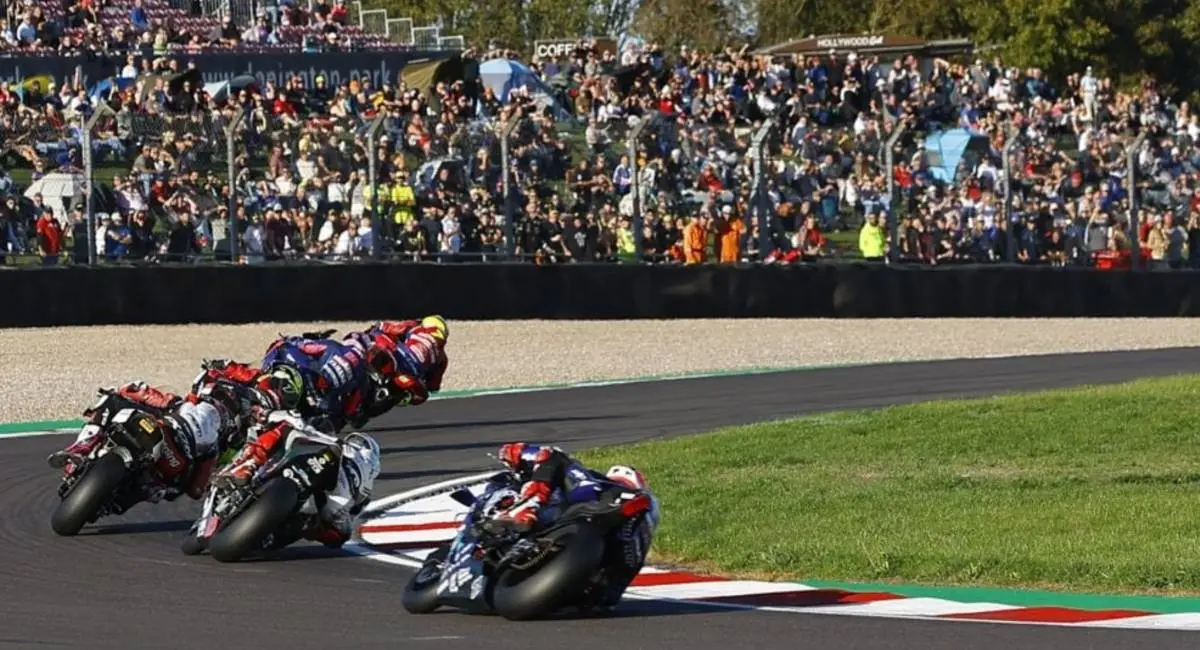
The British Superbike Championship is catching the World Championship off guard and proposing a new regulatory philosophy that could usher in a new era. From 2027, the world’s most competitive national championship will introduce the new “Next Generation” technical platform.
The revolution was decided to open the doors to new manufacturers and respond to the changes taking place in the sportbike market. For many years, Superbike has revolved around 1,000cc maxi bikes, but a single displacement limit has highlighted major performance differences between projects that vary in design age, engine architecture and, above all, the degree of sophistication of their road-going models. To overcome these critical issues, the BSB will adopt BoP, or “Balance of Performance”. It is hardly a new idea, since this regulatory concept is already used, with a certain degree of success, in several support categories such as Supersport and SportBike, including at World Championship level.
The World Championship is taking a different direction
The World Superbike Championship recently laid out its 2027–2030 regulations, taking a radically different direction. According to the intentions of the FIM and the promoter, performance parity in 2027 should be ensured by the combined effect of two measures: fuel-flow regulation and control of the engine’s maximum rpm. These are the two solutions used individually in recent seasons. The idea is that applying them together could work, alongside the introduction of identical fuel for everyone, supplied by a single provider.
How Next Generation BSB will work
The centrepiece of the regulatory revolution will be the electronic control unit supplied by Mectronick, which will replace the current ECU—identical for everyone for many years—whereas in the World Championship there is no such requirement, meaning each manufacturer can use whichever unit it prefers. Every bike on the grid in the 2027 BSB will be calibrated to operate within defined performance parameters, achieving the most balanced performance possible among motorcycles with very different displacements, architectures and models. BoP will be based on controlling torque values, a decisive factor in performance, far more so than peak power and engine speed.
A 200-horsepower target
The BSB organisers’ aim is to balance performance at around 200 horsepower, acting specifically on torque values throughout the entire power delivery range. It has been specified that BoP will evolve during the 2027 championship, meaning the initial values will be theoretical and then adjusted according to the data emerging from the first races on the calendar. This power figure represents a drastic reduction compared with the performance of today’s Superbikes: in the World Championship, factory-team bikes are now approaching 250 horsepower. Some road bikes even produce more power than the Superbikes we will see racing in the BSB: the Ducati Panigale V4 R available from dealers has 218 horsepower. It will therefore have to undergo a radical performance cut to comply with the new regulations.
Closer to road bikes
The BSB is therefore putting the brakes on technical sophistication and rising costs. The series will move closer to production machinery. With one important qualification: older models will be allowed to use specific components to reach the required performance range. In this way, according to the BSB organisers, races will be closer and all manufacturers will have a chance to make a strong showing, regardless of displacement, architecture, design age or level of sophistication. Costs will also be drastically reduced, although the Mectronick ECU will still retain traction control managed by the inertial platform, anti-wheelie control and launch control.
The arrival of new manufacturers
With these new rules, the BSB hopes to maintain strong interest from the manufacturers currently involved—Ducati, Yamaha, Kawasaki and Bimota—but above all to encourage many others that are waiting in the wings to join. The first interested party is Aprilia, which cannot compete in the World Championship because the RSV4 now has an enlarged 1,100cc engine. But with these rules and such a low maximum power threshold, Chinese manufacturers such as CFMoto and ZXMoto—currently developing or already testing future Superbikes on track—will also find the BSB an easy route into competition. Interesting fact: ZXMoto has announced a Superbike with a five-cylinder engine—a machine that, under current regulations, cannot race in WorldSBK. However, it would be eligible to compete in the 2027 BSB without issue.
The BSB is therefore taking a completely different path and issuing the World Superbike Championship with a highly ambitious technical—and reputational—challenge.

-> Follow us on Instagram too: @Corsedimoto
Continue reading
You might also like
More news
Popular articles
Loading