In the 1980s, Lamborghini took on the two-wheeled challenge with an innovative motorcycle that had no future. Here’s its brief history.
The history of motorsport has seen its fair share of carmakers trying their hand at two wheels. We’ve told you about the legendary Ferrari, but it wasn’t the only one: Lamborghini is another dream marque that gave it a try during the turbulent 1980s, ultimately producing just one model that, unfortunately, proved to be a spectacular flop. In the end, only six examples were built, and they have since become collector’s items. Let’s revisit their brief history.
The origins
Ferruccio Lamborghini, then a well-known entrepreneur in the tractor industry, founded Automobili Lamborghini in 1963, with its headquarters in Sant’Agata Bolognese. Legend has it that he made the decision after encountering various mechanical problems with his Ferrari and receiving sarcastic remarks about them from the founder of the Maranello marque. Lamborghini went all in on creating a “perfect car,” inspired both by his zodiac sign, Taurus, and by his passion for bullfighting (a set of practices, rituals and spectacles involving physical interaction between humans and bulls, or between bulls themselves). In just three years, this new company became a global automotive legend—and it remains one to this day.
The crisis of the 1980s and the two-wheeled experiment
Lamborghini’s history, however, hasn’t always been remarkable. As time went on, the company reached a point when it came perilously close to disappearing. In the 1980s, following a previous decade of difficulties, it faced a severe financial crisis that led to bankruptcy and forced founder Ferruccio Lamborghini to leave the company. Then along came the young Frenchmen Jean-Claude and Patrick Mimran, the marque’s first major lifeline. With innovative ideas and a willingness to explore uncharted territory, they relaunched the company as Nuova Automobili Ferruccio Lamborghini and decided to try something extraordinary: a motorcycle. The project, however, would not be developed in Italy. Instead, it was entrusted to the renowned French workshop Boxer Bikes (renamed Boxer Design in 1999), which also applied technologies derived from the aerospace industry.

The Lamborghini Design 90 is born
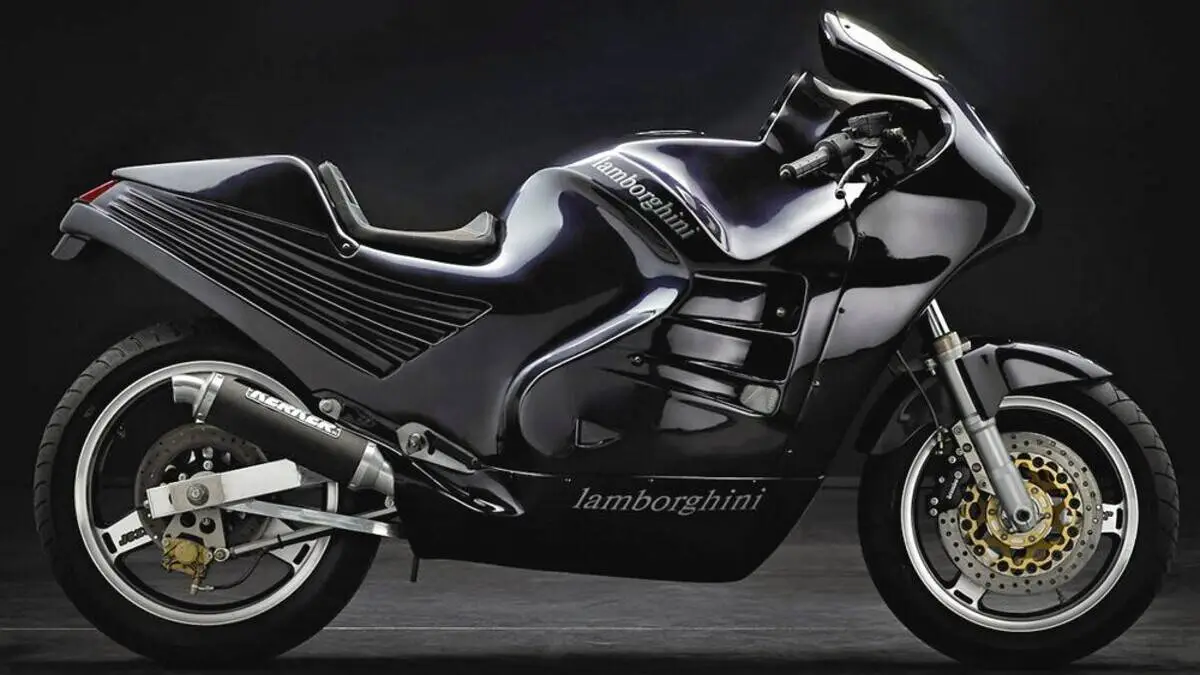
The project also bears the signature of Claude Fior, a passionate motorsports enthusiast and outstanding French motorcycle-frame designer (he died in 2001 at just 46). He was responsible for the hand-welded perimeter frame made of aluminium alloy, the backbone of a motorcycle that was decidedly cutting-edge for its time—1986. Its only slight drawback, somewhat at odds with the marque’s identity, was that beneath the fibreglass bodywork sat not a home-grown engine, but a Kawasaki four-stroke inline-four with a 997cc displacement, derived from the GPZ1000RX and producing between 120 and 130 hp. Other specifications included liquid cooling, dual overhead camshafts and four valves per cylinder, a top speed of 258 km/h, and a six-speed manual gearbox. Dry weight was 180 kg. It featured a hand-beaten aluminium tank and aerodynamic monocoque bodywork, with a removable cover over the rear seat for an optional passenger.
From dream bike to flop
Sadly, the innovative Lamborghini Design 90 failed to win people over, primarily because of its prohibitive price: around 13,000, more than twice the cost of any sports bike of the time. On top of that, customers weren’t impressed by its styling. The Mimran Group’s successful stewardship therefore took a heavy blow from a project that proved to be a dead end: of the 25 planned examples, only six were built, and five are believed to still exist.
The partnership with Ducati
Lamborghini gave up building motorcycles, but not its involvement in the motorcycle world. In 2020, it began a strong partnership with Ducati—an interesting collaboration between two companies born in the Motor Valley and now both part of the Volkswagen Group through Audi. It began with the Ducati Diavel 1260 Lamborghini, followed by the Streetfighter V4 Lamborghini in 2022 and the Panigale V4 Lamborghini in 2025. The latter’s 2026 version is being produced in 630 examples. What’s more, MotoGP has also seen several special liveries dedicated to the Sant’Agata Bolognese marque. The first appeared at the 2018 and 2019 Mugello Grands Prix; in 2020, Lamborghini’s Centro Stile designed the liveries for the Pramac team’s Ducatis for the entire season.
-> Follow us on Instagram too: @Corsedimoto
Continue reading
You might also like
More news
Popular articles
Loading