Motorcycle Stories: 1993 European Road Racing Championship, true talent and the Hockenheim heartbreak
Stories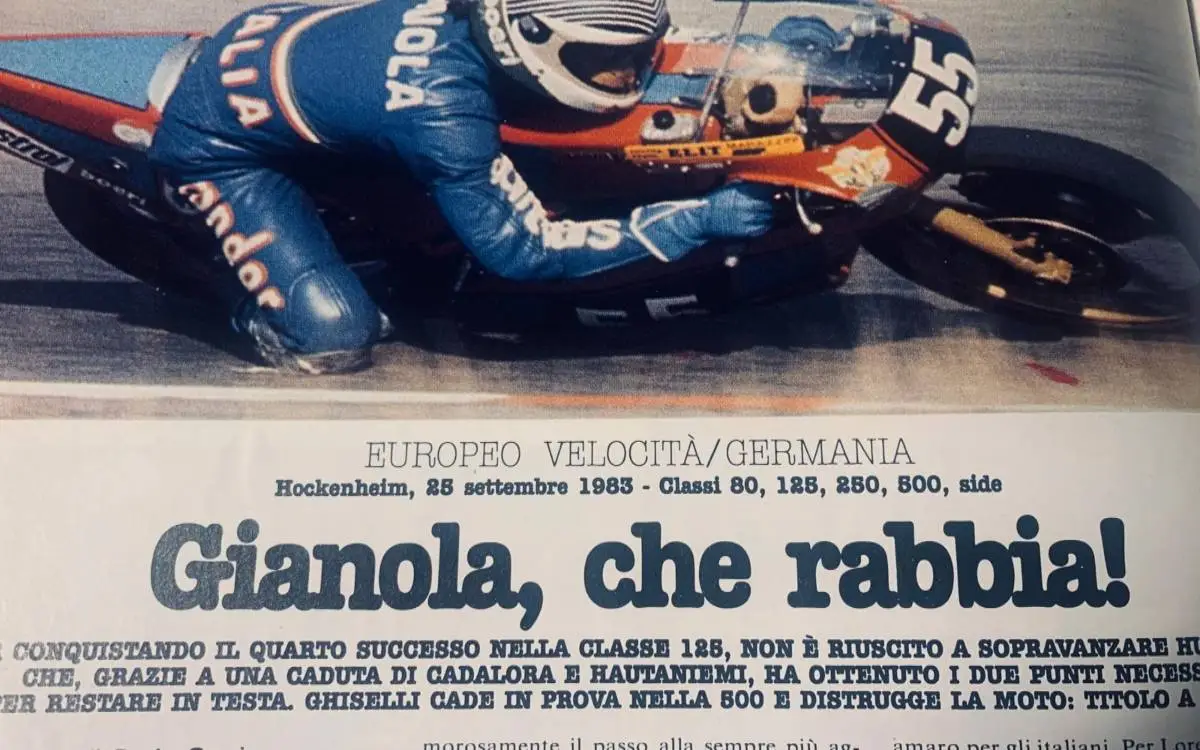
With the various federations turning a blind eye, promoters have now swallowed up everything, including the right to legislate on technical and sporting matters. But a few years ago, things were different.
At the start of the 1980s, in an effort to bring some order to access to Grand Prix races and give riders rarely admitted to world championship events the chance to compete internationally, Eng. Brenni, then president of the FIM/CCR, had championed the revival of a multi-round European Championship, specifically for riders not accepted into the world championship. The top three finishers in the European Championship earned the right to race in the world championship the following year.
The Italian Team Azzurro
At the same time, an idea was gaining traction within the Italian federation, driven by Speed Racing Technical Director Renato Chiarelli: select, support and help young riders, giving them the opportunity to excel and reach the highest levels. Both FMI President Zerbi and CS head Comanducci immediately embraced the idea. Within a few years, it would grow from simply providing riders with financial and technical support into the creation of Team Italia—almost fifty years before Dorna’s much-celebrated Road to MotoGP™ program of today.
The newly established European Championship was the ideal stage for Italy’s young hopefuls, who were major players from the outset. Giuseppe Ascareggi won the 50cc title and Pierluigi Aldrovandi the 125cc title in 1981; the following year, Stefano Caracchi took the 125cc crown and Fabio Biliotti the 500cc title. Leandro Becheroni’s extra title in ’81 should also be added to the tally.
For the 1983 season, Team Azzurro—as the initiative was known—was strongly represented in every class. In the 125cc category, traditionally a happy hunting ground for Italian riders, a formidable quartet of young talents lined up: Ezio Gianola, Luca Cadalora, Domenico Brigaglia and Fabio Meozzi.
Despite a few setbacks for the unlucky Gianola, including a broken gearbox at Misano and a puncture in Austria while he was leading, after the first four races the Italian quartet was dominating the scene.
Brigaglia led the standings on 43 points, followed by Meozzi on 34, Cadalora on 33 and Gianola on 30. Their closest pursuer was German rider Willy Hupperich, on 25 points. It is worth remembering that the points system at the time awarded 15-12-10-8-6-5-4-3-2-1 points to the top ten finishers, in that order.
Bad luck has perfect aim
But from the fifth round in France, at Le Castellet on July 17 (perhaps the date was an unlucky omen?), the worst of luck struck Team Azzurro. The first warning came when Brigaglia badly fractured his foot at the chicane during practice. Then, at the start, Cadalora shot into the lead but soon had to stop with a seized engine. Selini took over at the front, but was out of the race, with Gianola and Meozzi in pursuit and Hupperich some way back. Then Gianola broke a bearing, and Meozzi slid off, leaving Hupperich free to take maximum points for the championship.
Things went no better in Finland, where Brigaglia and Cadalora were absent. Gianola dominated the race, but with two laps to go his engine suddenly gave out. Frenchman Bordes won, with Hupperich third.
At the end of August, the championship moved to Brno and its road circuit. This time Gianola finished third behind H. Muller and Auinger, who were ineligible because they were on the world championship grading list, and took the full European points haul. But Hupperich beat Cadalora and a still-injured Brigaglia to third place among the European riders.
Two races remained—Assen and Hockenheim—and all four Italian riders were still mathematically capable of becoming European champion. But they would have to fight for it.
Enrico Fugardi’s horrific crash
In the Netherlands, where Enrico Fugardi suffered a horrific crash in the 500cc race that effectively ended his chances of a top-level career, once again everything went wrong. Hupperich slid off, but no one managed to take advantage. Gianola, battling at the front, suffered an engine failure after setting the race’s fastest lap; Brigaglia stopped with a battery problem. Cadalora was the only one to score, taking second behind local rider Willem Heycoop on the Sanvenero.
There is an incident from that race that involves me personally. I was there as an FMI steward on the International Jury, standing by the pit wall, when I saw Heycoop come back into the pits. A little later, he was racing again. I thought he was a lap down, but when the results were published, there he was in first place ahead of Cadalora. At the jury meeting, I raised my concerns. The timekeepers were consulted and confirmed that Heycoop was on the lead lap. Evidently, I was mistaken—but believe me, it was hard to confuse Heycoop, dressed in pristine white leathers and riding an all-white bike—not even a single ice-cream vendor could have missed him! To this day, I still feel I was taken for a ride. And above all, those extra three points would have come in handy!
The Hockenheim showdown
On the eve of the final round in Germany, Hupperich led with 60 points, Cadalora and Brigaglia had 53, and Gianola 45. All four were still mathematically in contention for the title.
And at Hockenheim, everything seemed to be going perfectly. Gianola waved goodbye to everyone and pulled away, Brigaglia, Cadalora and Meozzi were all in the points, while Hupperich was trudging along in 12th, outside the points. The final lap began, and all eyes were fixed on the entrance to the Motodrom. Gianola came through alone and stopped before the finish line, following Chiarelli’s instructions in case he needed to sacrifice the win to help Cadalora or Brigaglia. Meozzi was ahead of Finland’s Hautaniemi and Cadalora. The three reached the Sachskurve—and disaster struck. Hautaniemi slid off, and Cadalora, glued to his rear wheel, could not avoid him and went down too. Meanwhile, Hupperich had moved up to 11th. The two crashes allowed him to gain places and pick up the two meagre points that secured him the European title. Seeing the carnage, Gianola then crossed the line slowly, victorious. Adding insult to injury, Finland’s Jussi Hautaniemi had been racing with an Italian licence that season!

Hockenheim was not just a bitter disappointment for the Italian 125cc team. In the 500cc class, Lorenzo Ghiselli, who was in contention for the title and is pictured above wearing number 4, saw his chances disappear when he crashed in practice. His good bike caught fire, forcing him to race on the old ’81 model.
Finally, after hearing so many comments on TV about Pirelli’s final Superbike race celebrating the Italian company’s previous experience, it is worth remembering that in 1983, Team Azzurro’s 500cc riders Marco Papa and Armando Errico were equipped with Pirelli tyres. Ghiselli also switched to the Italian tyres midway through the season, when they were supported by engineers Ghilardoni and Merati.
(Photos from the Paolo Gozzi Archive, originally published in the weekly magazine Motosprint)
-> Follow us on Instagram too: @Corsedimoto
byMaurizio Mazzoni
Continue reading
You might also like
More news
Popular articles
Loading