High-Altitude Superbike: Pucarani challenges riders and machines in Bolivia’s thin air
StoriesTuesday, 27 January 2026 at 22:00
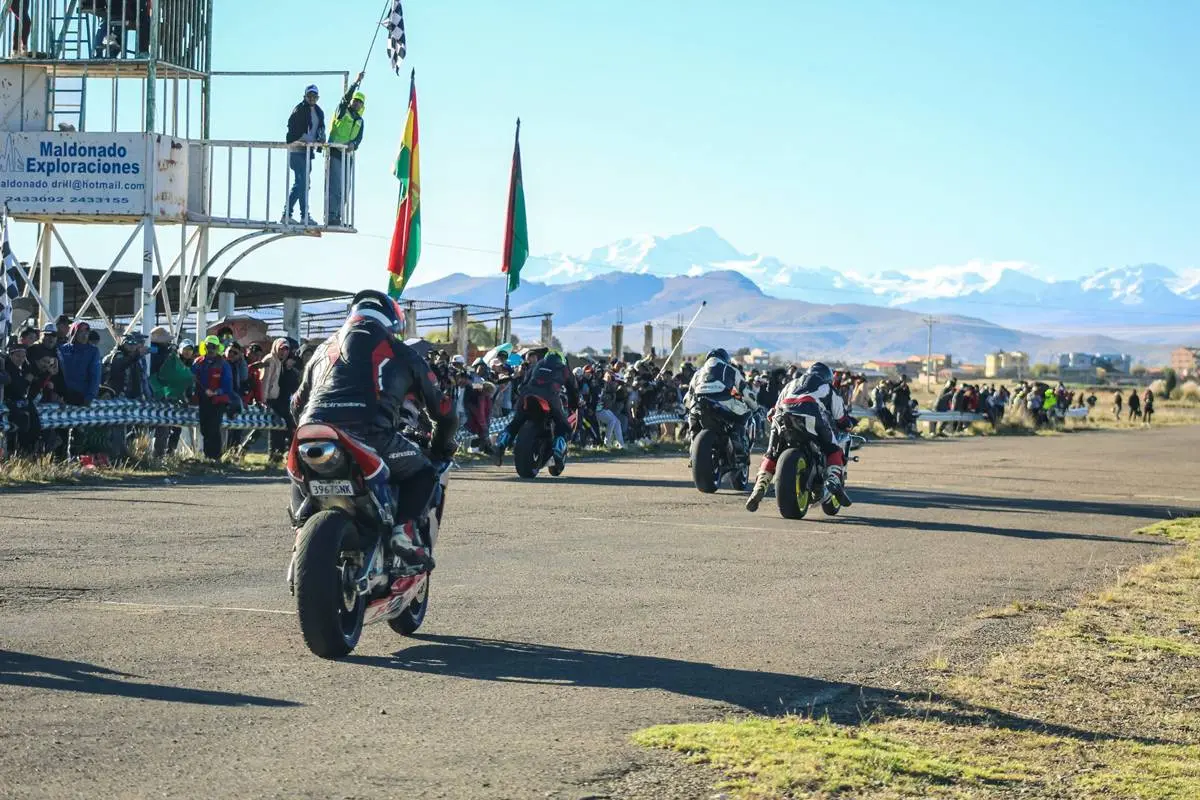
When you think of the Andes, a Superbike race certainly doesn’t come to mind. At most, memories of the Dakar during its South American chapter might resurface. Yet in Bolivia, at an altitude of about 4,000–4,100 meters above sea level, there’s a racetrack. It’s the Autódromo de Pucarani, in the Los Andes province of the La Paz department. It even hosts the Bolivian Superbike Championship.
On the Bolivian circuit, both machinery and the human body are put to the test even before starting the stopwatch. Inaugurated in 1994, the Autódromo de Pucarani is known as one of the highest in the world, a geographical detail that completely defines its character.
The track unfolds in various configurations, with a maximum length just over three kilometers. The asphalt is basic, devoid of the refinements typical of modern circuits, but all the more authentic and unforgiving for it. There are no shortcuts here: every mistake is magnified by the environment, by the altitude, by the thin air that envelops riders and machines, just like in the Dakar.
From a motorcycling perspective, Pucarani is a technical provocation. At this altitude, a naturally aspirated engine loses a substantial portion of its power, and even the most modern units suffer from the lack of oxygen. Acceleration is less brutal, top speed is lower, and the bike’s behavior changes corner after corner. It’s not just a matter of numbers, but of sensations: you have to open the throttle more decisively, yet without aggression, because the response is never as immediate as it is at sea level.
In this context, the rider becomes an integral part of the equation. Fatigue sets in earlier than expected, breathing grows short, and focus must be managed intelligently. Clearly it’s not FIM homologated. Nevertheless, it hosts races of the Bolivian Superbike Championship with bikes such as the R1, Honda CBR 1000, and Kawasaki ZX-10R. There are various classes, so riders also compete on older Yamaha R6s, Suzuki GSX-R 600s, Triumph Daytonas, as well as with various 250 cc bikes, Moto3, and often hand-built Moto2 machines.
The Autódromo de Pucarani will never host a World Championship race. However, it remains a powerful symbol of what racing has been and, ultimately, still is: an extreme challenge, where speed matters less than courage and the ability to keep going when the air seems no longer enough.
Continue reading
You might also like

More news
Popular articles

Loading