Motorcycle Stories: Folks, keep the journalists on your side!
StoriesWednesday, 24 June 2026 at 14:29
One of the first important steps kids learn when they step into the world of racing is the importance of maintaining good relationships with the media, whether that’s traditional print newspapers or all the electronic contraptions that have popped up in recent times.
But this isn’t new, even if the need to manage image, sponsors, and supporters has certainly amplified the issue.
The Fourth Estate
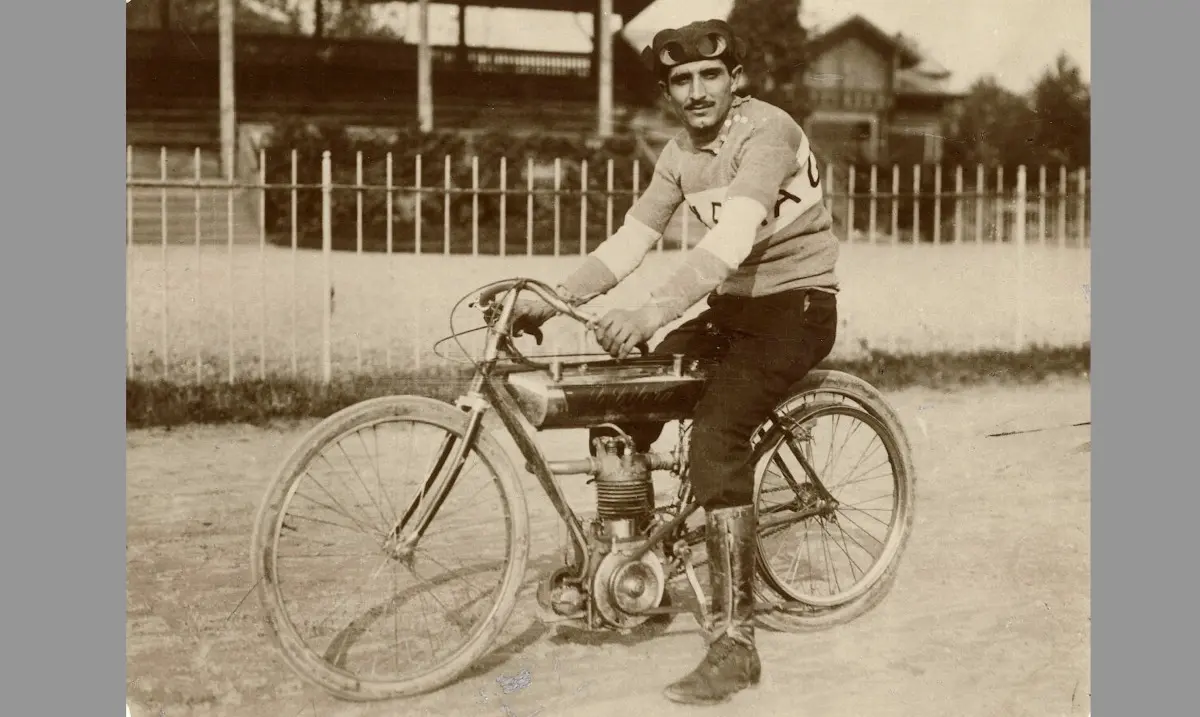
But before? Having good relations with the Fourth Estate has always had its advantages—rest assured—one hundred years ago as today! Let’s go back in time to 1910, the era of pioneers, even before the birth of the FMI which, under the name Moto Club d’Italia, would see the light the following year.
One of the most important races on the national scene took place near Florence: the Coppa della Consuma, which from Pontassieve, starting from the bridge that crosses the Sieve river, leads to the pass separating the Arno valley from the Casentino. To avoid the pass summit being snow-covered again, as had happened the year before, the race was scheduled for the end of May and the finish line moved forward to the junction of the newly opened road to Vallombrosa.
A story from 1910
A full 27 riders at the start—a remarkable number for the time—with the bikes no longer divided by weight but, following the new international rules, by engine capacity. Category I was limited to quarter-liter machines, that is 250cc; Category II to three-quarter liter (334cc); and Category III to half-liter (500cc). The Category II bikes started first, then Category III, and finally the quarter-liters, with two-minute intervals between competitors and ten minutes between the classes.
Overall victory went to the Borgo 500 ridden by the constructor himself, Michele Borgo, in an excellent time, even if the biggest impression was made by the third-place finisher, Cesare Musso, who on his Borgo 500 “Tandem” had «voluntarily», as the reports specify, taken on a passenger, a certain Alessandro Bianco, finishing 4 minutes behind the winner. Success for Alfredo Squilla on the Bücher in Category II and for Amedeo Bartolini on the Motosacoche in Category I, though with a better time than the higher class.
Giuseppe Gilera’s unlucky day
Also starting among the half-liters was Giuseppe Gilera, but the future great constructor from Arcore had no luck, reaching the top with his bike wheezing and only an hour after the start.
In Category I, 10 Motosacoche machines and 3 SIAMT bikes from Turin were entered, but while the Swiss bikes all reached the finish and won the Trophy for Industry, the three SIAMTs were all incredibly struck by bad luck: Aluffi crashed after one kilometer of racing; Pellegrino punctured right after the start and retired; while the third rider, Luigi Semeria—who was also the constructor—was involved in an accident on his way to the start, arrived late, and was not allowed to start by the unyielding race officials.
This is where good relations with the press reveal their full value! Through a procedure unthinkable today, the Turin firm asked for and obtained permission to run a test the following day, obviously under the supervision of the same race officials. On that occasion, Luigi Semeria reached the summit—despite a fall—in a time far better than that of the class winner Bartolini, a time that would have even placed the small Turin bike third overall.

The press to the...rescue!
So while Guido Marchi, Motosacoche’s agent for Tuscany, flooded the newspapers with advertisements celebrating the success of the Swiss machines, SIAMT was also able to highlight Semeria’s feat in the sports press with a short piece of clear polemical and promotional flavor—publicity essential to the survival of the modern Turin creation, which cost a hefty 2,350 lire, a real fortune!
-> Follow us on Instagram as well: @Corsedimoto
byMaurizio Mazzoni
Continue reading
You might also like
More news
Popular articles
Loading