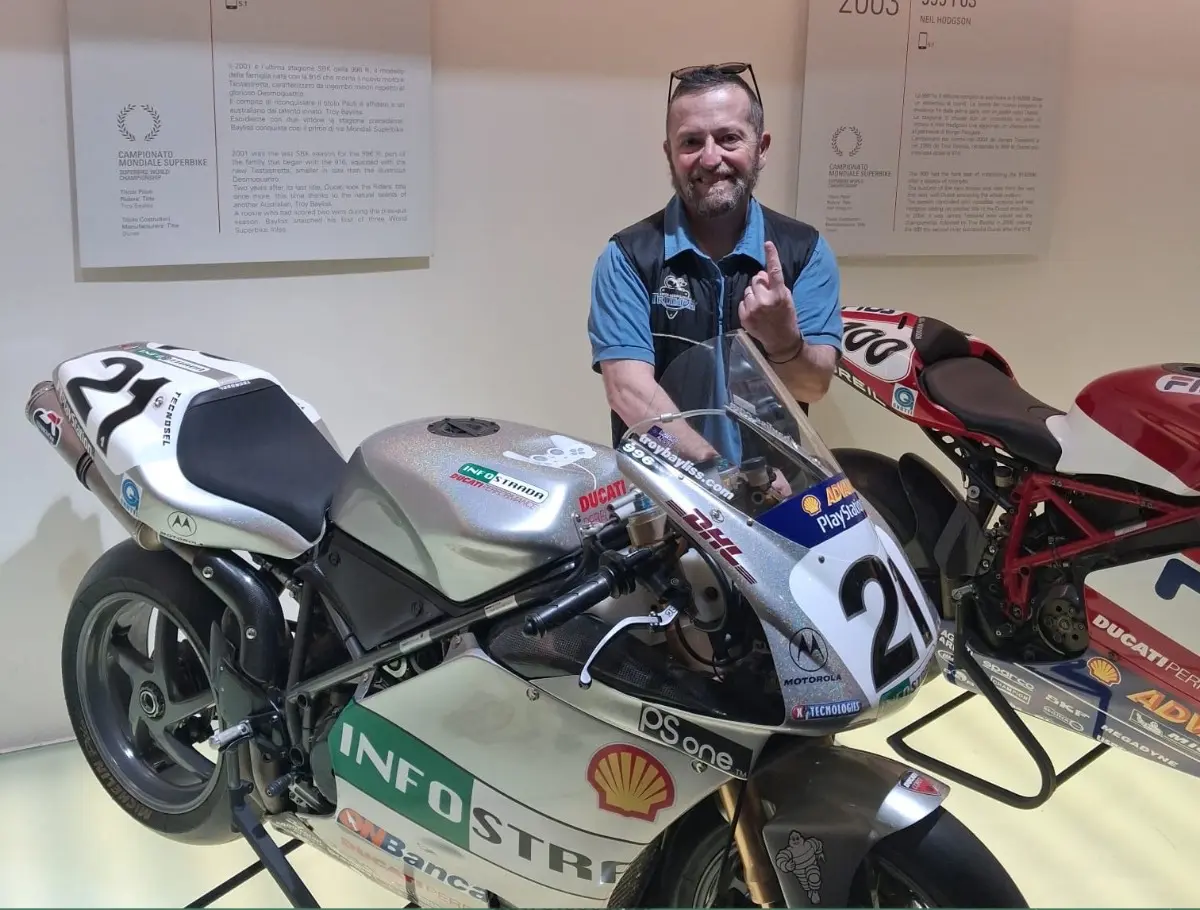
Our reader Ascanio Gardini has the Ducati legends of the past stitched onto his skin. Not just figuratively, and as you read what he tells us you’ll understand why. In recent days he visited the Ducati Museum and factory. These are his emotions, and living them.
On the day dedicated to “Made in Italy,” I had the opportunity to visit the Ducati Museum and Factory. For the guided tour inside the factory, I must extend special thanks to Maria Teresa Galesi of the Ducati Museum, who went above and beyond to make sure I could take the tour even though spots had long been sold out.
She must have sensed my passion which, at fifty-five, keeps growing instead of settling down as my age would suggest. Perhaps it also helped that I told her how important King Carl Fogarty and Super Troy Bayliss are to me, for what they’ve taught me and the life lessons I pick up every time I rewatch their races and study their lives through newspapers and social media. I wonder if the tattoo on my chest dedicated to Troy and Carl had an impact, or my request to go for a ride with Super Troy at the WDW 2026. To which Mrs. Maria Teresa, after a startled look, replied, “What courage!”
A unique world
The experience was one of a kind, and even as you approach Ducati’s entrance gates you sense that you’re not just in front of a motorcycle manufacturer, but a dream factory. One of those companies that helped write Italy’s history over these hundred years, since distant 2026. The murals outside capture this century in just a few images, taking us on a journey through time. The atmosphere is amplified by the Museum visit, where we can admire only the most representative motorcycle models. Some technical solutions indissolubly linked to Ducati for years are also explained, such as desmodromic distribution and the trellis frame. Although it’s not very large, the Museum is arranged with a logic that enhances its historical heritage: every bike, every object, enjoys breathing room around it and dedicated lighting so it can be admired in all its beauty and, above all, importance.
I lingered in reverent silence, mixed with a sense of disbelief and admiration, not only in front of King Carl’s and Super Troy’s bikes, but also the 1996 Ducati 916, with which a certain “Australian crocodile,” one Troy Corser, won his first World Superbike Championship. I was drawn to the first 851 and the first Scrambler.
The factory moves you
The tour inside the factory was even more moving, because it confirmed the predominance of the human factor over the purely technological. This doesn’t mean Ducati is an artisanal workshop, but you can see and appreciate the human touch that likely helps make all Ducati production something truly unique. Visiting the production lines, seeing how each Ducati is born and cared for, is an experience absolutely worth having whether or not you’re passionate about motorcycles.
I’ll close with an observation: the visit took place in groups of about fifteen people. In my group there were several people who had never ridden a motorcycle. Speaking with some of the staff present confirmed this: the museum appeals to everyone, not just those who have two wheels in their blood. It means Ducati truly is a piece of the history of our small, great country. Happy one hundred years, Ducati!
Continue reading
You might also like
More news
Popular articles
Loading