Betrayal, genius and speed: how Degner brought MZ's secrets to Suzuki and ushered in the Japanese era
Stories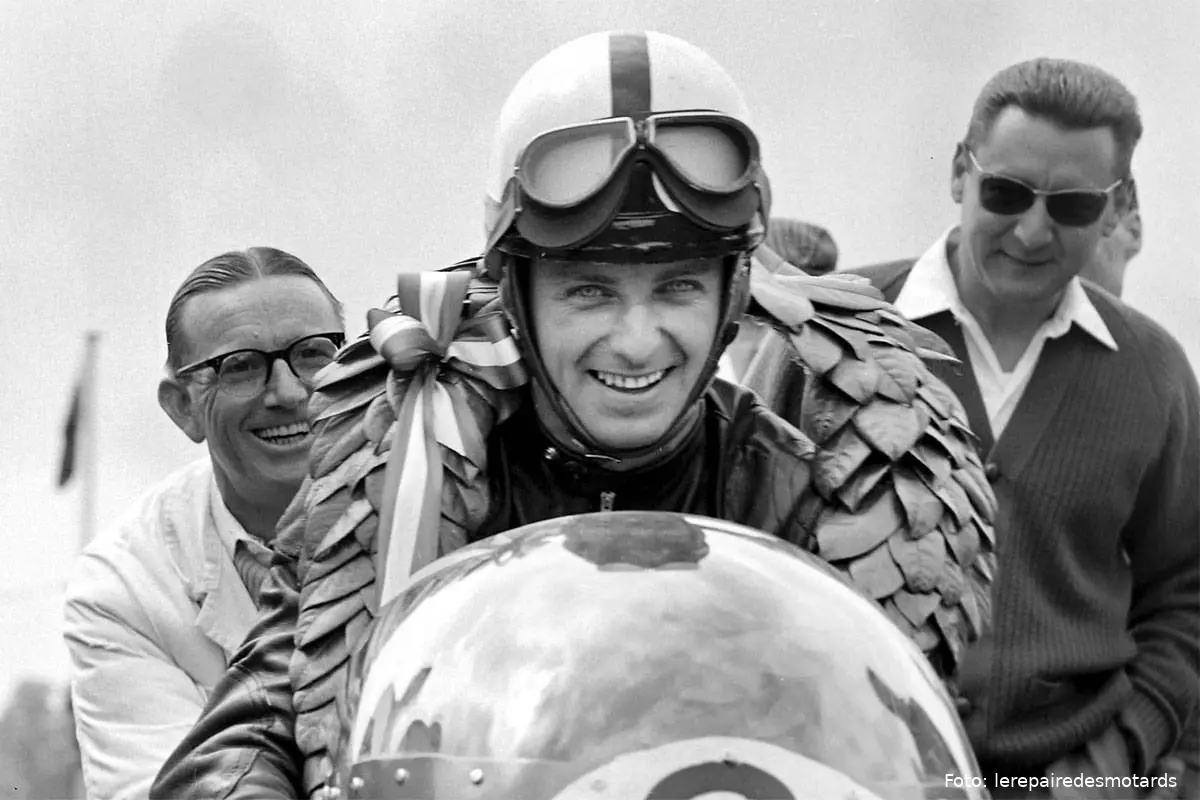
There’s a thin fog that wraps around the tales of motorcycling from days gone by. Often it’s made of premix and whispered secrets. It’s there, in that limbo between courage and betrayal, that the legend of Ernst Degner lives. His is a spy story that ended in mystery.
Ernst Degner was born in 1931 in Gleiwitz, today Gliwice, in Poland. He spent his youth in East Germany, where motorsport was supported by the state as a technological showcase of socialism. He entered the orbit of MZ in Zschopau, a small but very dynamic company.
Degner was a fast rider, but not only that. He was an integral part of the technical department. He worked closely with Walter Kaaden, the brilliant engineer who was perfecting the concept of the expansion chamber, the key to turning the two-stroke into a winning weapon. Degner raced, tested, suggested changes. He was the link between the test bench and the track.
He was talented, brilliant, and ambitious, but he lived under the Stasi regime. He therefore earned a worker’s wage and had very limited freedoms, while his Western counterparts raced for glory and money.
Degner then began to look beyond the Berlin Wall. He knew he possessed extremely valuable technical knowledge that the rest of the world did not yet have.
The decisive moment came in 1961, during the Swedish Grand Prix. He raced on Saturday and disappeared on Sunday. He did not return home to East Germany but stayed in the West. A few months later, Degner signed with Suzuki. Degner brought not only his talent but also the technical drawings and the secrets of Kaaden’s expansion systems. For the Japanese company it was like opening a secret vault: suddenly, the Japanese two-stroke made an impressive leap in quality. It wasn’t just a matter of horsepower, but of a deep understanding of flows, resonances, the very soul of the engine.
Ernst Degner won the World Championship in the 50cc class with Suzuki, beating European competition and giving Japan one of its first world titles in Grand Prix motorcycle racing. It was a success that went far beyond the standings: it marked the beginning of the Japanese era.
From that moment on, the manufacturers of the Land of the Rising Sun progressively dominated the lightweight classes and then the entire global scene. The two-stroke know-how, once kept in Zschopau behind the Iron Curtain, had now become global industrial heritage. Degner, for better or worse, had been the vehicle of this transformation.
Degner’s racing career, however, was also marked by serious accidents. He continued to work as a technician and consultant, but he never regained the central role of his early years with Suzuki. Later, his figure became increasingly elusive. Amid murky business dealings, personal problems, and a certain underlying restlessness, Degner seemed to carry the weight of a life lived always on the edge: first politically, then in sport. He lived the rest of his life in fear of reprisals from the Stasi, who considered him a traitor to the homeland. He died in Tenerife in 1983, at just 51 years old, under ambiguous circumstances.

Continue reading
You might also like

More news



Popular articles

Loading