by Marc Seriau/paddock-gp
For the Thailand GP at Buriram, every MotoGP team had a homologated aerodynamic technical configuration for each of its two riders. Although most had already been seen during various tests, Aprilia had kept one—or rather several—little surprises in store for us.
With a 2026 season in which engines are generally frozen (with the exception of Yamaha), manufacturers had no choice but to work on other aspects, such as Ducati’s case with the Ride Height Device being banned next year, or aerodynamics, whose lessons will be particularly important in 2027 given the announced restrictions.
During winter testing we saw many different configurations, particularly regarding the area behind the riders’ legs and buttocks, which this year is still relatively free.
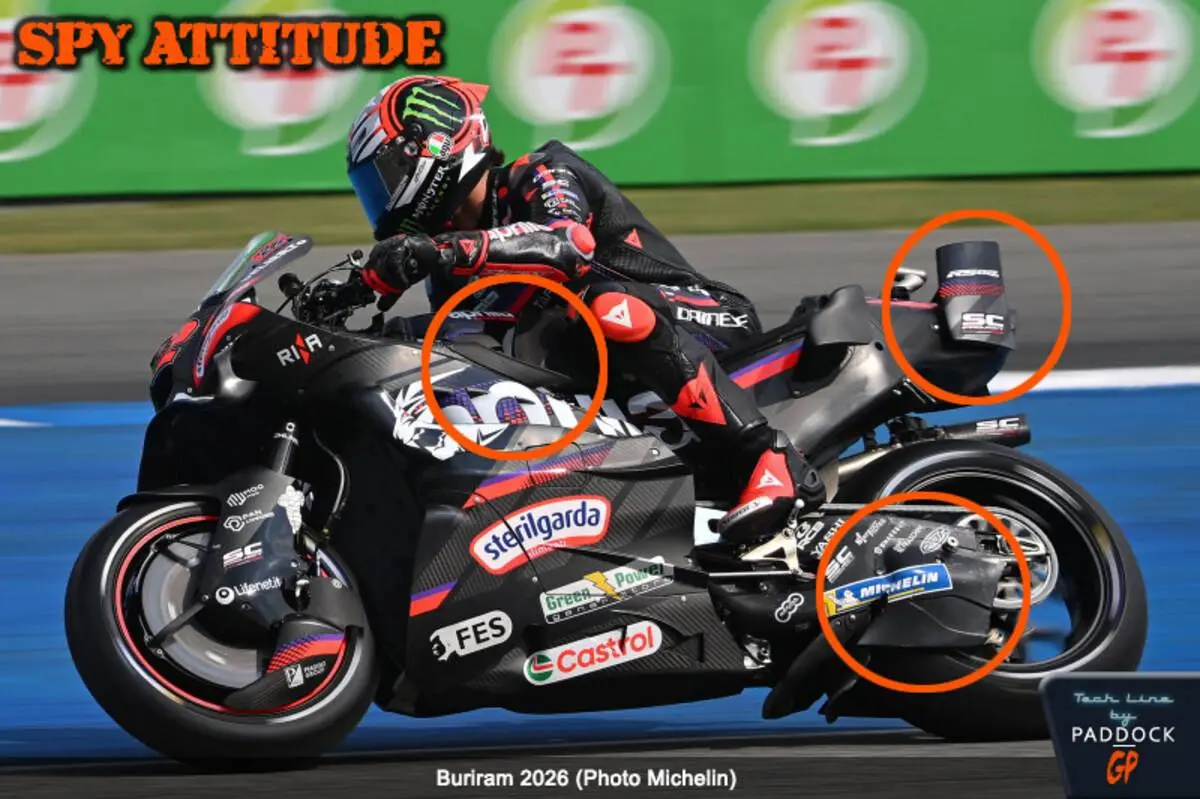
At Aprilia we observed that numerous different aerodynamic appendages were tested, ranging from “stegosaurus” wings to “automotive-style” wings. From the tests in Thailand onward, rumors circulated that some of these elements served more to disrupt the slipstream of potential pursuers than to provide additional downforce at lean. We obviously cannot confirm this, but we merely note that at Buriram the two factory 2026 RS-GPs used “automotive-style” wings in this area, unlike the Trackhouse team’s bikes and their numerous and varied appendages...


But the most striking thing in Thailand, from Friday morning onward, was the use of a sort of inverted “Batwing” on the swingarm.

We had already seen the Noale bikes use these components invented by KTM (though patented by Aprilia, but we’ll get back to that). However, this new version is much larger than the previous one and, above all, positioned under the swingarm rather than above it. On the right, they are covered by an aluminum sheet to prevent exhaust gases from damaging the carbon fiber.

Without further information on their functions, we will simply—and honestly—say that these are elements that seem to “clean the airflow” in this area... We can also note the disappearance of the four carbon tubes located on the left side of the RS-GP that appeared in the 2025 Misano tests, whose function no one had really grasped, as well as the chain guides to address the issues encountered last year on the factory bikes.

But all this is just accessory, in the sense that it does not concern the homologation of the aerodynamic configuration.
By contrast, the new fairing chosen for the start of this season features a real innovation, spotted by Dorna Sports’—or rather, Liberty Media’s—cameras... The fairing appears to have two additional openings on its front face to capture air, which then exits at the sides, outside the riders’ arms, in a straight line.


The aerodynamic design around arms and legs is a sort of project conceived by Marco Di Luca, Aprilia’s aerodynamics engineer. Recall that in a previous version, the 2023 one, air was captured more or less at the same point and channeled over the upper surface of the fairing, with the goal of improving straight-line aerodynamics.
Honestly, motorcycle aerodynamics has now gone far beyond the stage where simple common sense was enough to explain the whys and wherefores, but it’s undeniable that the field is the subject of in-depth studies and is becoming increasingly interesting...
Read also
Continue reading
You might also like

More news

Popular articles
Loading