MotoGP before pay TV: Uncini’s ordeal, the invisible live broadcast, and the scoop from a Tuscan attic
Paolo Gozzi Column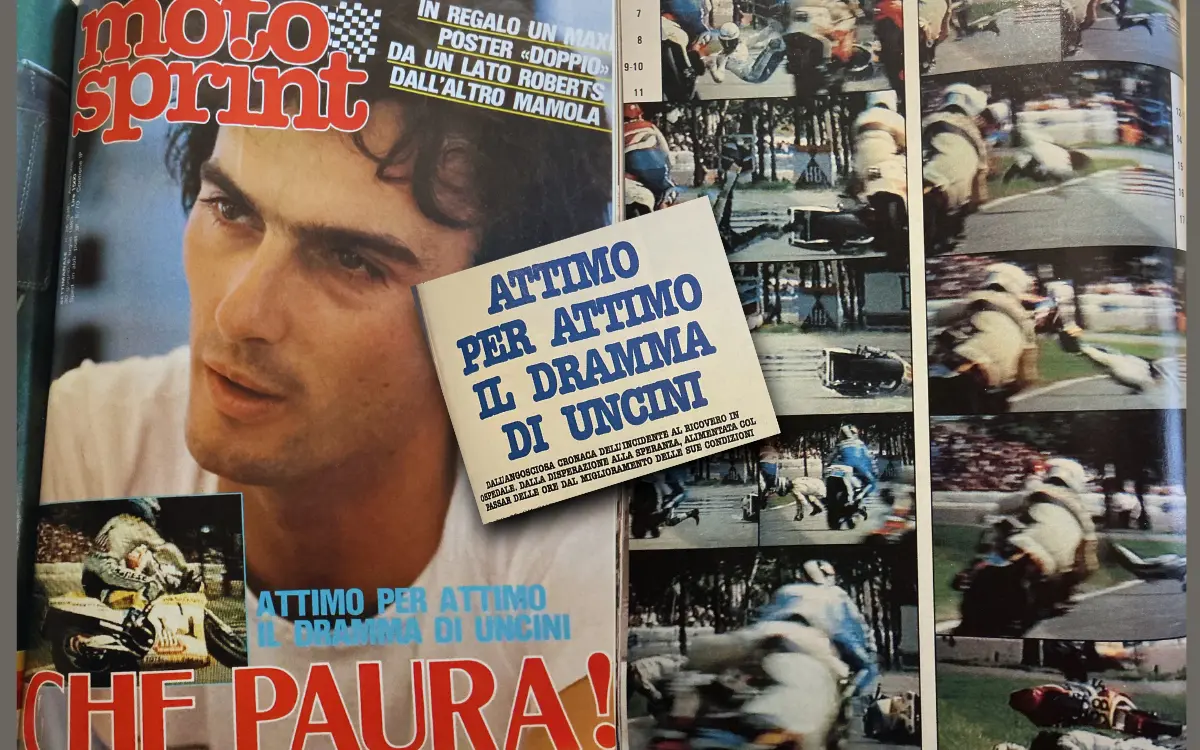
In the 1983 Dutch GP at Assen, Franco Uncini was hit by Wayne Gardner and nearly died. He was the reigning 500 GP World Champion, the top class at the time. This is a MotoGP story everyone knows. What nobody knows is a behind-the-scenes detail from that dramatic day tied to the world of TV and newspapers.
Prologue
Pay TV in Italy changed the way people followed sports in the summer of 1993, when Tele+ began broadcasting football matches live. Before then, live football was only on the radio, through “Tutto il calcio minuto per minuto,” which from 2:30 to 4:15 every single Sunday kept millions glued to their earpieces. TV in Italy was born in 1954, and until 1992 goals were only seen in the late afternoon on broadcasts that became famous, like “90° Minuto.” In reality, some people in Italy had been watching live matches for twenty years before the arrival of pay TV. A handful of Tuscan engineers had found a way to intercept the signal from RAI’s transmission relays, illicitly reselling the images. VIP clients and fan clubs enjoyed live football in defiance of RAI’s countermeasures: every blackout of the signal through increasingly complex encryption systems was always bypassed with ingenuity and cunning. Was it legal? No. In fact, Mario Sussi, one of the masterminds, told this story only years later in “90 minuti in Paradiso, la diretta del calcio quando ancora non c’era.” This fascinating spy story captures television, football, and society in the ’70s–’90s. It is published by CDM Edizioni (the publisher of Corsedimoto) in the “Mediamente” series. Read here to learn more.
And what do Uncini and motorcycles have to do with it?
Among other things, in 1974 Mario Sussi founded TV4, one of the first “free” TV stations (to use the definition of the time) operating in Tuscany. That’s where I took my first steps in journalism. At 17, I hosted the area’s highly followed football analysis program every Monday at 8:30 p.m. TV4 was, obviously in secret, the epicenter of intercepting the signals that RAI swapped between its various offices. It was located in Castelfiorentino, a town in the heart of Tuscany, right along the north–south corridor connecting the Rome, Milan, and Turin headquarters. Mario Sussi and his team had built antennas to capture the signal and, above all, the decoder (obviously illegal) needed to decipher the protection codes RAI used to secure its images. These weren’t just football broadcasts, but all kinds of content, even off-air: in Castelfiorentino they intercepted for years the private conversations of journalists, directors, and announcers. In the ’80s, only some Motorcycle Grand Prix races were broadcast live by RAI. The 1983 Dutch GP wasn’t scheduled. Watching it secretly was the only option.
Watching the GP no one else was seeing
TV4’s studios were housed in the usable attic of the Casa del Popolo in Castelfiorentino. A safe zone for intercepting matches: the Italian Communist Party polled over 70% there; no authority could have imagined it all started from there. I arrived early in the morning to watch that Dutch GP that no one in Italy would see: 50, 125, 250, sidecar, and finally the 500. A feast of races, as was the custom back then. It was Saturday, June 25, 1983. The 500 started at 3:20 p.m. Kenny Roberts was on pole, while Franco Uncini, the reigning champion with Team Gallina’s Suzuki, started from the fifth slot. At the end of the first lap, Uncini crossed the line behind Spencer, Katayama, Mamola, and Roche. Back then, Assen wasn’t like it is now. After the finish line there was a very fast chicane, then a two-kilometer straight heading toward the city center. The first corner, called Bedeldyk, was a 90-degree right that they took in first gear on the 500. Under acceleration Uncini lost control and, after a highside, was left in the middle of the track.
Tragedy narrowly avoided and a journalistic scoop
Franco tried to crawl on his knees toward the edge of the track. Roberts, Middelburg, and Fontan managed to avoid him by tightening their line. But Wayne Gardner, with his view blocked, hit him square on. A terrible impact, right on Uncini’s head; he was thrown far and lay motionless. By a miracle he survived and, after a few days in a coma, recovered. Later he would return to racing, still in the 500 class. In that spot, far from the paddock, there were no photographers. Motosprint had one of the masters of the era on track, Franco Villani, but he had stationed himself at a more distinctive point. No one had a photograph of the accident. But I did, from 1,200 kilometers away. I was watching and recording the races, so I could calmly jot down the results from the final on-screen graphics. I realized I had something exceptional in my hands. I rushed home to get the Olympus I used to cover European Championship races for Motosprint. Back in the studio, I photographed the video and informed the editor-in-chief that we had all the photos of the accident, taken from the live TV feed that no one in Italy had seen.
The lucky kid
At first they didn’t quite grasp what I had, because magazine photography at the time was an art form and no one would dream of photographing a live TV broadcast—which, moreover, the newsroom hadn’t even watched. On Saturday evening I sent the film roll to Bologna via “fuorisacco,” a special mail service used by correspondents to get photos and texts to newsrooms. It traveled by rail, in postal carriages, and the newspapers’ clerks would collect it at the station. Motosprint, which then hit newsstands on Thursday mornings, was the only magazine in the world able to show the photo sequence of the accident, even if the images were a bit “grainy” because they were taken from TV frames. Cover headline: “What a scare! Moment by moment, Uncini’s drama.” I had captured those moments.
Epilogue
Motosprint published fifteen frames inside, plus the one on the cover, to accompany a profile of Franco Uncini. My name appears nowhere. I had been contributing to Motosprint for only a few months, and they sent me to cover the European Championship, a minor series. I was the last to arrive, a rookie kid. Sticking your nose into World Championship coverage wasn’t a beginner’s business. Back then, newsrooms were a bit like barracks; you had to earn certain spaces. Sometimes, not even sensational scoops were enough.
Continue reading
You might also like
More news
Popular articles
Loading