What a title! What do trains have to do with motorcycles? They’re polar opposites: the former are forced to follow the rails, while bikes are the undisputed symbol of freedom of movement. And yet the two have been linked in various ways since the dawn of motorization, with different kinds of ties over the years: necessity, convenience, rivalry, hostility, folklore.
In the early days of motorization, when the first motorcycle factories were mostly located in the north, it was unthinkable to reach race venues, perhaps very far away, with the unreliable means of the time: the bikes would travel by train to their destination, where mechanics and riders would retrieve and prepare them for the race, after which they were sent back to the factory by rail. Even when, years later, it became customary to entrust a few special machines to the most important dealers nationwide, factory riders would travel to their destination by train, where they would find bikes and local mechanics at their disposal for the task ahead.
Retiring? You’re going home by train
But that’s not all: when choosing the route for a grueling event like the North-South Raid, about 900 km from Milan to Naples, particular care was taken to stay close to the railway lines so that in the event of possible—and very likely—mechanical failures forcing a rider to retire, they could easily find support to return to base. In fact, between Bologna and Florence, for example, the crossing of the Apennines was chosen on the Pistoiese Hill, where the railway line passed at the time. The “direttissima” with the Montepiano tunnel would be built much later. Obviously, even those who managed to finish the punishing race would be happier to return by train rather than having to get back in the saddle for the trip home, and even more so years later, when the race was extended by another 500 km, all the way to Taranto.
Motorcycle vs. train: the long speed duel
But in 1923 the motorcycle had a resounding triumph! Compared to the 17h25m that the State Railways boasted for the express Milan–Naples, the winner, Guido Mentasti on a Frera 500, took only 16h51m25s2/5 to cover the distance, inflicting more than half an hour on the renowned train service. Naturally, the Gazzetta dello Sport highlighted the feat with a telling cartoon for the 1925 edition, hoping the result would be improved even further, but it wasn’t to be: the winner Enrico Manetti, on the Frera 350, fell short, albeit slightly, of the express’s time, naturally net of any delays. Here is the illustration from the Gazzetta (1923)

1925 La Gazzetta dello Sport celebrates Mentasti’s feat, faster than the express
Shipping the bike by rail, sometimes as accompanying luggage, remained widespread among privateers for a long time, at least until the mid-1960s, after which trailers and small vans took over.
The railway also brought frustration when, during long road races, riders ran into a closed level crossing, and it was not uncommon to see them ignore the lowered barriers, ducking underneath with their bikes and dashing across the tracks so as not to lose time, while the crossing keeper waved frantically to avert disaster. Look at the photo below to see what happened at the 1955 Motogiro...

Motogiro 1955: i piloti bloccati dal passaggio al livello si arrangiano
Racing history is full of rails
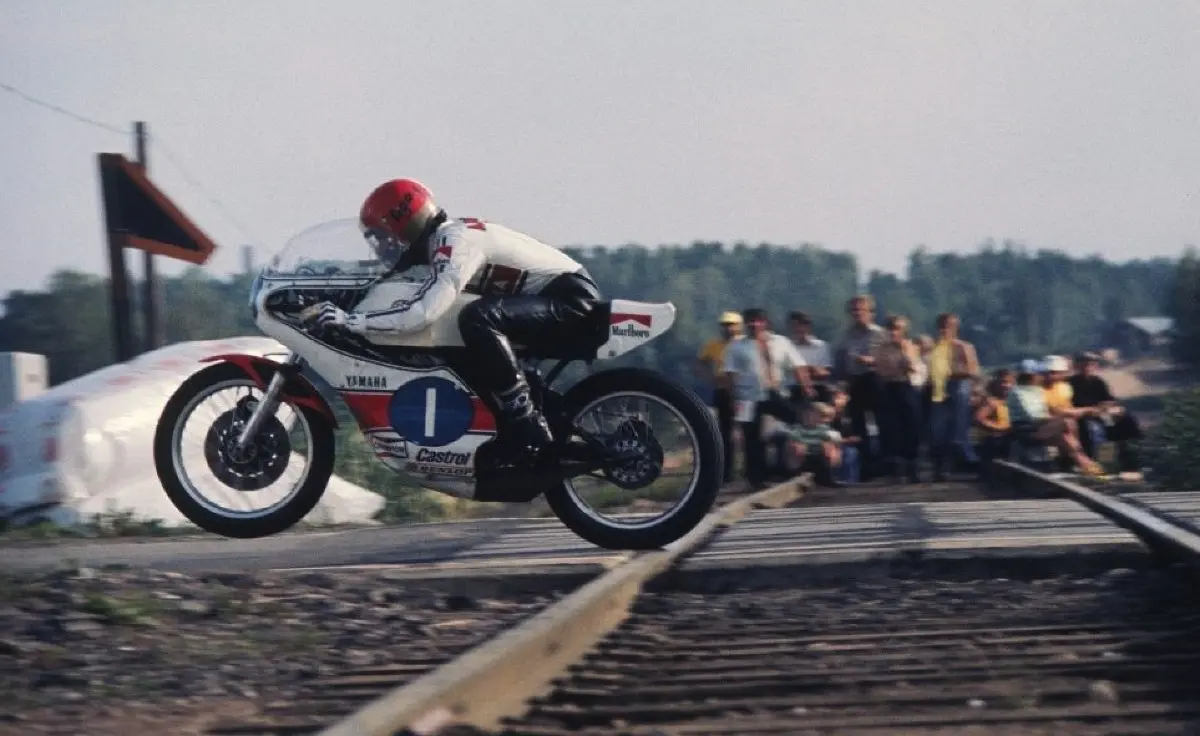
With the end of road racing, the relationship between trains and motorcycles has practically faded away. Only the folkloric aspect remains on those circuits where railway tracks, or similar, are still an unavoidable presence. The Finnish circuit of Imatra is legendary, where photos of bikes crossing the tracks with stationary trains in the background are an inevitable must every time. In the opening photo is Giacomo Agostini with the Yamaha 350.
The hill climb from Mendrisio to Monte Generoso in Switzerland can also boast a certain fame, remembered for the mishap of the great Mike Hailwood, exceptionally entered in the race, in the 1968 edition, when the mighty 6-cylinder Honda, on landing after crossing the tracks—left exposed rather than covered by a platform as usual—lost balance and dumped him heavily to the ground. Look below to see how...

1968 Mike Hailwood con la Honda 250 al Monte Generoso
Almost unknown here, but well known in Spain, is the climb to Montserrat. Here too, the course is crossed by the funicular tracks leading to the famous Sanctuary, and the spectacular photos are countless. Here’s how it looked in 1971

1971 Cesar Rui Perez con la Derbi 75 al Montserrat (foto di Francisco Alguersari su Espana Motociclista)
These are images of a more romantic, but certainly less safe, era of motorcycling. For older enthusiasts, it is undoubtedly a pleasure to see them again, but it’s right that they remain memories of the past.
byMaurizio Mazzoni
Continue reading
You might also like

More news
Popular articles
Loading