Mondial Piega 1000: a Superbike dream of Italian ingenuity, a Honda heart, and a bitter ending
StoriesMonday, 11 May 2026 at 16:28
Story of a shattered dream. In the early 2000s there was talk of the great return to competition of a historic motorcycle manufacturer: Mondial.
It all began in 1999, when Lombard industrialist Roberto Ziletti acquired the brand with a crystal-clear goal: to bring the name that dominated the early years of Grand Prix motorcycle racing into World Superbike. To challenge the giants, a worthy powerplant was needed. Ziletti knocked on Honda’s door, asking to purchase the V-Twin engines from the VTR 1000 SP-1. In a world where Japanese manufacturers are fiercely protective of their technology, the unthinkable happened: Honda said yes. The reason was a debt of gratitude dating back to the 1950s, when founder Soichiro Honda was gifted one of Mondial’s racing bikes to study. Almost fifty years later, that favor was repaid in the form of 999 cc, 90-degree twin-cylinder engines producing 140 hp.
Exquisite engineering and carbon fiber
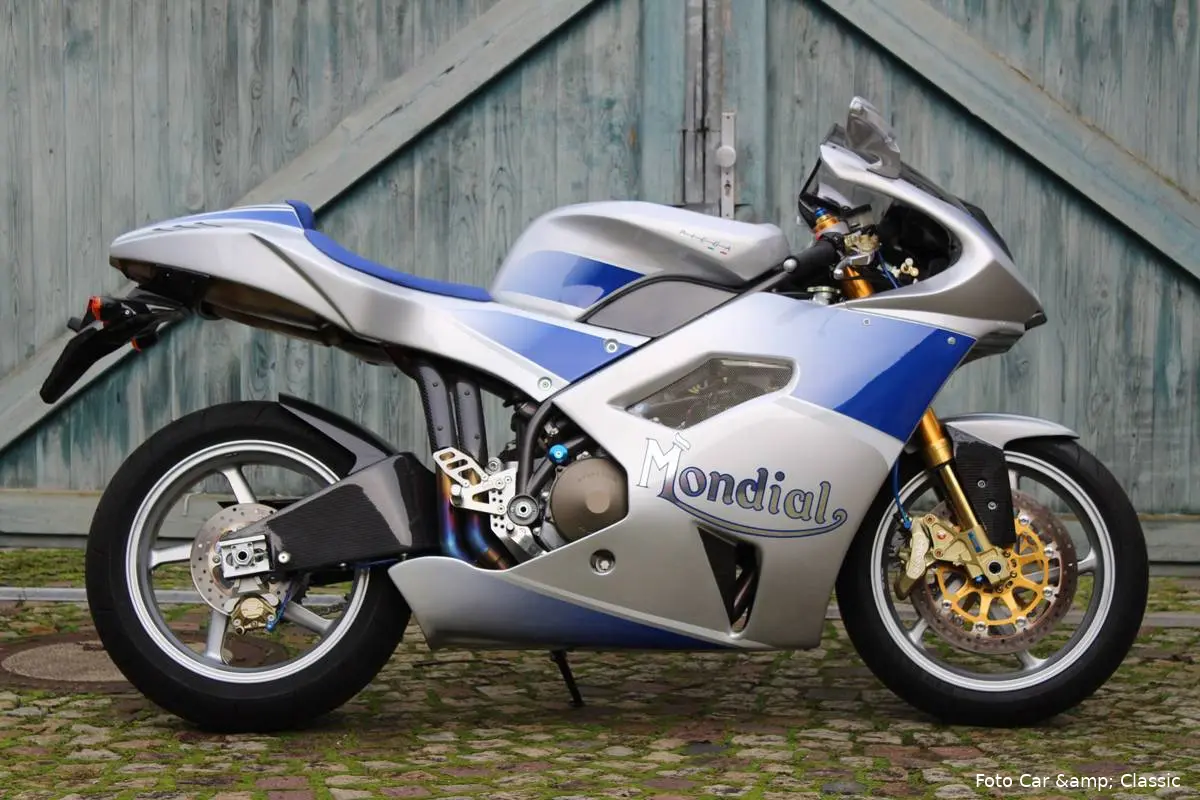
While the engine was Japanese, everything else was pure Italian genius. Designed by a team led by Nicola Bragagnolo and Sandro Mor, the Piega 1000 stood out for its trellis frame made from chromium-molybdenum-vanadium tubing, a choice aimed at superior controlled flex compared to the rigid aluminum frames of the time.
The aesthetics were an ode to lightness: a ultra-compact wheelbase (1419 mm) and extensive use of carbon fiber for the bodywork and even the outer skin of the swingarm. With a dry weight of just 179 kg (dropping to 168 in the EVO version), the Piega was slimmer and more responsive than the very Honda from which it derived. The components were the best of “Made in Italy” and the global market: Paioli forks, Öhlins shock and steering damper, Brembo brakes and Marchesini wheels.
Superbike: the missed stage
To race in the World SBK, the regulations required the production of at least 250 units. Mondial got to work, but the road was all uphill. The bike was well liked but failed to achieve the hoped-for success. The decision to sell the bikes exclusively through bank orders or the internet did not help their spread.
On track, the Piega only made sporadic appearances. Although three bikes had been prepared for the World Championship and promising signs were seen in Endurance, such as 5th place at the 6 Hours of Sugo, the SBK project never materialized into a full season. The lack of funds and a business management that soon became rather fragile led Mondial to bankruptcy in 2004, after producing around 150 units.
Today the Mondial Piega 1000 is a rare collector’s item, a splendid motorcycle capable of combining Japanese reliability with exquisite Italian chassis engineering. A shooting star that, for a brief instant, made people dream.
If you enjoy the content from our news outlet, you can select it as a preferred source by clicking here
Continue reading
You might also like
More news
Popular articles
Loading