BMW allure and mystery: the phantom MotoGP bike that inspired the winning Superbike
StoriesTuesday, 11 August 2026 at 10:42
by André Lecondé/paddock-gp
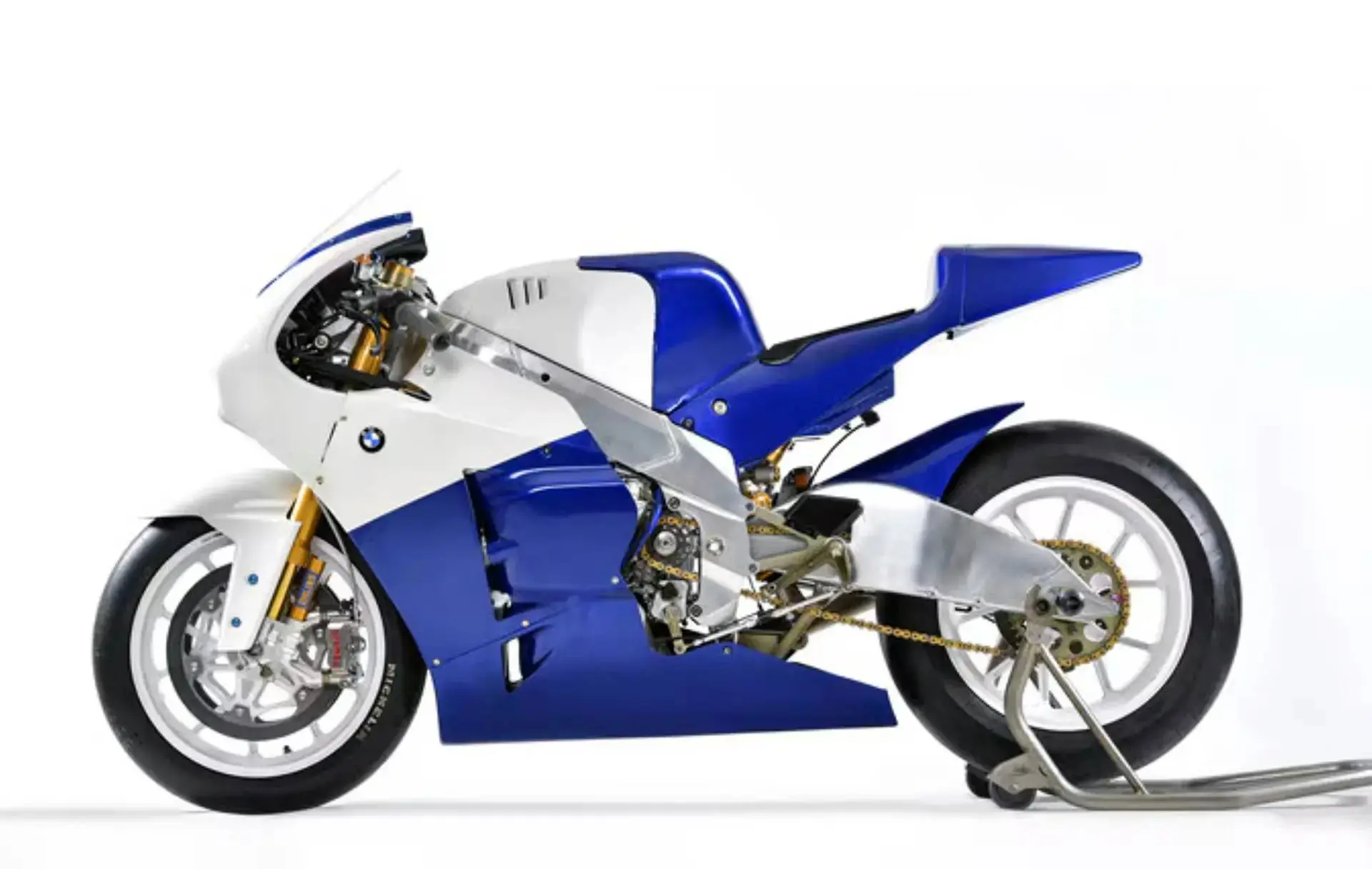
For several years in the early 2000s, Oral, a company from Modena, worked intensively on BMW’s most mysterious project.
MotoGP history is full of projects abandoned before even reaching the starting grid. But few are as fascinating as the early-2000s BMW project. At a time when manufacturers were completely redesigning their prototypes to respond to the 990cc four-stroke revolution, the German giant secretly developed a particularly ambitious Grand Prix motorcycle.
A project entrusted to a Formula 1 legend, tested for several years by two renowned riders… before being definitively abandoned. A little-known adventure that nevertheless had a lasting influence on BMW’s future superbikes. But who knows if the Bavarian colossus will try again: for now the commitment is ruled out, yet with a giant of this size, never say never.
MotoGP arrives, BMW seizes the moment
In 2002, the premier class turned the page, abandoning the legendary 500cc two-strokes in favor of 990cc four-stroke prototypes. For all manufacturers, it was a fresh start. BMW, which at the time had no official program in the premier category, saw in this regulatory revolution a unique opportunity to explore new technologies. The project was launched with the utmost discretion.
To carry out this mission, BMW turned to an exceptional figure: Mauro Forghieri. Former technical director of Ferrari between 1962 and 1984, the Italian engineer was one of the brightest minds in Formula 1 history. He was responsible, in particular, for several world titles won by Ferrari and some of Maranello’s most iconic single-seaters. Through his design studio Oral Engineering, founded with Franco Antoniazzi, Forghieri was given carte blanche to envision a MotoGP engine. The design approach was, of course, inspired by Formula 1. So instead of designing a traditional motorcycle engine, Forghieri drew heavily on BMW’s Formula 1 engine experience.
The result was a spectacular inline three-cylinder engine, whose architecture was practically half of a Grand Prix V6. The engine stood out for its pneumatic valve actuation, electronics that were extremely sophisticated for the time, and an estimated output of over 210 horsepower. On paper, the performance was impressive. On track, however, things proved far more complicated.
A powerful and untamable BMW
To develop the prototype, BMW enlisted two experienced riders: Luca Cadalora and Jeremy McWilliams. Private testing began in 2003. The two discovered an incredibly powerful motorcycle that was extremely difficult to manage. Jeremy McWilliams, despite being accustomed to the formidable 500cc two-strokes, went so far as to describe this engine as the wildest he had ever ridden. Beyond this mechanical “violence,” there was another major problem: weight. The chassis was heavily penalized by the bulky electronic system and the numerous sensors used by the engineers to analyze the engine’s behavior.
BMW, however, did not give up. A second-generation chassis was developed to reduce overall weight and improve handling. Then, another twist. MotoGP announced a rule change for 2007 with the introduction of 800cc engines. Far from giving up, Oral Engineering adapted its three-cylinder engine to this new displacement. The prototype was built. It was tested. But it would never take part in a single Grand Prix. In the end, BMW abandoned the project.
The final decision was not based on technical considerations, but economic ones. At the same time, BMW was preparing to launch a brand-new production sportbike: the S1000RR. Unlike MotoGP, the Superbike World Championship offers a showcase directly linked to commercially available motorcycles. Every victory can be immediately associated with a model available at dealerships. The calculation was simple. The board chose to focus its investments on WorldSBK rather than on an expensive MotoGP program with no direct commercial benefits.
The BMW MotoGP project and SBK inspiration
All the work done on electronics, particularly on traction control and engine management developed to tame this over-210-horsepower triple, would be reused a few years later. In fact, these technologies would become an integral part of the S1000RR, which would compete in the Superbike World Championship. In other words, BMW never raced in MotoGP, but the experience gained from this project contributed greatly to its successes in WorldSBK.
The most fascinating mystery
In hindsight, this BMW MotoGP remains one of the most incredible “what ifs” in Grand Prix history. The German manufacturer had brought together a legend of engineering, developed a technologically revolutionary engine, invested several years in private testing, and enlisted experienced riders. But without ever taking the big step into official competition.
For BMW, however, the project was not in vain. It served as a technological laboratory for the S1000RR, a motorcycle that would later establish itself as one of the benchmarks of the global Superbike scene.
Paradoxically, the greatest legacy of BMW’s MotoGP prototype is therefore not found in Grand Prix archives. Rather, it lies in the victories achieved a few years later by a production bike that became one of the pillars of the Bavarian manufacturer’s racing strategy.
Read also
Continue reading
You might also like
More news
Popular articles
Loading