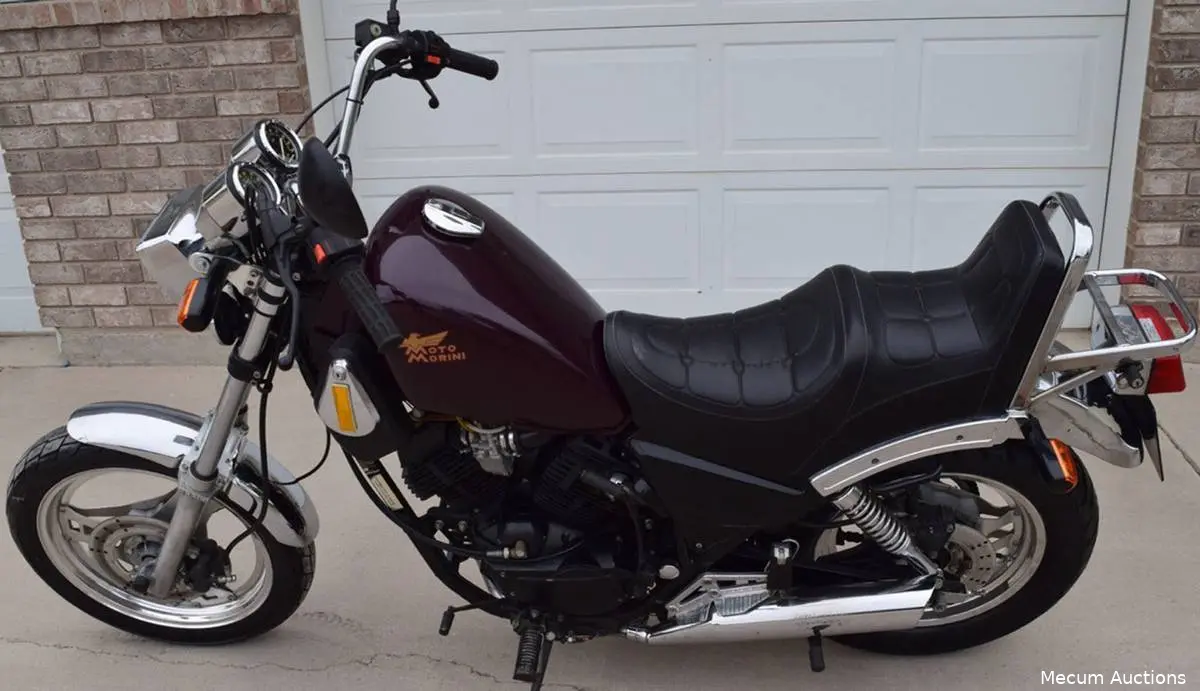
The courage to dare, to go beyond. In the mid-eighties, Moto Morini was squeezed between financial difficulties and a market that was changing its skin. In 1986, the Italian brand presented the Excalibur 350, seeking to interpret the American dream with an Italian twist.
Despite a debatable aesthetic, it was a rock-solid bike and fun to ride. The Excalibur was an act of pure creative resistance.
The first impact was a real shock for Moto Morini enthusiasts. Accustomed to the sleek, sharp lines of the legendary 3 ½, they found themselves facing a creature flaunting bullhorn handlebars, a two-tier seat as generous as an armchair, and a teardrop tank that seemed to stare straight toward Milwaukee. Yet behind those almost eccentric shapes beat a noble heart.
Beneath the custom superstructures lay the legendary 72-degree air-cooled V-twin, a masterpiece by engineer Franco Lambertini.
Technically, the Excalibur was a motorcycle that refused to compromise on mechanical quality. The 344 cc engine, with its pushrod valvetrain and iconic flat Heron heads, managed to deliver around 35 horsepower at 8,000 rpm. These weren’t just numbers on a spec sheet, but the guarantee of smooth delivery and an unmistakable sound.
Despite a weight that was hardly featherlight and a chassis tuned for relaxation, the Excalibur retained that lively engine character that allowed it to comfortably exceed 140 kilometers per hour. It was a very respectable speed for a small-displacement cruiser.
The Excalibur’s life was a dance between two worlds. On one hand, the attempt to attract young riders captivated by the myth of custom bikes, and on the other, the need to keep Italian quality intact. The motorcycle stood out for traditional yet robust chassis solutions. It had a double cradle frame in steel tubing and a pair of inclined rear shock absorbers to complement the low, tapering line of the tail.
Today, the Excalibur 350 is no longer seen as the “black sheep” of the Morini family. It’s viewed as a piece of history that carries the scent of an era when daring was still possible. It may not have had the elegance of the twin-cam racers or the purity of the Sport, but it represented the last surge of independence from a brand that refused to surrender to homogenization.
Continue reading
You might also like
More news
Popular articles
Loading