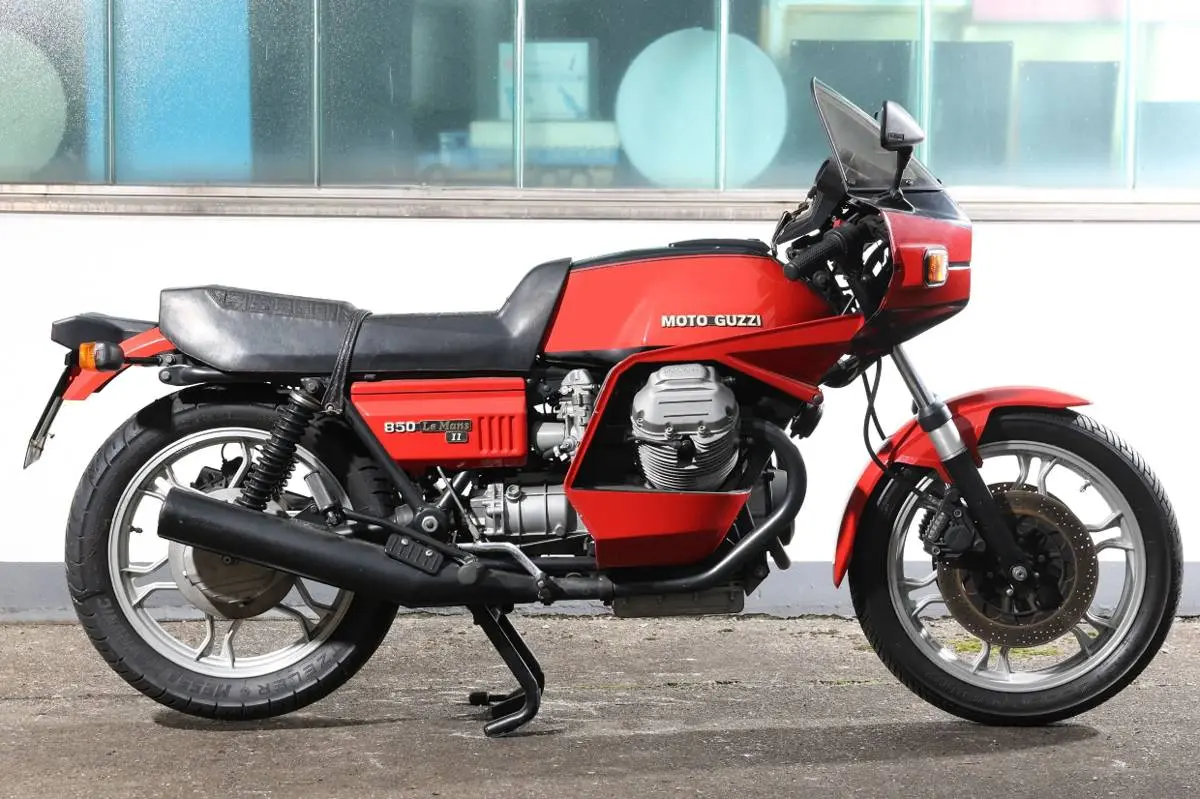
In 1976, Moto Guzzi launched the Le Mans 850 on the market, a sports bike destined to define an era. Inspired by the famous French endurance race, the 24 Hours of Le Mans, this 90° V-twin wasn’t just built for the road: it was an ambitious project, capable of combining high performance, advanced technology, and a design that would influence subsequent models for nearly twenty years.
The first Le Mans presented itself as an Italian-style café racer, while the later series moved toward the concept of sport touring, with wider fairings and greater comfort, without losing the bold character that had made it instantly iconic.
When it arrived at the Milan Show in ’75, the 850 Le Mans did not debut shyly. Low clip-ons, a sharp little fairing, and that red paint that was more than a color—it was attitude. Production was supposed to be limited. Then the orders flooded in: everyone who understood, or simply sensed, that this bike would go down in history wanted one. The Le Mans was fast, edgy, imperfect, and for that very reason, magnetic.
Le Mans II and III
In ’78 it shed its skin. The “bikini” fairing gave way to an imposing half-fairing, wind-tunnel tested like a delicate weapon. The new attire made it more mature, less instinctive, better suited to long journeys. It was a Le Mans that, without losing it, shifted its emotional center of gravity: from youthful fury to the elegance of middle distances. The heart was refined too, with cylinders treated with Nigusil, more durable and more willing to endure mile after mile of road. It wasn’t as fast as the first, and it knew it, but it had its own way of reminding you that speed isn’t the only measure of beauty.
In 1981 came the Le Mans III—lean, precise, with a 25-liter tank for those who wanted to forget the world a little longer.
The engine regained vigor thanks to redesigned heads, new exhausts, and details engineered to give the power a fuller, rounder shape. Guzzi also became the first Italian manufacturer to comply with American emissions regulations. A quiet but important move: you can stay true to your soul even when the world outside changes.
The final evolution
At the end of 1984, the Le Mans grew again, becoming a 1000. A full liter, generous, almost proud. 40 mm carburetors, hotter cams, and the determination to keep pace with the world.
It was a time of difficult choices: the 16-inch front wheel, insisted on by De Tomaso, which shifted balances, sparked debates and moods; the geometries that remained the same as before; the perception of a motorcycle that, though improved, found itself battling a market where Japanese four-cylinders were redefining the center of gravity of speed. The Le Mans held on until 1993, but the world was racing in another direction.
Continue reading
You might also like


More news

Popular articles

Loading