Moto Morini 250 Bialbero: the handcrafted jewel that humbled the four-cylinders, amid records and epic duels
Stories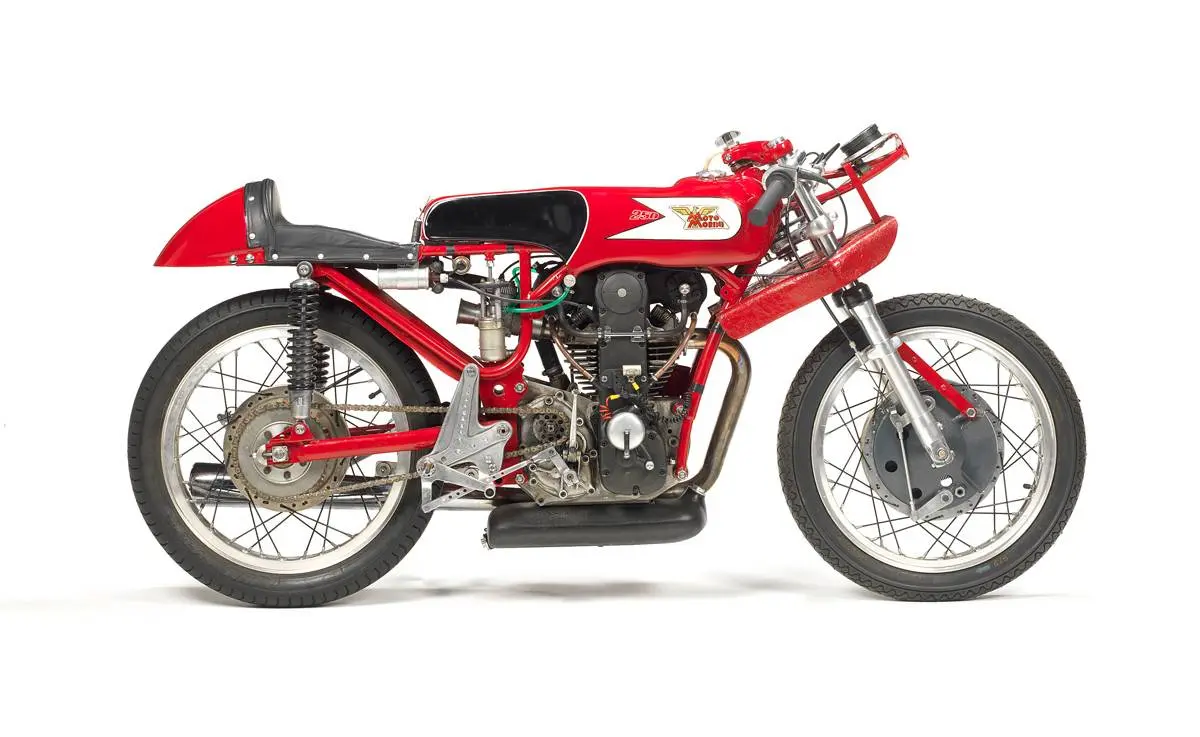
First the silence, then the sparks. The Moto Morini 250 Bialbero GP made its debut without fanfare and then became the fastest single-cylinder of its era.
In the 1950s and 1960s, when tracks were full of gravel and courage, Moto Morini stood out for its obsessive attention to detail, its stubborn pursuit of technical perfection, and its determination to compete against giants with vastly greater resources.
In 1956 Moto Morini took part in several 250-class races with an enlarged Rebello. The excellent results encouraged the company’s leadership. In 1958 a 250 Grand Prix machine was built, destined to become the “Queen of single-cylinders.” The project was signed by Alfonso Morini, assisted by Dante Lambertini and Nerio Biavati, who ran the racing department with artisanal passion and technical precision.
The debut came at the 1958 Nations GP, on the ultra-fast Monza circuit. Emilio Mendogni and Giampiero Zubani led the race from the first to the last lap, beating Carlo Ubbiali on the MV Agusta, the reigning world champion. The Moto Morini already showed its strength: a single-cylinder 4-stroke with twin overhead camshaft timing, driven by a gear train housed in a right-hand side cover. The first version produced 32 hp at 10,500 rpm, an exceptional figure for a single-cylinder.
In 1959 the Morini 250 won two national events in Modena and Imola but soon found itself competing in a rapidly evolving world. The twin-cylinder engines from MV, Ducati and MZ, and the four-cylinders from Honda and Benelli, marked the beginning of a new era, leaving the Italian single temporarily on the fringes of the world championship. Tarquinio Provini, Morini’s factory rider, still achieved exceptional performances, though without standout results.
In 1962, however, Morini was back in the spotlight. Tarquinio Provini and Walter Tassinari, at the helm of the Bologna-built singles, enlivened races on the Italian circuits of the Adriatic Riviera, going head-to-head with all the leading World Championship teams. The 250 Bialbero’s power had reached 35 hp at 10,500 rpm, while the best four-cylinders exceeded 40 hp. Provini won the Italian 250 Championship, beating his teammate Tassinari in the final race at Sanremo. A triumph that rattled Honda’s engineers, who would never tolerate being beaten by a single-cylinder.
The following year, at the 1963 Spanish Grand Prix, Provini stood on the top step of the podium, defeating Jim Redman and his four-cylinder Honda. At Hockenheim, in the German GP, the Morini also took victory and set a record average speed, confirming the extraordinary merit of the project. Unfortunately, financial constraints and travel setbacks prevented the team from participating in crucial events such as the Tourist Trophy and the East German GP. At the Japanese Grand Prix the Morini then had to yield to the bikes of the Japanese teams, and the World Title slipped away by just two points.
The 250 Bialbero then went on to dominate the Italian Speed Championship for a long time, winning it with Provini, Agostini and Bergamonti. When Alfonso Morini, after nine years of national and international victories, decided to withdraw from racing, many rival manufacturers breathed a sigh of relief. The Morini 250 Bialbero GP wrote a unique page in the history of motorcycling. With its legendary single-cylinder, it proved that heart, ingenuity and craftsmanship could compete with immense technology and capital.
Continue reading
You might also like

More news
Popular articles

Loading