September 20, 1938. The European Championship, the highest expression of international motorcycling at that time (the World Championship is still yet to come), is being contested this year for the first time over multiple rounds. The Monza Autodrome is decked out for the Nations Grand Prix, which constitutes the final race of the championship.
National flags flutter in the wind and, alongside the Italian tricolor, the banners of the two nations dominating the championship this season stand out: the British Union Jack and the red flag emblazoned with the swastika of GrossDeutschland—the “Greater Germany,” the term the Third Reich adopted after the annexation of Austria the previous spring.
The Italian Title alongside the European
The Monza race also serves as the final round of the Italian Championship; the result is obtained by extracting the Italian riders from the race’s overall classification.
The technical landscape of Italian motorcycling in the second half of the 1930s is peculiar: the major domestic manufacturers—Guzzi, Gilera, Bianchi, Benelli—have produced exceptional models in the 250 and 500 classes, but they completely snub the 350, which is entirely in the hands of British makers, led by Norton and Velocette. Only at the very end of the decade will the German brands NSU and, above all, DKW enter in force with their exceedingly complex supercharged two-stroke machines, capable of putting down, for the era, monstrous power—bikes the English would nickname “Shakebones.”
Tough life for privateer riders
Italians thus have to make do; moreover, unless you get into the good graces of a factory team—perhaps with the indispensable help of politics—there’s no chance of breaking through as a privateer in the 250 and 500 classes. Only the 350 class offers a minimum of competitiveness for a private rider, who is nonetheless forced to turn to perfidious Albion’s racing market to obtain a decent machine. The lone alternative is the courageous MM, the Bologna-based company driven by the ingenious Mario Mazzetti, which has built an excellent 350. Unfortunately, the small Emilia-based firm is always short of cash to develop its bikes beyond the bounds of national-level competitiveness.
In 1938, the Livorno native Ugo Chiesa had been frequenting motorcycle races for nearly a decade, but there were no factory bikes for him. Frankly, he wasn’t a superstar like Tenni; several good finishes, plenty of retirements due to unreliable machines, a few wins in second-tier races—in short, his was a “journeyman’s life,” as Ligabue would later sing.
Even so, he managed to earn the esteem of Jacques de Rham, founder of the Scuderia Maremmana, who in recent seasons had entrusted him with their Norton Internationals—somewhat long in the tooth, to be honest, but the Florentine specialist Ariani, in whose care they were, still managed to make them competitive, at least on the national stage. Indeed, it’s worth recalling how as early as 1936 Ariani built a rear suspension for the Norton, which at the time still had a rigid frame—predating Birmingham’s adoption of the system on its factory bikes.
A Livorno rider with a big coup in his sights
For the good Ugo Chiesa, 1938 could be the year of the big coup! At the time, the Italian champion’s title was the most coveted recognition for our riders.
The Italian Championship, which had been run over multiple rounds since 1921, featured five rounds that year; points awarded were 5-3-2 for the top three finishers, and one point to all riders who finished within the time limit. The Coppa Mussolini—sycophantically renamed in deference to the Duce the Nord-Sud Raid, i.e., Milan–Naples, extended in ’37 to Taranto—awarded increased points, namely 7 to the winner, and in the event of a final tie served as the decisive tie-breaker.
It was precisely at the Coppa Mussolini that Ugo Chiesa seized a hugely important class victory with his Norton, taking the lead in the championship. But soon MM hit a purple patch and, in the subsequent races in Bologna and Turin, the Bologna bike took two consecutive wins with Michele Mangione and Luigi Bonazzi, while Chiesa came up empty-handed. In the fourth race on the roads of the Lario Circuit, the laurels again went to Michele Mangione and his MM, while Chiesa had to settle for a single point for fifth place. Yet it was precisely that meager point that kept the faint flame of hope for the title alive on the eve of the final race.
Monza as it was in 1938
The decisive Monza round that year was held on the 6,993-meter so-called Florio Circuit, which from the Lesmo curves ran out to the park’s central avenue and then, with two 90-degree turns and a short link, returned to the South Banking. At Monza, Mangione lined up with 13 points against the 8 of Chiesa and Bonazzi, meaning that for the Roman MM rider it was enough, to secure the title, simply to finish within the time limit.
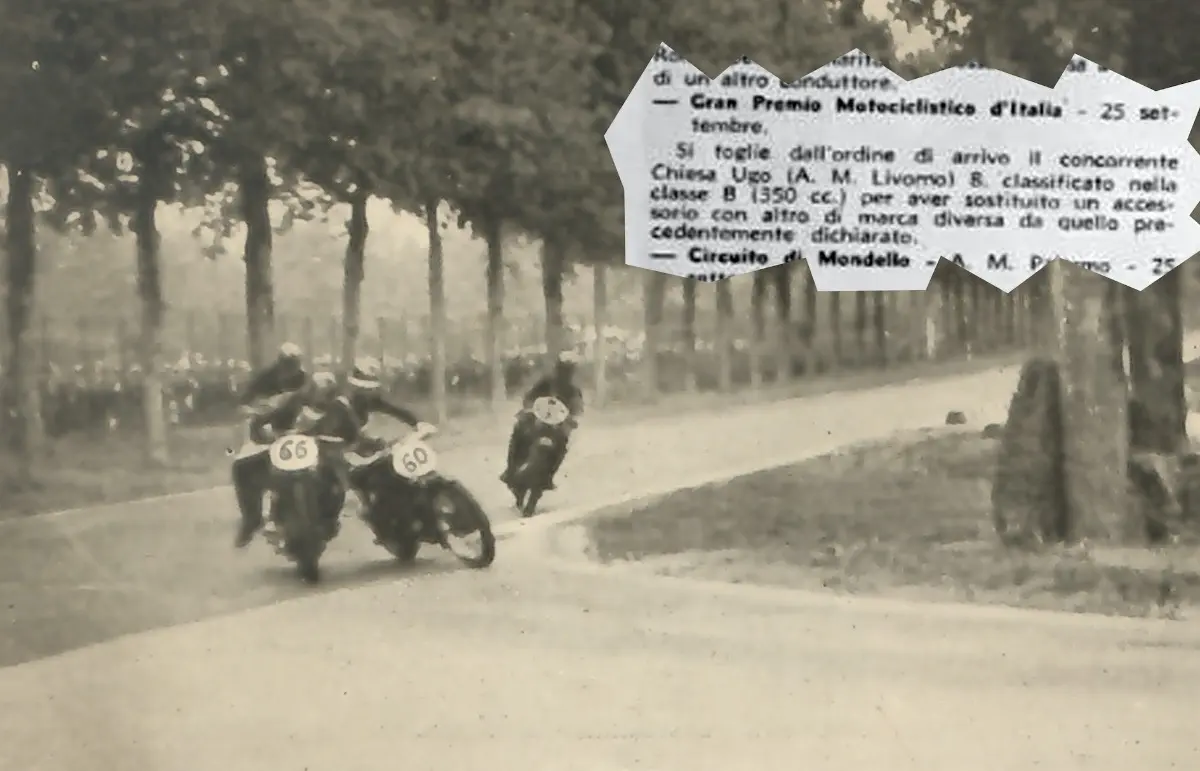
But that day at Monza everything went wrong for MM: Mangione dropped out after a few laps with engine trouble, while Bonazzi tumbled on the thirteenth lap due to a collision with Ugo Chiesa’s Norton—the incident is captured in the photo at the top. At that point the Livorno rider was first among the Italians—indeed, he soon became the only Italian still in the race—so over the remaining laps to the checkered flag it was enough to nurse the machinery to bag the five points needed to draw level with Mangione atop the standings, which would hand the title to Chiesa thanks to his Coppa Mussolini victory. The race ended with the success of Englishman Ted Mellors on a Velocette, earning him the European title, but in eighth place—first and only among the Italians—came Ugo Chiesa, who at that moment became Italian champion! Unfortunately, the joy of the Livorno rider and the entire Scuderia Maremmana clan was short-lived: the cold shower came in technical inspection, where the Moto Club d’Italia officials found that Chiesa’s bike was fitted with an accessory—the saddle—not matching what was declared on the entry form. Result: Chiesa excluded from the results, no Italians classified at the finish, and the standings unchanged from the eve, with Michele Mangione and MM crowned champions of Italy. A real sting!

Michele Mangione portrayed at the 1938 Lario Circuit
Aside from Mangione’s unquestionable merits (pictured above at the 1938 Lario Circuit), it may seem excessive to disqualify a rider just because he fitted a saddle—certainly not a mechanical component that could affect performance—different from what was stated on the entry form. But at the time, the regulations on this matter were extremely strict, and there was a clear reason. The cash prizes put up by motorcycle race organizers were not exactly lavish, but riders could instead count on bonuses offered by accessory manufacturers based on their finishing position—prizes often far greater than the official purse itself—and the MCI rules, as was also the case internationally, therefore protected the interests of accessory makers against any “oversights” by the riders.
It had already happened at the TT
Enthusiasts of the Tourist Trophy will recall that the great Piero Ghersi also experienced something similar in 1924 when, as a newcomer to the Isle of Man, he delivered an exceptional performance to take second place on his Guzzi 250, only to have the result stripped in scrutineering due to a spark plug of a different brand than the one declared at registration.
What could have been the triumph that would have secured Ugo Chiesa a place in the history of Italian motorcycling thus faded into a bitter disappointment. It’s not elegant, but allow me to say—since we’re talking about the saddle—that poor Ugo literally had the title pulled out from under his backside! And while Scuderia Maremmana would find consolation the following year, when the Florentine Aldo Bernardoni became Italian 350cc champion, for Ugo Chiesa there was nothing left but to drain to the dregs the bitter chalice of disqualification.
Read also
CorsedimotoTV, the Corsedimoto YouTube channel: subscribe here
byMaurizio Mazzoni
Continue reading
You might also like
More news
Popular articles
Loading