The world of motorsport has always attracted the international jet set. While we must acknowledge that car racing holds the crown, for several years now two wheels have also been carving out an important space, drawing the interest of stars from finance, politics, industry, and entertainment during sporting events.
There’s no doubt that at the pinnacle of these occasions—where motorsport is intimately blended with high society to the delight of the world’s media—the Monaco Grand Prix reigns supreme.
Such is the media pull of the race organized by the Automobile Club of the small, luxurious, fairy-tale Principality that the FIA itself has granted two ad hoc regulatory exemptions: the race distance is shorter than the standard set for world championship events, and the awards ceremony does not follow the category’s protocol, but instead the ceremonial set by the ruling house of the Principality—a rite that, until just a very few years ago, provided for only the winner to be awarded.
Motorcycles on the little streets of the Principality
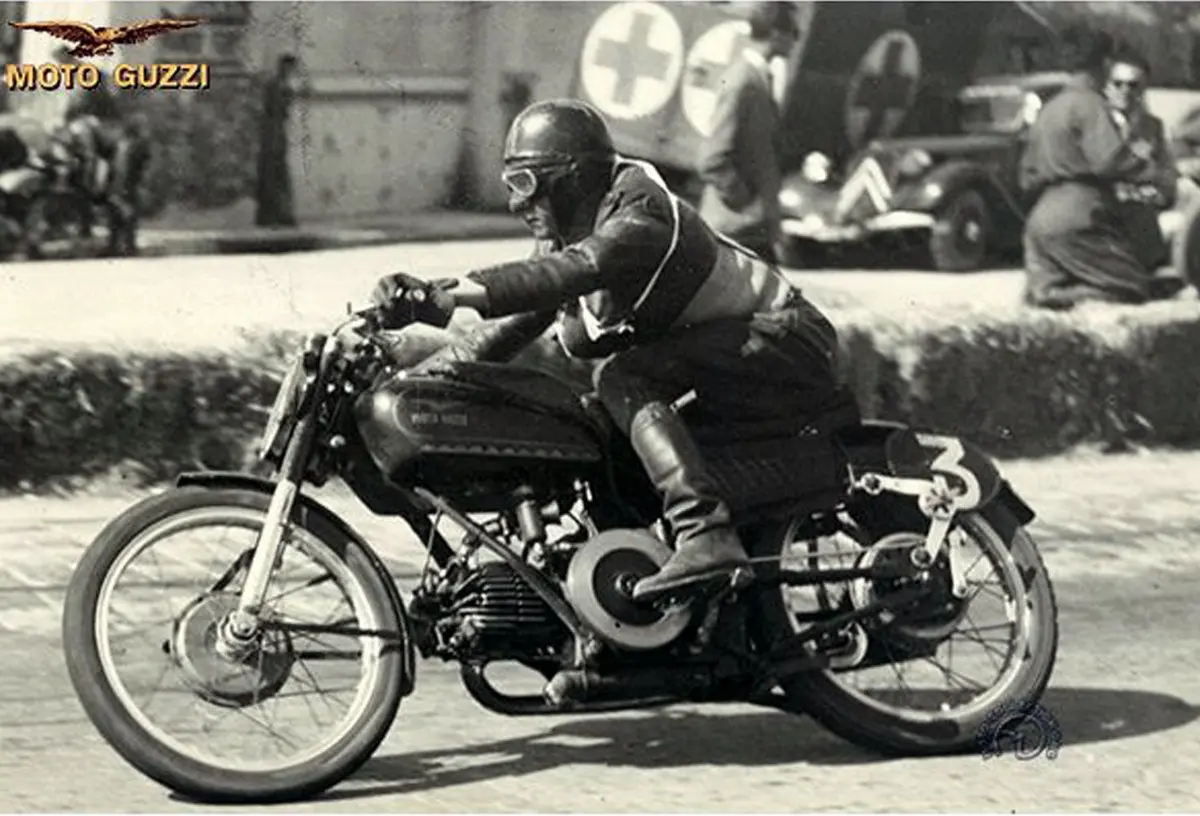
But you’ll say, Monaco means only Formula 1! Well, that’s true, but… there’s a catch! In 1948, after the long, tragic years of the war that had bloodied Europe, as life was slowly returning to normal, the tenth edition of the Monaco GP was organized for May 16, Whit Sunday. Taking advantage of the fact that in many European countries, including France (and consequently Monaco), Whit Monday is a public holiday, a motorcycle version of the Grand Prix was also scheduled, reserved for the 500 class only. While the cars would battle over the classic 100 laps of the circuit, which at the time measured 3,144.6 meters, the motorcycles would race over 60 laps—still amounting to a total distance of 188.686 kilometers. Quite the undertaking on a narrow, twisty course broken up by short straights, where in very short order you encounter both the slowest corner on the world scene—the tight downhill hairpin at the Old Station, taken at about 50 km/h—and the rapid, sweeping bend inside the tunnel, attacked with the throttle wide open up to the demanding Swimming Pool chicane, with the quay bollards right at the exit.
Racing in the city
It’s true that permanent circuits could be counted on one hand at the time, and that some, like Monza, were unusable for a variety of reasons, so riders were used to racing in cities, but the Monegasque layout was really on the limit—no hint of run-off areas, all lined with stone balustrades and marble, elegant and architecturally admirable as you like, but decidedly ill-advised for any close contact.
The car race was also the first held under the regulations of the new FIA-defined F1: 1½ liters for supercharged engines and 4½ liters for naturally aspirated engines. After an initial burst from the Simca-Gordini of Jean-Pierre Wimille, Nino Farina’s Maserati soon took command of operations, holding it firmly to the end for a superb tricolore victory, followed at the finish by Chiron’s Talbot-Lago and another Maserati, De Graffenried’s.
After the cars, here come the bikes
Unfortunately, numerous mechanical failures and tire wear had detrimental effects on the track, so the following day the riders, out for the final morning practice, found themselves having to perform miracles of balance. Our own Bellocchio, on a Guzzi and still with one arm tightly bandaged from a fracture suffered shortly before in Nice, had a very nasty crash at the tunnel exit that raised the worst fears. Fortunately, by evening, after being hospitalized and undergoing thorough checks, the fears subsided, but the Genoese rider obviously had to withdraw from the race.
The twenty riders on the grid offered an excellent cross-section of the motorcycling of the era, with the nearly fifty-year-old Stanley Woods, “the Irish Dasher,” on a Velocette 350; the Englishman Fergus Anderson with Guzzi; the Gilera Saturnos of Nello Pagani, who had also raced in the car event before retiring after 64 laps, and Aldo Brini; and of course a large French contingent, from the fiery Jean Behra to the Nice natives Jean and Robert Braccini, Jacques Onda, Georges Houel, Michel Dini, and Georges Monneret.
An Italian victory
Right from the start Anderson took the lead, chased by Pagani, while Behra immediately complained of mechanical problems. Soon Robert Braccini and Dini went down. In his lively duel with Pagani, Anderson set the fastest lap of the day, but shortly after, both were forced to retire. Jacques Onda briefly popped into the lead with the Terrot 350, but soon Aldo Brini, riding the Gilera Saturno he had personally prepared in the family workshop, forcefully took command and held it firmly to the end. Behind him was another Italian, Francesco Gambi on the Norton, who got the better of Monneret’s AJS after a tough battle.
Before the Principality’s cosmopolitan crowd, Milanese rider Aldo Brini, a monumental bouquet of flowers hoisted on the tank, paraded for the victory lap under a shower of applause and finally climbed the royal dais to receive congratulations from Princess Consort Ghislaine, where Crown Prince Rainier handed him the gigantic cup awarded to the winner, “of not inconsiderable value,” as Motociclismo’s correspondent was keen to note in his report.
Tragedy at Sainte Dévote
Sadly, the Monaco Grand Prix Motocycliste was also marked by a fatal accident. On the 19th of the 60 scheduled laps, the 34-year-old Englishman Norman Linnecar lost control of his Norton at the Sainte Dévote corner and crashed violently into the wall of one of the buildings lining the street. Rushed to the hospital in Nice, the unfortunate rider died shortly after being admitted. A touching detail: Linnecar had traveled from London, where he lived, to Monaco together with his wife on a sidecar, from which he had then removed the motorcycle with which to contest the race.
There is no doubt that the Monegasque circuit was unsuitable for motorcycles. Thus its first motorcycle race also became the last in its history.
Read also
CorsedimotoTV our YouTube channel: subscribe here
byMaurizio Mazzoni
Continue reading
You might also like
More news
Popular articles
Loading