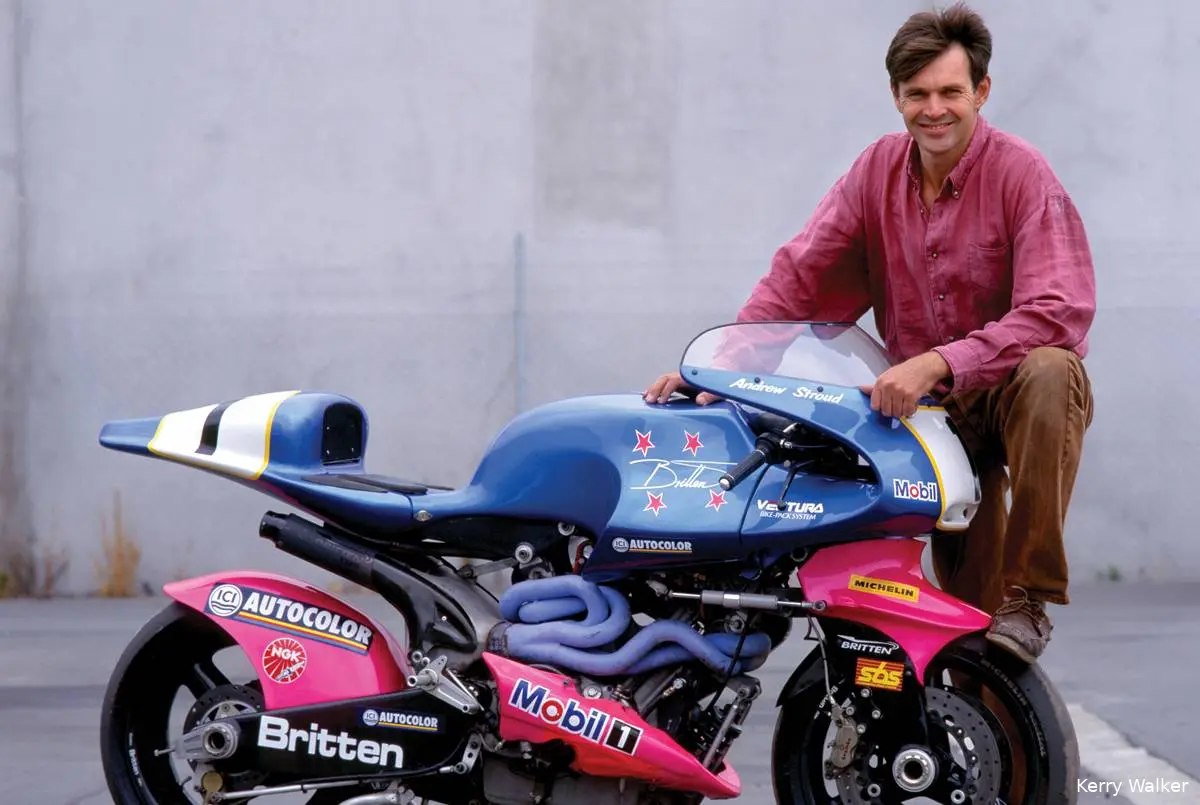
A story from another era, a story fit for a film. In the early Nineties, the giants of world motorcycling trembled before a single man: John Britten. He wasn’t the CEO of a Japanese multinational, nor a European magnate, but a New Zealand engineer who built dreams in a shed behind his house.
John Britten was from Christchurch, New Zealand’s second-largest city. He was severely dyslexic—so much so that at university he had to have exam questions read to him, record his answers, and then have them transcribed. Yet he was exceptionally intelligent, tenacious, and a true visionary. Dyslexia wasn’t a limit to his dreams; if anything, it may have spurred him to give even more.
John Britten grew up inspired by legends like Bruce McLaren and Burt Munro, inheriting their same stubborn determination. If something doesn’t exist, you can always build it. After ranging from heavy machinery design to artistic glasswork, John turned his genius to two wheels, founding the Britten Motorcycle Company in 1992.
His creation, the legendary V1000, was a shock to the entire racing world. While factory teams were still tied to traditional layouts, Britten unveiled a bike that looked like it had landed from another galaxy. There was no real frame, as the V-twin engine he designed himself served as the backbone of the entire structure. The extensive use of carbon fiber for the swingarm, wheels, and the futuristic “girder”-type front fork made the bike incredibly light and agile, while the radiator hidden under the seat allowed for unprecedented aerodynamic penetration.
The world realized the extent of his genius in 1991, when on the stage of Daytona his hand-built bike had the audacity to look down on the global superpowers in the Battle of the Twins. The Britten wasn’t just beautiful and different—it was damn fast.
In 1994, during official speed trials, the New Zealand machine managed to rewrite the class’s history by setting four world records recognized by the FIM. The V1000 shattered the standing-start mile record at 213.51 km/h, the kilometer at 186.24 km/h, and the quarter-mile at 134.61 km/h.
The pinnacle came in the flying mile, where the bike reached an astonishing top speed of 302.70 km/h. These figures, achieved with a machine that weighed as much as a modern 250cc but unleashed the power of a Superbike, confirmed that John’s extreme aerodynamics were far more than an exercise in style. The under-seat radiator and the ultra-minimized frontal area had turned the V1000 into the most sophisticated bullet on the planet, proving that the vision of a single man could surpass the limits imposed by conventional physics.
Unfortunately, just as his name was entering legend, he was struck by a serious illness. He passed away in September 1995, at just 45 years old. His death left an immense void, but his legacy lives on in the idea that you don’t need infinite budgets to revolutionize the sport—only the courage to think differently.
Continue reading
You might also like
More news


Popular articles
Loading