MotoGP falls into a hole: who is to blame for the Goiania debacle
MotoGPSunday, 22 March 2026 at 08:46

The “firsts” of motorcycling in Brazil have not been particularly fortunate, to use an understatement.
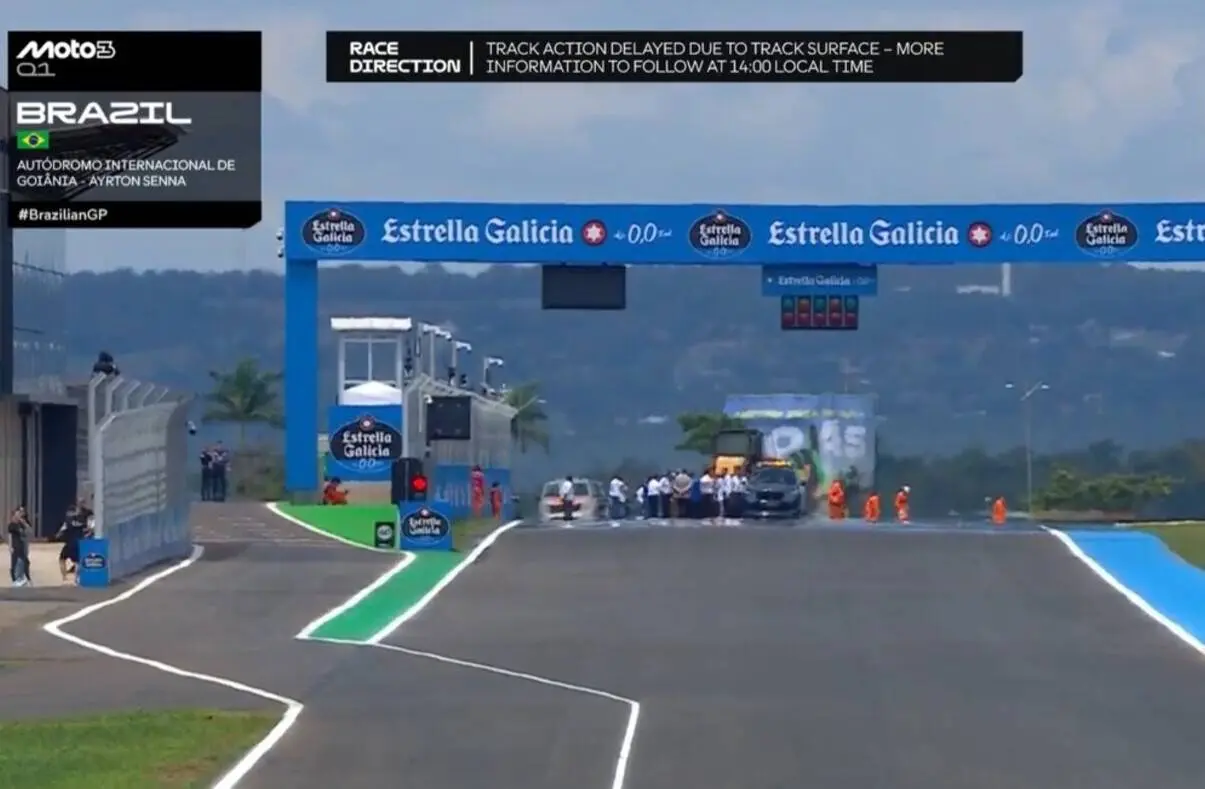
In 1954 in São Paulo, the first international event was christened by torrential rain, organizational disasters, and unpaid prizes that led to the Brazilian motorcycle federation being excluded from the FIM affiliates for 30 years. We got to 1987 with Goiânia opening the doors to the World Championship in the midst of the infamous radioactive accident, up to the contemporary return of MotoGP that almost fell into a hole. Literally: the hole that formed in the asphalt of the pit straight is an incident that cannot go unnoticed. Especially if, as we previously reported, not everything was carried out in accordance with the standards and the current protocol drafted by the FIM itself.
ANTICIPATED ISSUES
The Goiânia layout is liked by the riders, but as we have detailed in this article, something doesn’t add up regarding the circuit’s Grade A homologation. Among the points raised is the asphalt itself. It should have contemplated and accounted for the rainfall load of recent days. Moreover, based on statements from those directly involved, it essentially represents the cause of this “hole.”
THE ASPHALT
Bartolome “Tomé” Alfonso Ezpeleta, the FIM Safety Officer tasked with issuing (no later than last Thursday) the circuit’s Grade A homologation certificate (the highest level required to host MotoGP), admitted that “Due to the heavy rains in recent days, a subsidence of the asphalt occurred as a result of ground movement.” However, this clashes with the current directives aimed at preventing such incidents. We discussed this in detail: “The asphalt drains, but not uniformly. It must be said that the type of asphalt must be approved a priori by the FIM CCR Circuit Homologation Committee, therefore the responsibility is shared. Regarding the drainage system, it is not only the track asphalt that must be compliant: so must the pit lane, runoff areas, escape routes, and so on. From the images circulated in recent days, not everything drained within the timeframes essential for the proper running of the event.”
DOSSIER
In this regard, the host circuit must submit to the FIM a detailed dossier calculating potential water flow based on local weather conditions (the historical record), thus taking into account the intensity of usual precipitation, its duration, and the water flow coefficient. Consequently, the asphalt must be designed precisely according to the expected “rain load.” All the more so if Goiânia, in the midst of the so-called rainy season, is hosting MotoGP. It is therefore untenable to regard what happened as an “impossible-to-predict” problem, as stated by FIM President Jorge Viegas. The aforementioned dossier should have included the historical record of precipitation, with the asphalt and all infrastructure built accordingly.
Continue reading
You might also like

More news

Popular articles





Loading