Is Goiania a World Championship track? Riders like it, but MotoGP deserves the best
MotoGPSaturday, 21 March 2026 at 07:50

What is the Goiania track like? After the first (troubled) day of testing, the MotoGP riders unanimously gave it the thumbs up. Some exclaimed “Awesome” (Pecco Bagnaia), others called it a “Fun circuit” (Jorge Martin, but essentially everyone), and some think “It’s right to have smaller tracks that are different from the usual” (a serene Ai Ogura). In short: the revamped Autódromo Internacional Ayrton Senna is a bit small, but as the saying goes, “good things come in small packages.” The layout is not up for debate—it’s liked by the riders; if anything, it’s all the “surroundings” that raise doubts.
BEAUTIFUL TRACK, BUT SO MANY PROBLEMS
The track map didn’t seem to offer great variety, but anyone who watched last month’s Moto1000GP Desafio dos Campeões races had already realized that Goiania wasn’t all that bad. In fact, there are some fast sweepers, more than it might seem. With linked corners that need to be connected, giving the track a technical dimension that brings Brazil back into the World Championship. The problems, and not minor ones, lie elsewhere.
GRADE A
Goiania has obtained Grade A certification issued by the FIM CCR Homologation Committee, specifically by Bartolome “Tomé” Alfonso Ezpeleta (FIM Safety Officer), although there are still some outstanding points. The deluge of recent days has revealed certain shortcomings in terms of infrastructure and construction of the facility. Not just a surface that “After hours and hours never dries” (Pedro Acosta).
LENGTH AND ASPHALT
The track received Grade A certification even though, under current guidelines, its length falls below the recommended range (“The ideal circuit layout should have a total length between 4.2 km and 4.5 km”). Judging by the riders’ opinions, that’s no big deal. The asphalt, however, isn’t great: it drains, but not uniformly. It should be noted that the type of asphalt must be approved a priori by the FIM CCR Circuit Homologation Committee, so responsibility is shared. Regarding the drainage system, it’s not just the track surface that must comply: so must the pit lane, runoff areas, escape routes, and so on. From the footage that circulated in recent days, not everything drained within the time frames essential for the smooth running of the event.
RUNOFF AREAS AND SERVICE ROAD
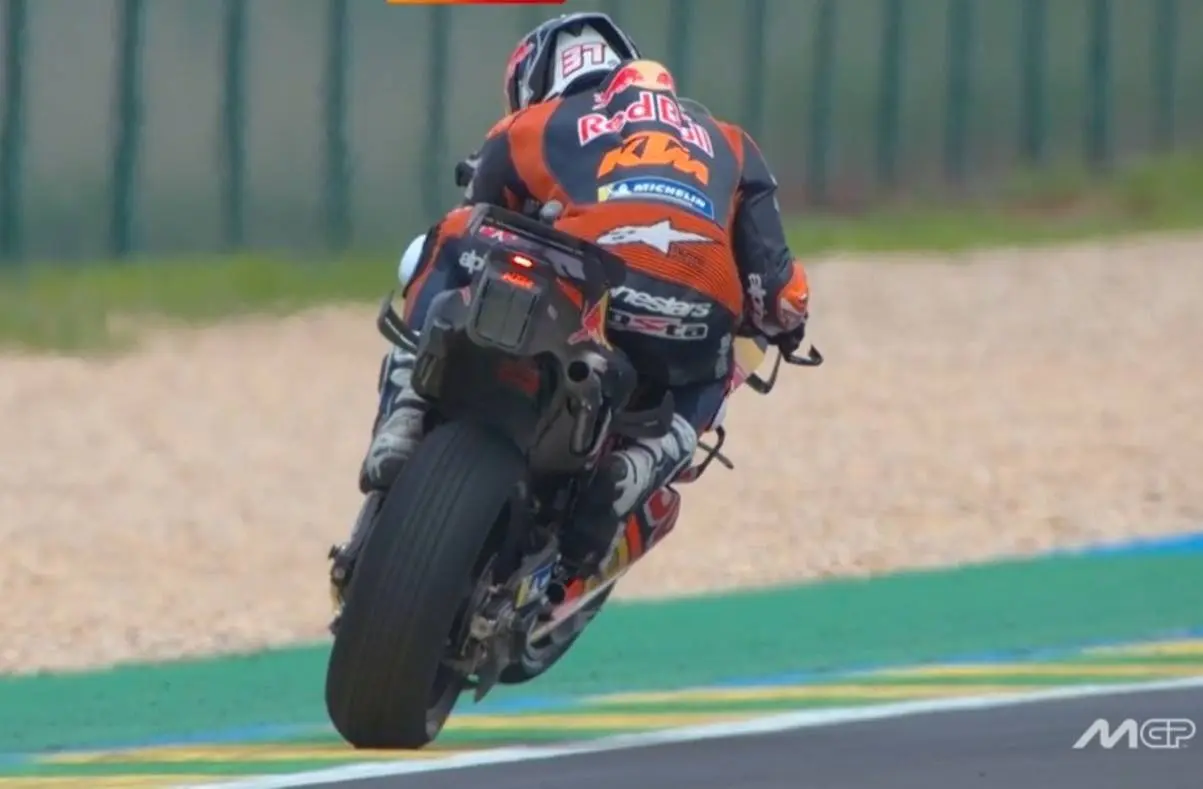
Another issue is the runoff areas. Due to the facility’s size, in several sections it was not possible to implement the guideline of 1/3 asphalt and 2/3 gravel—even in particularly fast sectors. From a safety standpoint, what’s worrisome, should the track be completely dry, is the final corner, where there aren’t wide runoff areas, and just one contact and/or a fall (a simple front-end tuck) is enough to send you straight into the barriers with no margin for error. Lastly, there’s a problem concerning the service roads. In some places they do not have a draining surface (as seen with the flooding in recent days) and are not uniform (“made of solid and stable material”), as expressly required by current protocol. Service roads must be essentially parallel to the track and must allow the regular and rapid passage of ambulances, doctors’ cars, fire engines, rescue vehicles, and moto-taxis. The inner and outer service road rings are interrupted, non-continuous, and can be accessed from the paddock via two entrances. Moreover, the service road should be two-way and, when circumstances do not allow it, several pull-off areas should be provided where emergency vehicles can stop and allow overtaking. In some sections, the space is really minimal.

Continue reading
You might also like

More news

Popular articles




Loading