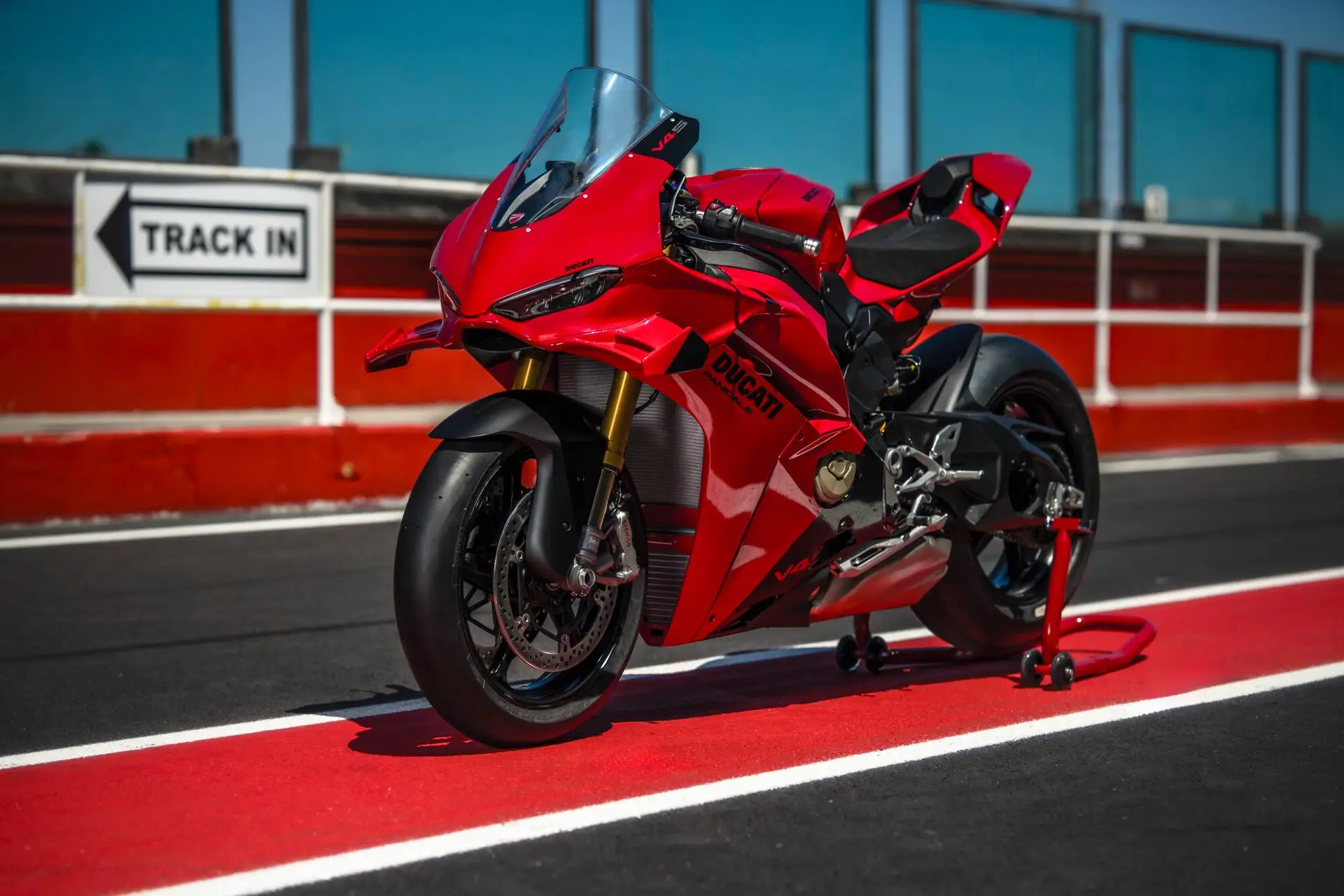
Ducati Panigale V4 2027, an evolution designed to dominate: details of the new model.
The Panigale V4 is a substantial part of Superbike history: seven generations of superbikes over forty years of success, evolution, innovation and world titles. For the 2027 version, Ducati has reworked every area—engine, aerodynamics, chassis and electronics—with the sole aim of making it even faster and more effective on track, as well as more intuitive and higher-performing. The new Panigale V4 will be available at Ducati dealerships across Europe from December 2026, with other markets to follow in the months after.
Tested by MotoGP and SBK riders, too
The Desmosedici Stradale now produces 218 hp (+2 hp), thanks to changes that improve its breathing and reduce mechanical friction. A taller final drive ratio and a rev limiter raised by 500 rpm in second through fifth gears also make better use of the power at high revs, increasing top speed and reducing the number of gear changes needed per lap. Ducati has also improved the bike’s dynamic behavior in the most critical phases of sporty riding—braking, turn-in, cornering and corner exit—through chassis and electronic upgrades.
The package was tested by Ducati riders competing in the Race of Champions and, during tests at the Vallelunga circuit, delivered an average lap-time improvement of a full four tenths of a second over its predecessor. The S version also offers extensive customization options: 11 different colors (five from Automobili Lamborghini’s Ad Personam program), two liveries and a range of approved accessories fitted directly during production, including the Front Brake PRO and PRO+ packages, the STM dry clutch and adjustable footpegs.
More powerful and efficient Desmosedici Stradale engine
At its heart, of course, remains the Desmosedici Stradale, the result of a technological connection between Ducati’s production superbikes and its MotoGP experience. For the 2027 model, greater efficiency comes from a revised exhaust system, a new higher-flow air intake (+0.6% at 300 km/h) and a recalibrated lubrication circuit that reduces power losses. Maximum output in the Euro 5+ homologated configuration has therefore risen to 218 hp (+2 hp), with the gains concentrated mainly between 12,000 and 14,000 rpm and a peak increase of +3.5 hp at 13,000 rpm. The tangible benefit is even stronger drive during the decisive phases of a lap, when every fraction of a second depends on the ability to accelerate harder and more consistently. At high speeds, this improvement is further enhanced by the new air intake, which adds up to 1.3 hp at 300 km/h.
Ducati has also adopted a taller final drive ratio (17/42 instead of 16/41) and raised the rev limiter to 15,000 rpm in second through fifth gears, as it already was in sixth. The result is a higher top speed and more time spent in the optimal gear, reducing the number of shifts and allowing the rider to focus more on lines and riding. The new Akrapovič Full Racing Exhaust PRO complete system is also available, adding a further 11 hp and 7 Nm of torque while reducing the bike’s weight by 6.6 kg. The result is a bike that accelerates more effectively, responds more quickly to changes of direction and comes closer to the performance of a true race bike. The increased aerodynamic drag generated by the new air intake is offset by the redesigned wing profile, featuring larger, more efficient endplates.
Chassis: more feel, more grip, greater cornering speed
For the new Panigale V4 S, Ducati engineers focused on the chassis’s ability to make the most of the tires at extreme lean angles. The main change is to the Front Frame, whose lateral stiffness has been reduced by 12%, improving its ability to keep the tire in contact with the asphalt at greater lean angles. This means more front-end grip, more precise turn-in and a greater ability for the bike to tighten its line toward the apex, which in turn makes it possible to maintain higher cornering speeds and open the throttle earlier on corner exit.
The new final drive ratio is also important: by reducing the wheelbase by 8 mm, it makes the Panigale V4 S even quicker to change direction, improving agility through twisty sections while requiring less physical effort. The V4 S version also introduces new clip-on handlebars that can be adjusted for track use. Raising them by 10 mm creates a more upright riding position, following the development seen on MotoGP bikes in recent years. This provides greater leverage on the steering, improving control and reducing physical effort during direction changes and longer, harder braking zones.
Electronics
The electronics on the new Panigale V4 S bring its riding sensations and techniques ever closer to those of Ducati’s MotoGP and Superbike machines. The main new feature is Dynamic Engine Brake, which replaces the previous Engine Brake Control and uses the DVO (Ducati Vehicle Observer) algorithm to adjust engine braking according to the actual load on the rear tire. This delivers more predictable behavior on corner entry, greater stability when braking with the bike leaned over and increased confidence when riding at the limit. Alongside Dynamic Engine Brake, the new Race Brake Control makes its debut, bringing technology from the most exclusive models in the Ducati range: it increases the rear wheel’s contribution during deceleration, allowing the available grip to be used more effectively.
Together, Dynamic Engine Brake and Race Brake Control allow riders to harness rear-wheel braking power that would normally be within reach of professionals alone. This makes it possible to brake later while maintaining speed on corner entry and taking tighter, more efficient lines. The result is a significant improvement in lap-time performance, accompanied by a greater sense of control and confidence for a much wider range of riders. With Model Year 27, the Panigale V4 is also more versatile on the road, thanks to Vehicle Hold Control (VHC), which makes hill starts easier, and cruise control, now standard.
Born from racing experience, a new evolution of the class benchmark.
-> Follow us on Instagram too: @Corsedimoto
Continue reading
You might also like
More news
Popular articles
Loading