Pere Riba's Analysis: "I'll explain why today's Superbike doesn't work
SuperbikeTuesday, 16 June 2026 at 18:50
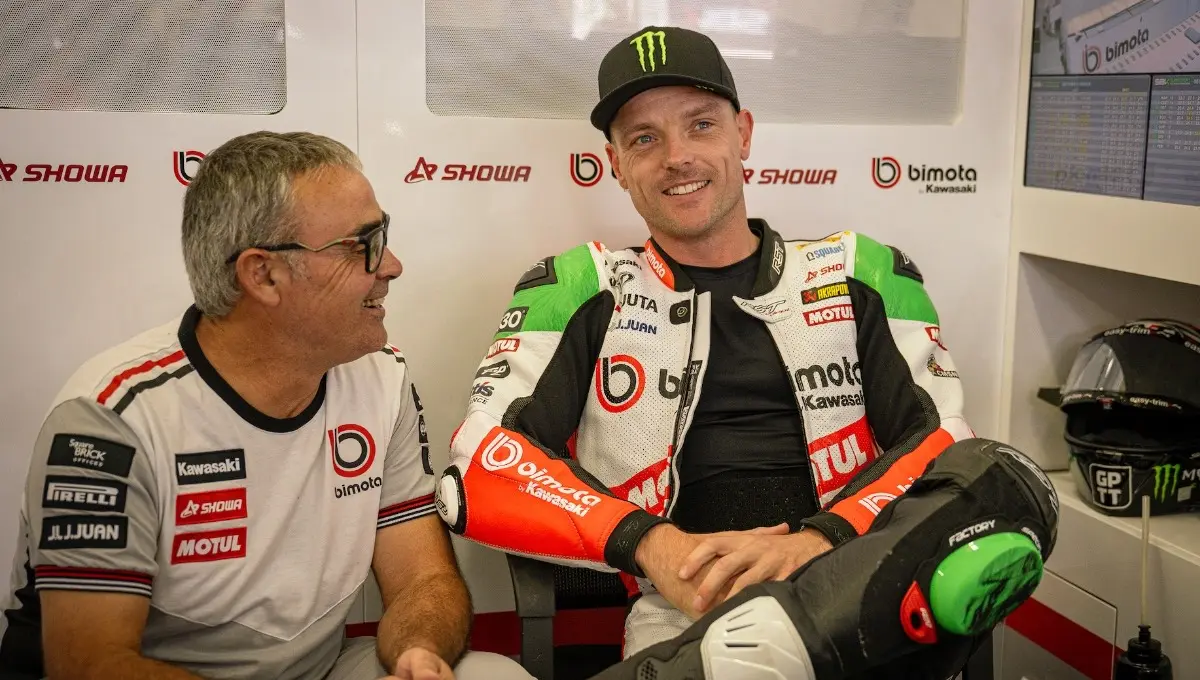
The years go by, times change, and motorcycling changes. Superbike changes too, but in the paddock you still find charismatic, romantic, knowledgeable people you can talk to for hours about bikes and riders.
Pere Riba, 57, was a rider of solid quality. He raced 250GP in the World Championship, then in Superbike, Thunderbike, and Supersport. He also did a season in MotoGP with the D’Antin team’s Yamaha YZR500, scoring points. But he became truly great on the other side of the pit wall. For fifteen years he has been one of the pillars of Provec Racing, the technological and managerial arm of Kawasaki Racing in World Superbike. Since 2015 he’s been Jonathan Rea’s reference engineer, winning six World Championships in a row. Now that the factory Kawasaki has decided to bring Bimota back to the fore, he’s alongside the Briton Alex Lowes. The Catalan Pere Riba is an inexhaustible source of anecdotes, explanations, and verdicts. A heart passionately “old school” Superbike that still beats very strong. Here’s what he has to say.
The Bimota balance sheet
It’s very, very positive. You know how it works: it’s hard to create a competitive package. You need the bike, the riders, a team. It’s a very difficult mix to achieve. We developed the production bike to obtain homologation, in a very short time. A year and a half later, I can say that between Japan, Italy, and the team we’ve done an excellent job.
Hard work pays off
If we’re here, it means we’ve done an incredible job. But the others are working too. There are Yamaha, Honda, BMW, but no one has done the job we have. So we’ve been good, very good. We’re in a very difficult championship situation. Ducati has done an incredible job; they are truly at the top. We’re talking about a company that wins in MotoGP, they have a racing structure that is truly the best. From 2025 to 26 they made the biggest improvement I’ve ever seen with the same bike. They adopted the double-sided swingarm, refined the aerodynamics, the balance, the electronics. Those last two elements go hand in hand in competitive projects.
Fast-tracking the process
Remember 2019? Jonathan had already won four World Titles in a row when the Ducati Panigale V4 R arrived. That project changed the face of Superbike. But it didn’t win right away—we kept winning with Kawasaki. It took Ducati three years to win the World Championship. That shows you how good Bimota has been at fast-tracking so quickly. It was anything but a given.
Is Ducati untouchable?
I don’t know the details—I’m not at Ducati—but from the outside it seems to me the big step came with the double-sided swingarm. The monoshock setup was at the limit; technologically they’re at a very high level, they have tons of information from many teams, many riders. They have a very tight connection with MotoGP. So what happens now? All the teams and riders who don’t have a Ducati are on the limit.
Are the others screwed?
There are two ways to read it. You can say “chapeau,” you’ve been brilliant, you’re the strongest. The second: Superbike lives on the concept of balancing performance. I mean balance in general: technical and also non-technical. The key is the concept: balance. They introduced fuel flow control, but it’s useless—you can all see it. So the situation is that this kind of balancing doesn’t work. The result has been zero. Today we can only fight to finish behind the Ducatis.
The best of the rest
It’s a tough situation. Put yourself in the shoes of a rider who lines up knowing he can’t win. Or in the shoes of a technician, a mechanic, all of us: we arrive in the box in the morning already knowing we won’t win. Don’t get me wrong, I don’t want to stir controversy. I’m just making two observations: Ducati has done an amazing job, the regulatory balancing doesn’t work.
Rev limiter and fuel control
The rev limiter wasn’t the perfect system, but it balanced things better than fuel control. I don’t want to get into technical evaluations, but I see that this year they launched SportBike; I see 400cc bikes racing against 800cc bikes, with different cylinder configurations, projects, and vehicle identities that are very far apart. Yet the races are beautiful, and the same goes for Supersport—it’s spectacular. Superbike is not. I’m not pointing fingers, I’m just saying that Superbike today is not a good championship.
What would you change?
Let’s be clear: balancing performance in World Superbike is a very difficult job, nothing like MotoGP. Over there they introduced a single ECU, but those are prototypes—you can’t do everything, but you can do a lot. Here we have road bikes that are completely different from each other. So making a regulation that works is an extremely delicate game.
And why do they never get it right?
Right now the rules go through the MSMA, the manufacturers’ association. The brands involved in Superbike are five, and to change anything you need unanimity. If one vetoes, any change gets rejected. From my point of view it makes no sense, it’s not smart. There should be a more democratic criterion: if three propose changing course and two are against, the majority should prevail. Instead, if one party doesn’t like a proposed change, they can stop it. Everything stays frozen, and the result is right in front of us. I’m not blaming Ducati, or anyone. It’s the structure that doesn’t make sense.
Michelin shift: what should we expect?
We already tried them at Jerez after the last 2025 round, and we did another test at the end of May in Aragon. Michelin is Michelin, but the tire’s character is different. Pirelli has done a good job since 2004. There have been ups and downs, but they’ve always kept improving. Now we have tires that work superbly, with a very wide operating window: in the heat, in the cold, performance doesn’t drop from the first lap to the last. In the last 3-4 years they’ve also made a step forward in durability. But Michelin works well too; it’s just different. It will be up to the manufacturers and teams to adapt to this new technological philosophy. You’ll see that not much will change; everyone will find a way to adapt in the best possible way. The performance delta (here are the first times at Aragon, ed.) is already very small, and we haven’t even started working on it yet.
How good is Bulega?
He’s a good rider. Sure, right now he’s riding the best bike in the paddock, but results don’t fall from the sky. Winning is always difficult; you can’t make mistakes. If you have a margin it’s easier, but there’s no doubt he’s a good rider. What will he do? I don’t know. I note that Iker Lecuona with the Honda was finishing seventh-eighth; now with the Ducati he ends up a second behind Bulega. Right now the technical gap is too big to evaluate the rider. Remember that all the riders in the paddock are very fast; they’re all guys who know how to ride a motorcycle hard. But Ducati is a big step ahead, so it’s hard to form a precise opinion.
And if Bulega had a Bimota?
You want to know if he’d still be out front with a fifteen-second advantage? I’ll answer clearly: no, one hundred percent no. But he’s a great rider, no question. He’s a top rider, but I don’t know how top, because he’s racing with a bike that’s seven steps ahead of all the others.

If you like Corsedimoto’s content you can select us as your preferred source by clicking here
Continue reading
You might also like

More news
Popular articles
Loading