New Ninja ZX-10RR and more support: Puccetti reveals the changes in Kawasaki’s WorldSBK garage
SuperbikeThursday, 19 March 2026 at 15:57
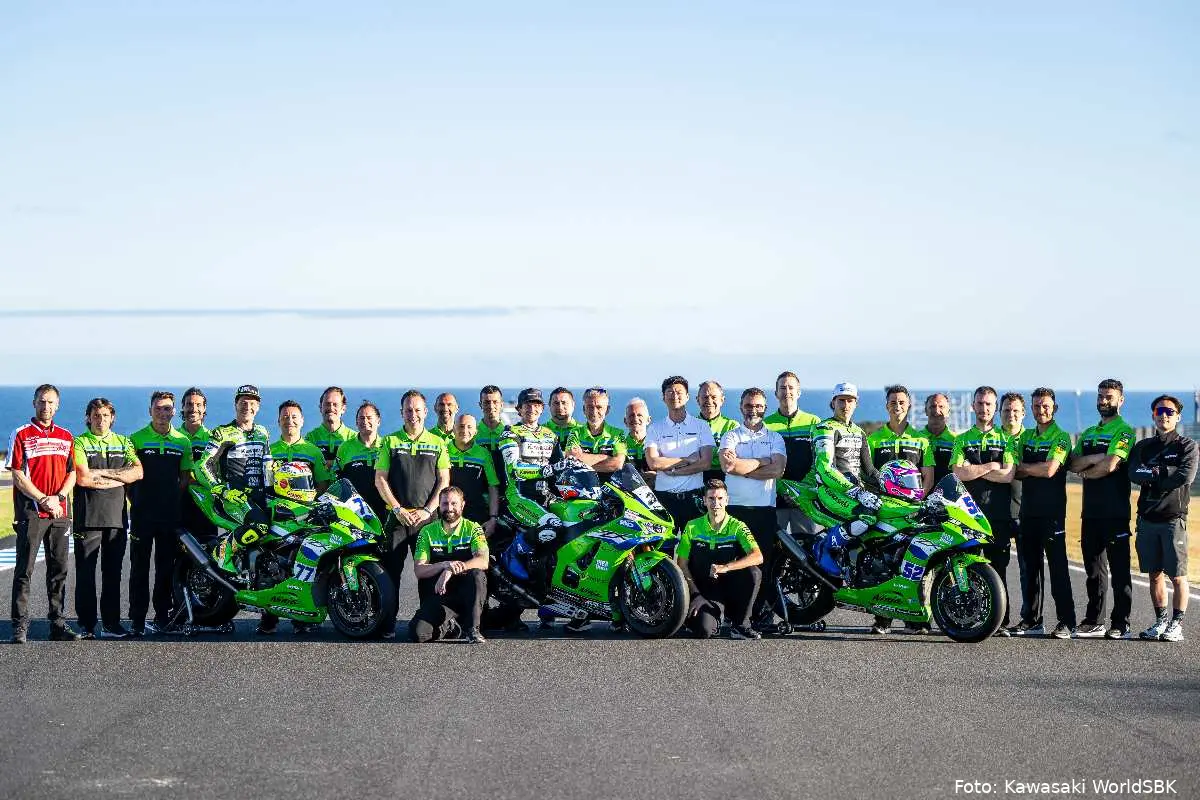
Manuel Puccetti gave an interview to Corsedimoto to take stock of Kawasaki’s situation in Superbike and Supersport. He also spoke to us about Razgatlioglu in MotoGP.
The Kawasaki WorldSBK team is fielding a new Ninja ZX-10RR in 2026, and there’s great curiosity to see what results Garrett Gerloff can aim for, given that in the opening round in Australia he already showed very good potential. He scored 15 points; a year ago it was only 3. Now we’ll have to see how the next round at Portimão goes, where the Supersport duo of Jeremy Alcoba and Dominique Aegerter will also be called upon to do well after a challenging debut at Phillip Island. We discussed all this and more with team principal Manuel Puccetti.
Kawasaki Superbike–Supersport, Corsedimoto interviews Manuel Puccetti
Manuel, what’s your assessment of the first round in Australia?
“As far as Superbike is concerned, we had our best weekend ever with Gerloff. On a circuit that favors Ducati, we managed to achieve some good results. The sixth place in the Superpole Race, finishing half a second from the podium, bodes well for the rest of the season. In Supersport we had some issues due to the many updates we brought to the bike over the winter. We didn’t have enough time to test and develop them in dry track conditions, as the pre-season tests were ruined by bad weather. We went to Australia with material that had a lot of question marks, and we experienced some teething problems. After returning from Phillip Island, we dedicated three days to the engine dyno and two days on track to solve the issues. I think we can consider ourselves ready to tackle the rest of the season at a high level.”
In Superbike you have a new Kawasaki Ninja ZX-10RR, and it seems there’s greater potential compared to the previous version.
“It’s a new bike, and from the outside one might think the only novelty is the wings, but there’s a lot more that’s new. Compared to last year’s bike, the differences include the engine, gearbox, throttle body, fork, and other chassis components, aerodynamics... There’s very little that’s the same. In Australia, Gerloff clocked the top speed in practically every session; the bike is extremely fast and considerably more competitive than the 2025 Kawasaki. Also, now we’ll log more kilometers and develop it further—I’m convinced we’ll be even more competitive. The limitation remains that we still have only one rider on the grid, but the bike has great potential and the team is very united. I think we can do considerably better than in last year’s Superbike championship.”
Is there an aspect of the bike that Gerloff has asked you to focus on to improve his feeling and speed?
“Electronics, which is an area where this year we’ve really stepped on the gas. Kawasaki is supporting us with two highly experienced technicians dedicated to our team, namely Danilo Casonato and Marcel Duinker—engineers who have been tied to Kawasaki for about twenty years. This is an additional strength because it enhances our working group. I think thanks to them as well we’ll be able to do a better job on the overall electronic setup and more. Then the more kilometers we do, the more we’ll get everything dialed in. It’s one thing to race with Ducati, which has eight bikes on track, and another to be with Kawasaki with a single rider pushing the development of a new bike. For 2027 my goal remains to have two riders.”
There’s also data sharing with the Bimota by Kawasaki Racing Team to lend a hand.
“Yes, there’s complete sharing in every session. The bike is identical, apart from the frame. It’s like having cousins with a similar bike, and we exchange information to try to help each other.”
Bulega dominated the Superbike weekend at Phillip Island decisively. Do you fear we’ll see the same script for the rest of the championship?
“He’s definitely the man to beat, and I’m convinced he’ll be the 2026 SBK world champion, but I don’t think the whole season will go like we saw in Australia. Phillip Island is a very pro-Ducati circuit and it also suits Bulega himself. In Europe he will still be the rider to beat, but I believe there will be opponents capable of getting closer.”
In Supersport there are great expectations for Aegerter’s return, a two-time world champion in the category. How is his adaptation to the Kawasaki ZX-6R going? Did the recent test at Cremona Circuit help take a step forward?
“After three years in Superbike he was used to riding a different bike, with various electronic rider aids, so returning to a more old-school bike without traction control, anti-wheelie, etc., isn’t easy. He needs time; we also gave him a training bike so he can put in as many kilometers as possible and get used to it. There’s an adaptation process, and having winter tests affected by rain didn’t help. After the first day of testing at Cremona he was already ahead of Alcoba, something unthinkable until the previous test, where he was much further back.”
What goals have you set for the next round at Portimão?
“In Superbike we aim to get closer to the top 5. In Supersport we can aspire to get closer to the podium, especially with Alcoba, who is in his second year with Kawasaki and therefore a bit more ready than Aegerter.”
Pre-season tests at Jerez and Portimão were ruined by terrible weather conditions, wasting teams’ money and time. In the future, would you be in favor of holding winter tests outside Europe?
“I’ve really been pushing Dorna and the media to get a change in the regulations. We could make better use of our budgets. Of the winter tests held between Spain and Portugal over the last 15 years, we’ve probably made full use of only 30–40% of the scheduled days; the rest have been affected by cold or bad weather. Going to Qatar, Malaysia, or Thailand definitely costs more, but the expense pays off 100% because in those places you can work normally. Instead, with the current situation, we risk throwing away about 60% of the money invested in testing. Except for Yamaha, we’re all united in wanting a change.”
MotoGP will no longer race at Phillip Island from 2027, and it seems WorldSBK could also lose that round from 2028. What’s your stance on the matter?
“For me, it remains a mythical circuit, beautiful and set in a fantastic location. It would be a shame if it weren’t confirmed on the calendar. On the other hand, though, it’s never been a particularly favorable track for Kawasaki. If I look at my own interests, I wouldn’t mind a possible exit of Phillip Island. Then again, since it’s one of the historic circuits of the championship, it’s normal for fans to feel some disappointment.”
Let’s finish with Toprak Razgatlioglu. What do you think of his first steps in the MotoGP world?
“I was in Thailand, and I think his debut was overall positive, despite Yamaha’s difficult moment. Even the performances of more experienced riders like Quartararo, Rins, and Miller show that the package is still raw. He needs time; the fact that Toprak is in the mix with them is already positive. He can’t do more than that—he’s a rookie, the latest arrival: he doesn’t know the bike, he doesn’t know the tires, he doesn’t know some of the tracks… In my opinion, we need a bit of patience. I’m sorry that the media hyped him too much over the winter; Toprak needs time, he shouldn’t be under pressure.”
You know him well and have the chance to talk with him—how is he handling this situation? In World Superbike he was used to always being at the front; now he has to adapt to a completely different dimension in MotoGP.
“We talked about it in Thailand. In recent years he was first or second, and his manager Kenan Sofuoglu taught him that second is the first of the losers, so now he’s experiencing great frustration at finding himself second to last or third from last. It’s not easy, but this situation is part of an adaptation process. Now his goal is to be among the other Yamahas, as close as possible to Quartararo. As a rookie, managing to stay close to Quartararo would mean doing a good job. Next year, with the new technical regulations and Pirelli tires, it should be easier.”
Continue reading
You might also like
More news
Popular articles
Loading