Libero Liberati, MotoGP Legend: the enduring memory of the 'Flying Terni native'
StoriesSunday, 13 September 2026 at 20:00
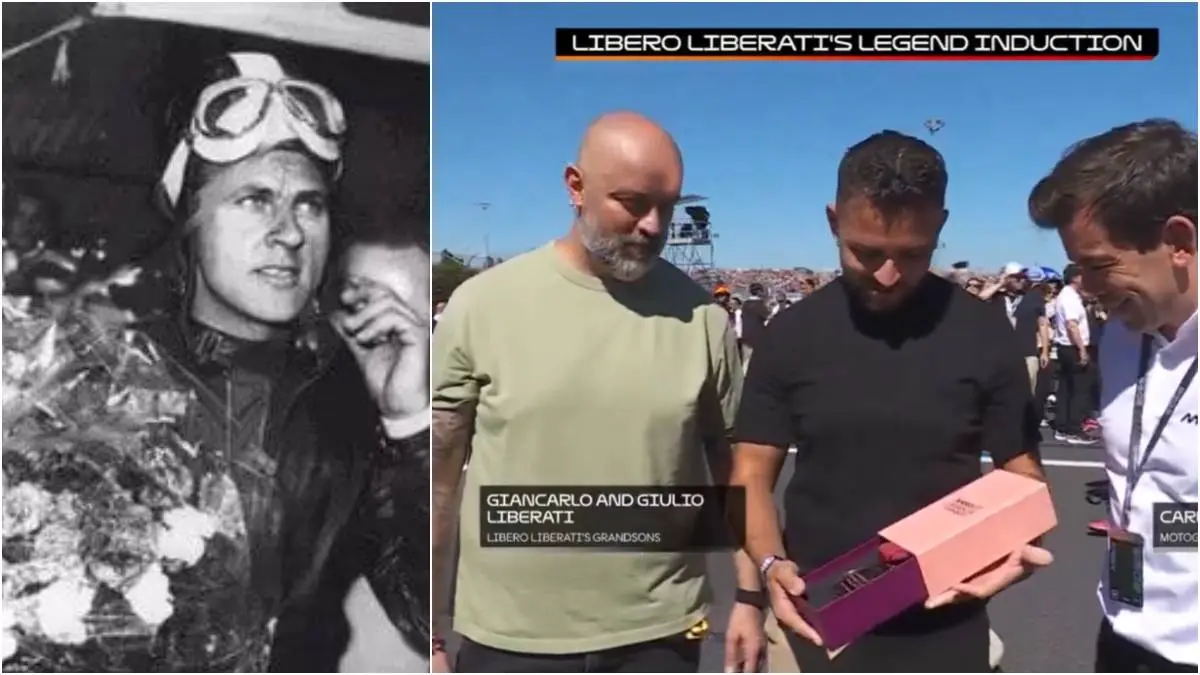
Libero Liberati officially enters the MotoGP Legends Hall of Fame: the award was presented to his grandsons before the MotoGP race.
After Loris Capirossi and Umberto Masetti, here is the third “new face” in the MotoGP Hall of Fame in recent days. Libero Liberati is a Legend too, and like the previous two, undoubtedly deserving. His was the era of the early years of Grand Prix motorcycle racing, and our riders were on fire: the hugely popular talent from Terni is the second Italian rider to become world champion in the premier class, then 500cc, after Masetti, honored yesterday. A man who died prematurely in a fatal road accident near Terni in 1962—he wasn’t even 36 years old...
Today his grandsons Giancarlo and Giulio Liberati (sons of Manrico, the youngest son of the ace from Terni) received the MotoGP Legend recognition, recalling another great historical moment before the start of the MotoGP race at Misano. A small curiosity: good blood doesn’t lie—Giancarlo Liberati was also a rider, albeit in Supermoto. He’s now a full-time instructor, but together with his brother Giulio he is committed to preserving the family’s historical memory, keeping the bond with motorcycling alive through official and institutional events in memory of their illustrious grandfather.
Libero Liberati, the profile of the “Flying Ternano”
Born in 1926, the “Steel Knight” (another nickname he was known by, also tied to the city’s main industry at the time) began working at just 11 years old in a mechanical workshop, later moving to the local steelworks as a driver. Don’t be surprised by the age—those were different times, and even children could contribute to the family finances... As an adult, however, Libero Liberati began racing motorcycles at the end of World War II, first in 1947 with a private Guzzi Condor (he won nearly all the local races he entered) and then with a far more competitive bike. But only thanks to a famous local collection: recognizing his enormous talent, his colleagues at the steelworks, local citizens, and members of the local Moto Club chipped in to buy him a Guzzi Dondolino, with which he won the Italian Third Category Championship in 1948. Two consecutive Italian titles followed in 1955-1956. A few years earlier he had already arrived in the new World Championship, and in 1956 came his first consecration with victory in the Nations GP in the 350cc class.
The road to the top-class title
In the same GP but in 500cc, this young talent from Terni gave Geoff Duke a real run for his money, finishing 2nd in a sprint. His appearances, however, were mainly sporadic privateer outings with limited means, starting in 1950 (with Moto Guzzi), then in 1951 (first approach with Gilera), on through 1959, between 350 and 500, with also a single 250 appearance in that final year. It was a brief international career, but it was precisely his only full season that delivered a precious World title. In 1957, in fact, Liberati entered history as the second Italian world champion in 500cc aboard the legendary Gilera, with four historic wins (Hockenheim, Spa-Francorchamps, Belfast, Monza) out of six GPs in total. In 1957 he also finished 3rd in the 350 world standings, with one win and four podiums in 6 GPs. Bear in mind that back then everything was very different in terms of organization, the number of season GPs, points allocation...
Farewell to the World Championship and a premature end
The non-compete pact signed by Italian manufacturers in 1957 effectively put an end to what could have been a promising world career, with, on the side, a refusal of MV Agusta—despite a stellar offer—out of loyalty to Gilera (with the sole exception of a 250cc World GP with Moto Morini). He did a few more GPs as a privateer, but without notable results—those came instead on the national scene—up to 1962, just as Gilera decided to relaunch in racing and staked everything on Libero Liberati. But on March 5, while out training on his Saturno, he reached State Road 209 Valnerina, unfortunately slipped on the wet at the Cervara bend and struck the rock face violently: it was fatal; there were still months to go before his 36th birthday. In his brief but stellar Grand Prix career he claimed a total of 6 wins, 14 podiums, 3 fastest laps, and the aforementioned world title.
Liberati and Terni, a timeless bond
The steel city, as it was called at the time, was deeply attached to its two-wheeled talent. At the exact site of the accident, a plaque was placed in memory of the Terni champion, later restored to its place in 2018 after various roadworks. Not only that: a monument by Carlo Lorenzetti was erected in front of the Libero Liberati Municipal Stadium—it is one of the few stadiums named after a champion from outside football, indicative of the importance of the “Flying Ternano.” Finally, a road tunnel not far from the Valnerina junction, where he lost his life, is also named after Liberati.
-> Follow us on Instagram: @Corsedimoto
Continue reading
You might also like
More news
Popular articles


Loading