by Ascanio Gardini
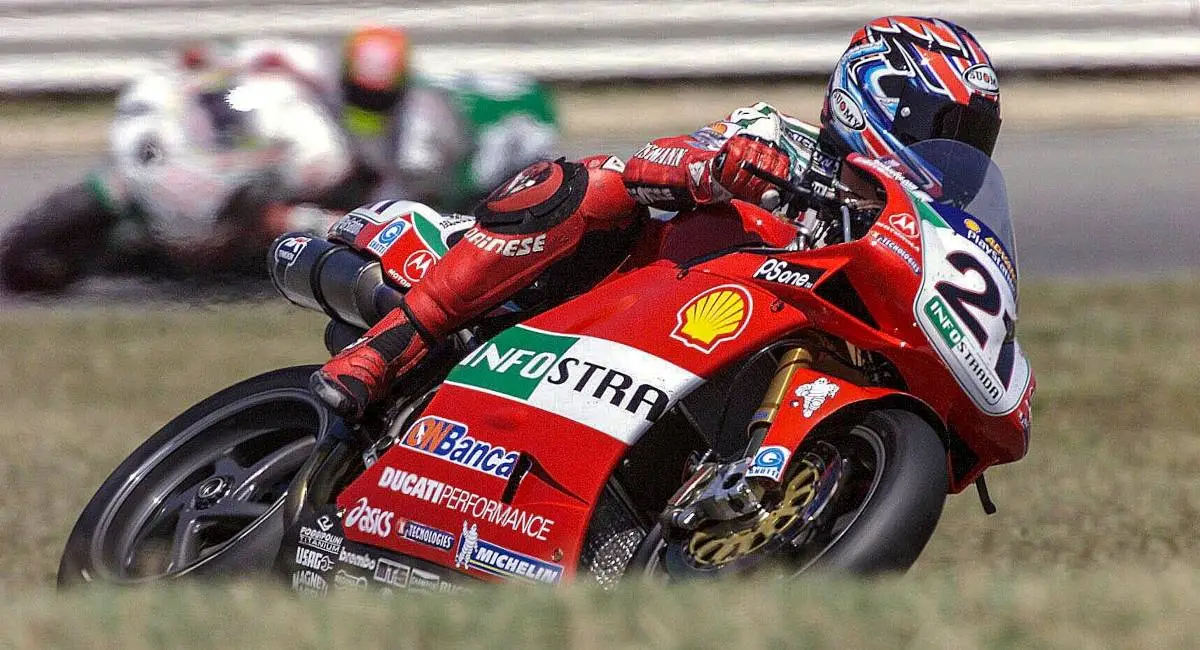
Ernesto Marinelli is a name that means a lot to motorcyclists (Ducati fans and Superbike enthusiasts in particular). The engineer spent many years as Ducati Corse’s technical manager, experiencing the team’s golden years firsthand and working alongside champions who became legends. He was with Ducati from 1996 to 2017, and since 2018 Ernesto Marinelli has worked for another major brand in the industry: Termignoni.
I ran into him by chance at Misano and, as a huge fan of Carl Fogarty and Troy Bayliss as well as a keen follower of the Superbike World Championship in the nineties, I started asking him a million questions, extracting a promise of a long chat. We finally sat down for it just a few days ago, close to the twentieth anniversary of Troy Bayliss’s victory on the Ducati Desmosedici at the Valencia MotoGP Grand Prix on October 30, 2006.
Although he is a very easygoing person, when certain topics come up he becomes remarkably talkative. For someone as curious as I am, it was easy to hit it off with him straight away.
When did Ducati move you over to the Superbike team?
“In 1997, when I worked my first World Championship as a race engineer for Carl Fogarty and Neil Hodgson. After writing my thesis on intake and exhaust ducts in 1995, I did an internship at Ducati and was then hired in 1996, straight into the Racing Department.”
You didn’t exactly get off to the best start in the World Championship: Carl Fogarty narrowly lost out to John Kocinski. It seemed that at a certain point Foggy was racing against John rather than trying to win the title…
“You’re right: it was a very strange situation. Years later, when I worked with Kocinski in the AMA Championship, I talked it over with him, and he told me he had never understood why Fogarty was so hostile towards him. Speaking of those riders, I have to say that Neil Hodgson impressed me straight away. Later, in 2003, I won my first Superbike World Championship with him on the brand-new 999. He was a great professional: aggressive on track, but extremely methodical and smooth in his riding, which reminded me a lot of Troy Corser, whom I worked with only briefly in ’98.”

“Carl Fogarty, on the other hand, was the opposite in many ways. He had a very aggressive, instinctive riding style and, at the time, a somewhat difficult personality. He was just as instinctive off the track. He didn’t have much feel when it came to setting up the bike, but he was a true ‘warrior’ on track who never gave up! It often happened that we couldn’t get the bike’s setup quite right by race day, which made us crew members more than a little anxious. But Carl would reassure us, saying he’d take care of it on race day. And he did: he could ride around the problems.”
But in 1997 there was a wonderful place called “Gasoland,” the kingdom of Paolo Casoli, aka “Gasolio,” who won you the 600 Supersport World Championship on the Ducati 748…
“Gasolio was phenomenal. A really likeable guy who loved playing pranks, but when he got on a bike he was incredibly fast and delivered excellent results. I can’t tell you much about his working methods, as I was in charge of the Superbike team and didn’t work directly with the Supersport team.”
People have always said that John Kocinski had a rather eccentric personality…
“I was just getting to John, whom I was fortunate enough to work with in the AMA Championship in 2000. He’s certainly a unique person, brilliant in some ways, but not easy to connect with. He was very ‘on-off’: black or white. He expected a great deal, and if you didn’t earn his trust, you were finished. Fortunately, after the first few events we hit it off straight away, and I have to say he’s the rider I learned the most from. For me, it was like a master’s degree at university. I remember John not only for his outstanding professionalism, but also for his meticulous approach to setup and his feel for the bike. He taught me things you won’t find in books: how to translate a single technical adjustment into the feeling experienced by the rider. With him, I developed a working method that I carried with me throughout my career.”
Back then, Ducati was accused more than once of not giving all its riders the same equipment. In 1998 in particular, both Fogarty and Chili had serious doubts about it…
“In 1998 I was working in the AMA Championship and was in the US, but I’m not aware of Ducati showing any preferences in that regard, and I never saw any technical favoritism. Unfortunately, some internal conflicts had developed, but even so, Ducati’s primary goal was always to win the championship, regardless of which team did it, so it tried to provide everyone with the same equipment.”
1998 was a very strange year, with so many riders in contention for the title right to the end. At Ducati, did you believe you could win the championship, or did you just take things one race at a time?
“That year I coordinated the Vance & Hines team with Anthony Gobert and Stevens, so I wasn’t fully up to speed on the situation. I can tell you that people knew the title was within reach, but a race is never decided until the mathematics say you’re champion. Unfortunately, unpredictable events—what we might call ‘bad luck’—can have a major impact on championships and races. From my own experience, I definitely remember the Daytona 200 in several different years, and Haga’s 2009 World Championship…”

In the AMA Superbike Championship, you had two incredible riders!
“That’s true—Anthony Gobert and Ben Bostrom were incredible. Those weren’t easy years, but they were also full of rewards, like the memorable double victory at Laguna Seca in 1999, in the WSBK races we entered as wild cards. Anthony won Race 1, and Ben won Race 2. 1998 was a difficult year because Gobert was suspended for three races. In 1999, the title slipped through our fingers by the narrowest of margins with Ben Bostrom.”
One theory about the birth of the universe holds that it all began with a big bang. Or rather… Big Ben Bostrom!
“Ben wasn’t just a rider with a unique style; he was also a terrific person and a consummate professional. I recently went to visit him at his villa in Las Vegas, and he’s still in fantastic shape. I was sorry we didn’t win the title together; he certainly deserved it. A couple of injuries affected the 2001 championship, and in 2002 Michelin dominated. That influenced our decisions for 2003, but I believe Ben could certainly have been a title contender.”
On the other hand, you found yourself working with a wild child like Anthony Gobert… (when this subject comes up, Ernesto Marinelli becomes extremely serious.)
“Tony was one of the most talented riders I ever worked with: when he was on form, nobody could touch him. Unfortunately, his well-known problems with alcohol and other issues affected his career and, sadly, his life too. He was often impossible to manage on a personal level. He also had a very particular way of working: he would allow you only three setup changes over a race weekend. In his view, that gave him an accurate feel for the bike’s limits and allowed him to ride right on the edge of grip through every corner.
Let me tell you a couple of stories. In 1999, we were at Daytona. After three free practice sessions with mediocre times, Anthony went out for qualifying. His first run was still only good enough for the middle of the grid. Then he came into the pit lane at full speed and asked to qualify—but there were still 50 minutes left in the session! Taken by surprise, we tried to figure out what was going on, but he was impossible to read. So we fitted new tires, and he went back out, setting a first lap of 1’49.0, which was already a track record. He came back in and asked for a second set of qualifying tires, on which he set a record of 1’48’5 that stood for several years. Then he sat down calmly in front of the screen: there were still 40 minutes left in the session, and he waited for it to end.
“Another time, still during those two years, we arrived at the circuit on Thursday, and he didn’t show up for two days. We looked everywhere, but nobody had heard from him—not even his mother or brother. We started to worry because he had missed both Friday practice sessions. He turned up calmly on Saturday morning. We immediately pounced on him, demanding to know where he’d been. He told us he hadn’t felt like riding and wanted a little time to himself. He took to the track on Saturday with the bike set up as it had been for the previous race and immediately took pole!”
Did Ducati ever consider bringing him into the Superbike World Championship?
“No, as far as I know, Ducati never intended to bring Gobert into the World Championship, given the difficulties he’d already had in his first year in the US.”

A tough question: I’ve never heard you speak ill of any rider. Was there anyone you would have liked to work with?
“You’ve never heard me speak ill of any rider because I got along very well with all of them, and each one always left me with something, as well as their friendship. Riders aren’t ordinary people: to do what they do, they draw on an inner strength that can sometimes be difficult to manage, but you have to connect with them to achieve results. First and foremost, the technician has to give them confidence that they can count on the best available. Different cultures and personalities require you to change your working methods. Noriyuki Haga, for example, was another incredible talent, but he had a completely different approach. He rarely pushed to the limit before qualifying or a race, always relied on his instincts, and constantly asked for changes. Even after winning a race by several seconds, he could ask you to completely transform the bike! Obviously, I wouldn’t do that; I’d limit myself to minor adjustments, which nevertheless kept him happy. One evening, after a few beers, I asked him to be honest and tell me why he kept asking for changes, even when the bike was dialed in. Completely at ease, he said, ‘Ernie-san, in Japan we grow up with the mindset that you should always ask for more in order to improve. I grew up that way, and I can’t help it!’ I’m very sorry we didn’t achieve that success together in 2009. They say bad luck isn’t real, and I can accept that when it comes to a mechanical failure or a crash. But in his case, bad luck really did affect us: in the end, we lost the championship by just a handful of points. That flock of pigeons at Monza, which he hit after a record-breaking start and which cost us what was almost certainly going to be a double victory—I can only call that ‘pure bad luck.’”
It’s been twenty years since Super Troy Bayliss won the MotoGP race in Valencia on the Ducati. Tell us about that event, especially given that for this adventure Troy insisted on bringing along the crew—including you—with whom he had just won the Superbike World Championship on the Ducati 999…
"I was incredibly fortunate to share an extraordinary period with Troy Bayliss. It’s impossible not to love him and not to give your all for him, because he always gave everything, on every occasion, and never backed down. Technically, perhaps he didn’t have the same feel for setup changes as some other riders, but his strength was that he tuned everything around performance (lap time) and never let his feelings—good or bad—affect him. If we made a change he didn’t like but his lap time improved, that was the way to go, and he’d be the first to tell you so. All the technical solutions we developed with him went on to work and were later adopted by everyone. The exception was the basic setup, which, because of his extreme riding style, was rarely compatible with other riders."
"Going back to the Valencia weekend, which was the most exciting of my career, Filippo Preziosi called me on Friday afternoon before the race weekend and told me that Troy would be taking Gibernau’s place for the final MotoGP race in Valencia, and that he absolutely wanted me, Paolo, and Davide to go with him. I spent the whole weekend in a bit of a panic, reading all the MotoGP procedures and reports from previous races, and looking at the data from those races. But honestly, I didn’t know what to expect, since both the bike and the tires were very different from what we were used to in SBK. When we got to the track, we decided on a strategy of preparing two different bikes: the first with a basic setup more or less like the one Loris and Sete used, and the second with the aim of replicating, as much as possible, the character of the 999 he was used to. He went out first with the MotoGP setup and did about ten laps, then went out with what we called the ‘SBK’ setup. When I saw him come back in smiling, I realized the weekend could turn into something special. Then, as we all know, the rest is history: it was simply epic!"
"Troy’s riding style is unique. He has an ability to adapt and move around on the bike that I’ve never seen in any other rider. Troy didn’t care whether the bike was very stable or precise; on the contrary, he wanted an extremely responsive, dynamic machine that would follow his movements with as little effort as possible, and a spacious seat that would let him shift forward and backward as needed."
The Valencia MotoGP race was certainly the most memorable, but I could probably write a book about the incredible moments and events involving Troy.
Let me tell you a story. On the Monday after Troy’s dominant World Championship victory at Portimão in 2008—pole position and two wins by a huge margin—Michael Schumacher came to test the bike. He was an extraordinary person and also very fast on a motorcycle, even though it was just a hobby for him. Troy told him it was the best bike he’d ever ridden! Michael went out and did two laps with Troy’s setup, just as it had been at the end of the race, then came back looking, shall we say, ‘shaken.’ He took off his helmet and told Troy and me that it was the first time in his life he’d ever been afraid on a motorcycle! After a few laughs together, I explained that Troy’s riding style was definitely extreme, so we changed the setup to something more conventional and carried on through the afternoon. He completed about fifty laps, with some very interesting times, considering he rode motorcycles just for fun. I was impressed by his incredible precision when describing every detail. He was a computer. Incredible!”
Speaking of Troy, a friend of mine named Barry Rivellini once told me that one evening—this must have been in 2008 or 2009—they were staying at a hotel during a Pirelli track event when someone decided to buy him and Troy a drink. They started drinking. My friend Barry, who can really go for it when he puts his mind to it, eventually called it quits while Troy kept going, and the bill came to around a thousand euros! The funny thing is, Troy got up the next day and rode more than a hundred kilometers on his bicycle…
(laughs loudly) “Troy trains constantly!!!! Even now, he’s in such great shape he could put quite a few ‘youngsters’ to shame.”

Is it true that one morning at Phillip Island he got you all out of bed at 6 a.m. to go to the track because the conditions were right to set a record?
“Yes, absolutely true. It was during testing in 2007. We were sharing an apartment, and at 5:30 he was already up checking the weather. He woke everyone and said, ‘Come on, guys, the wind is right today and the track is fast this morning, but I want to go out as soon as it opens! It’ll get worse later.’ We got to the track before everyone else. Almost an hour before practice was due to start, he already had his leathers on and everything ready. Then he actually set the record—I had no doubt he would.”
"He has incredible instinct and natural talent. Just think: eight or nine months after retiring in 2008, and after his last race at Portimão—his last experience on an SBK—we organized a test at Mugello. He arrived full of energy. It rained nonstop on the first day, but he still wanted to go out at 9 a.m., as soon as the track opened. He rode all day, doing 2:01s in terrible conditions, with half the track flooded. That was probably our best lap in those conditions. The next day, in dry conditions, he set the fastest SBK lap of that period. Anyway, I have a whole host of stories about Troy to tell!"
I got him to promise me another chat so I can hear all these stories—I’m incredibly curious about them. In the meantime, many thanks to Ernesto Marinelli.
-> Follow us on Instagram too: @Corsedimoto
Continue reading
You might also like
More news
Popular articles