Brazilian GP, an extreme challenge for brakes: Brembo unveils data and corners to watch
MotoGPWednesday, 18 March 2026 at 09:42
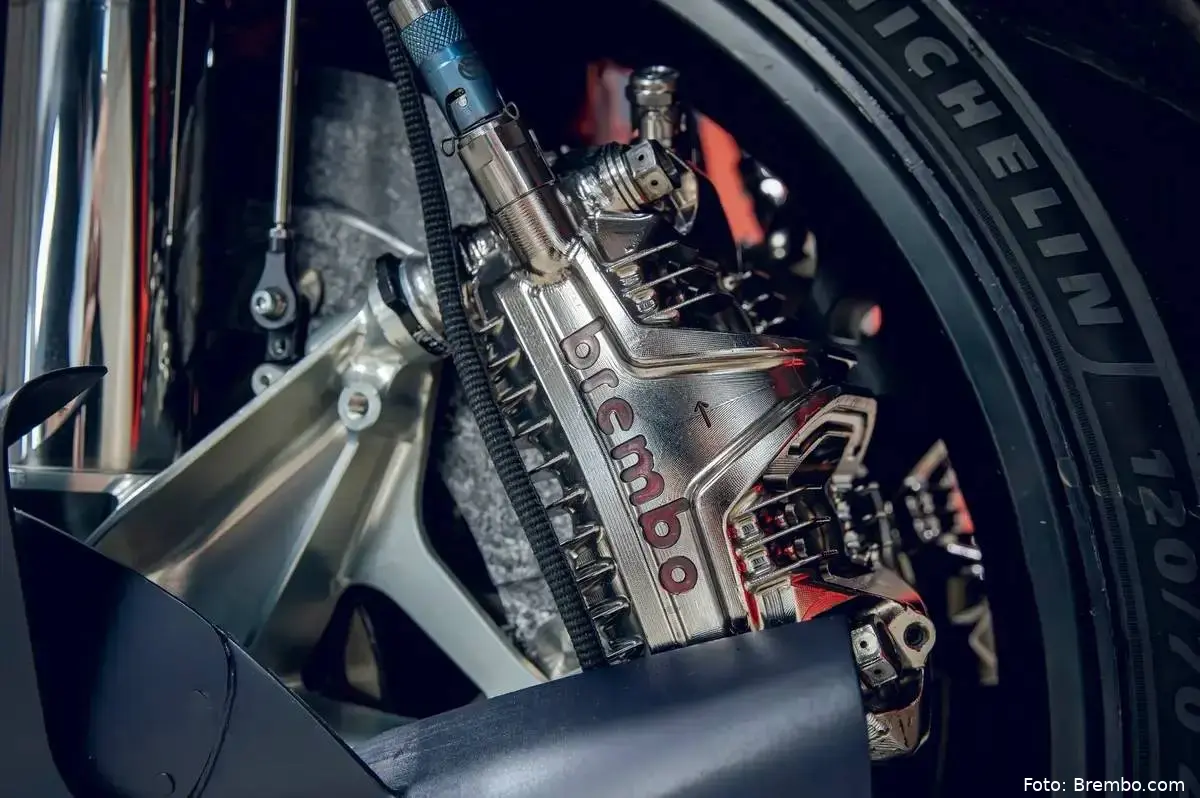
Brembo’s data for the appointment at the Ayrton Senna Autodrome, a highly anticipated and brand-new venue for the second round of the 2026 MotoGP World Championship.
Among manufacturers, teams, riders and brands working hard to best tackle this major novelty, let’s not forget Brembo, the Bergamo-based leader in braking systems, also ready for MotoGP’s long-awaited return to Brazil. From the moment it was announced, adrenaline has been sky-high and fans are set for a huge celebration to welcome the World Championship back. The date is at the historic Ayrton Senna Autodrome, inaugurated in July 1974 and host to the World Championship in the 1980s (here’s its history), but radically changed since then following a renovation begun in 2013 and costing the equivalent of 40 million euros. A fun fact: together with the Caruaru and Londrina tracks, it’s one of three Brazilian circuits named after Ayrton Senna, the unforgettable F1 champion who tragically lost his life during the San Marino GP at Imola in 1994.
Brazilian GP data
According to Brembo technicians, who for the eleventh consecutive year are working closely with all MotoGP riders, the Autodromo Internacional de Goiania – Ayrton Senna, 3.835 km long, falls into the category of the most demanding circuits for brakes. On a scale of 1 to 6, it earned a difficulty index of 4, despite featuring only 7 braking zones per lap: 3 rated High, 3 Medium and 1 Low. Except for one, all the others involve decelerations of at least 1.3 g. Over the course of a lap, the brakes are used for about twenty seconds.
The toughest corner
The most demanding corner for the braking system at the Autodromo Internacional de Goiania – Ayrton Senna is Turn 1, where speed drops from 337 km/h to 117 km/h due to a 4.4-second braking phase. During this time, MotoGP bikes cover 259 meters while riders apply a load of 5.6 kg on the brake lever and experience a deceleration of 1.5 g. Brake system pressure reaches 12 bar.
The Brazilian king
Last November in Valencia, home hero Diogo Moreira clinched the Moto2 World Championship, becoming the first Brazilian rider to win a World Championship under the FIM umbrella. He achieved this milestone aboard the Italtrans Racing Team’s KALEX, equipped with a Triumph engine and Brembo scoop calipers derived from MotoGP. In fact, for several years now, all Moto3 and Moto2 teams (here are Pirelli’s choices for the Brazilian GP) have been using Brembo calipers.
Disc range
Taking the crowd favorite as our example again, Diogo Moreira made his MotoGP debut with a 13th place riding the LCR team’s Honda. There are numerous differences compared to the KALEX he used in Moto2, starting with the discs: steel with a 300 mm diameter for the intermediate class, carbon with diameters of 320, 340 and 355 mm for the premier class. The 320 mm discs are used only on circuits that are not particularly demanding on brakes, while the 355 mm discs are recommended for the toughest tracks. The 340 mm Brembo discs are available in Ultra Light, Standard Mass, High Mass and Finned versions.
When 320 mm was enough
Brembo brakes made their debut in the premier class in 1976, but the first victory in Brazil dates back to 1988: Eddie Lawson triumphed by 13 seconds aboard the Yamaha of Giacomo Agostini’s team, fitted with 320 mm Brembo discs and 4-piston Brembo calipers. In 1986, the American’s YZR500 OW81 was the first to use Brembo’s radial master cylinder, which within a few years became the standard for racing bikes and is now used on all high-performance road bikes.
Continue reading
You might also like
More news
Popular articles
Loading