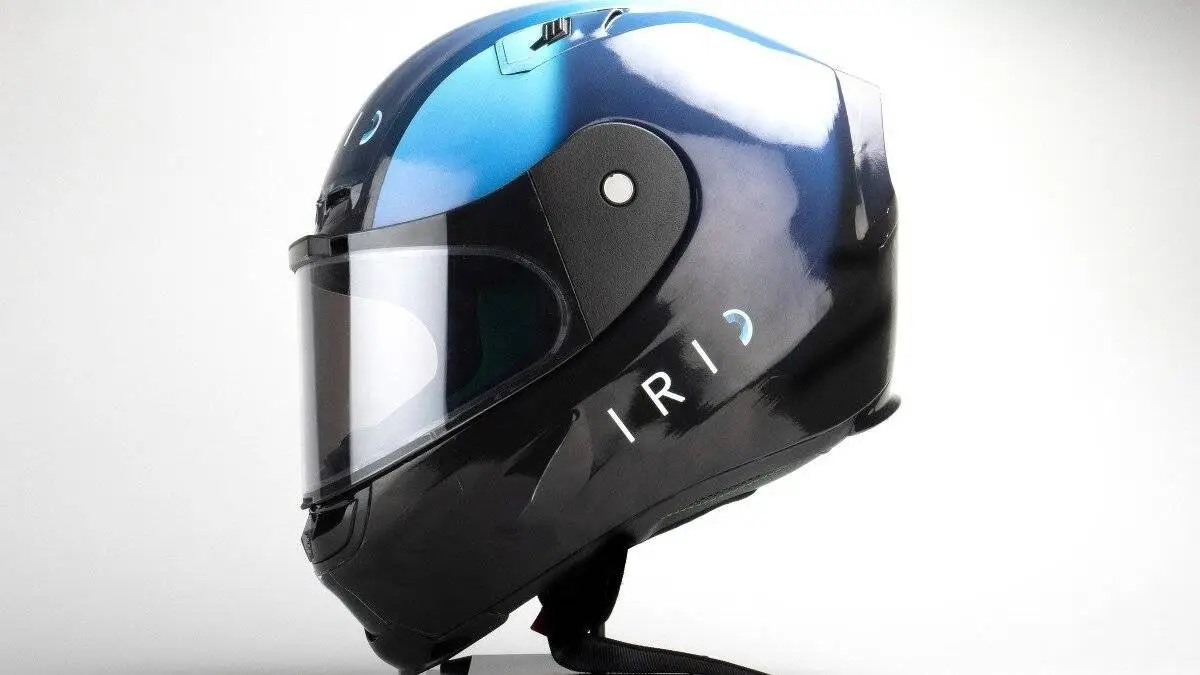
The visor that adapts to changing light in 0.09 seconds: the Italian IRID patent taking the motorcycle helmet world by storm.
Do you know what goes into an innovation? In this case, it’s a patented technology developed by Brescia-based company IRID... But let’s take it step by step. Among the many new products unveiled at EICMA 2026 is the Irid Dynamic Visor, a next-generation visor from LS2 Helmets, the Spanish helmet brand, developed in collaboration with the optical specialists at Italian company Out Of. It automatically adapts to changing light in the blink of an eye. But first, here’s a brief look at the technology behind it.
How the patented technology works
The technology behind solar-powered dynamic liquid-crystal lenses and visors is an Italian invention developed by Brescia-based IRID, a spin-off of sports eyewear brand Out Of that later became a dedicated technology division (IRID Technology), supplying components to international brands. It is a self-powered, solar-powered electrochromic optical system that changes the lens tint in less than a second without using batteries—a particularly intriguing innovation conceived by siblings Federico, Roberto, and Laura Righi. The project is protected by more than six international patents and has won major awards in the optical industry, including the Silmo d’Or, the “Oscar” of the eyewear world. Unlike traditional photochromic lenses, which rely on a slow chemical reaction triggered by UV rays, the IRID system works through an instantaneous physical-electronic process.
It features an integrated photovoltaic cell: a tiny solar panel is embedded in the upper part of the lens or visor to capture ambient light. A control microchip in the cell constantly measures the surrounding light intensity and sends a tiny electrical pulse to a special liquid-crystal film inside the lens. The crystals then rotate, continuously and uniformly adjusting how much light passes through the lens, with no preset steps. There are no buttons to press and no devices to recharge by cable: when there is no light, the system switches off instantly and returns to a clear state. Specifically, the tint dynamically varies from 60% in low-light conditions to 20% in direct sunlight, providing a smooth transition that prevents glare and sudden drops in visibility.
What are the technical advantages?
Since there are no batteries to recharge, the system does not degrade over time, is unaffected by extreme cold, and adds negligible weight. Unlike conventional chemically activated lenses, it switches from clear to dark and back again in 0.09 seconds—far less than a second. Because it responds to visible light rather than ultraviolet rays, the system works perfectly behind a car windshield, on cloudy days, and in the shade. It is waterproof, with fully sealed, water-resistant electronics and film. It is also scratch-resistant and UV-protective, and features an anti-fog treatment tested to withstand up to 120 consecutive seconds in critical conditions. There are two versions: Clear for road use and Dark, with a deeper tint, for the track.
It is currently sold with helmets, such as the LS2 Thunder GP Aero full-face carbon-fiber racing helmet. In this case, the complete package costs around €800; for other models, consult the official price list from the respective brands. In the motorcycle sector, this IRID technology has been adopted by major helmet manufacturers. We’ve mentioned LS2, and can also add Shark and Nolan, whose helmets feature these certified smart visors that eliminate sudden glare and the abrupt darkness encountered when entering tunnels. And it’s not just for motorcycles: the technology has also been adopted in several lines of sports sunglasses, especially for skiing and cycling. The Brescia-based company is also working to integrate the innovation into prescription lenses, personal protective equipment, military applications, and the automotive sector.
-> Follow us on Instagram too: @Corsedimoto
Continue reading
You might also like
More news

Popular articles