CFMoto has already considered a turbo for its superbike V4. This is revealed in patents filed in China for the SR-RR’s 997 cc engine. The most curious detail is almost a footnote, but it opens up some interesting possibilities. The Chinese brand’s hypersport could soon race in the production-based World Championship: watch the first test footage here.
The turbo on the cylinder head
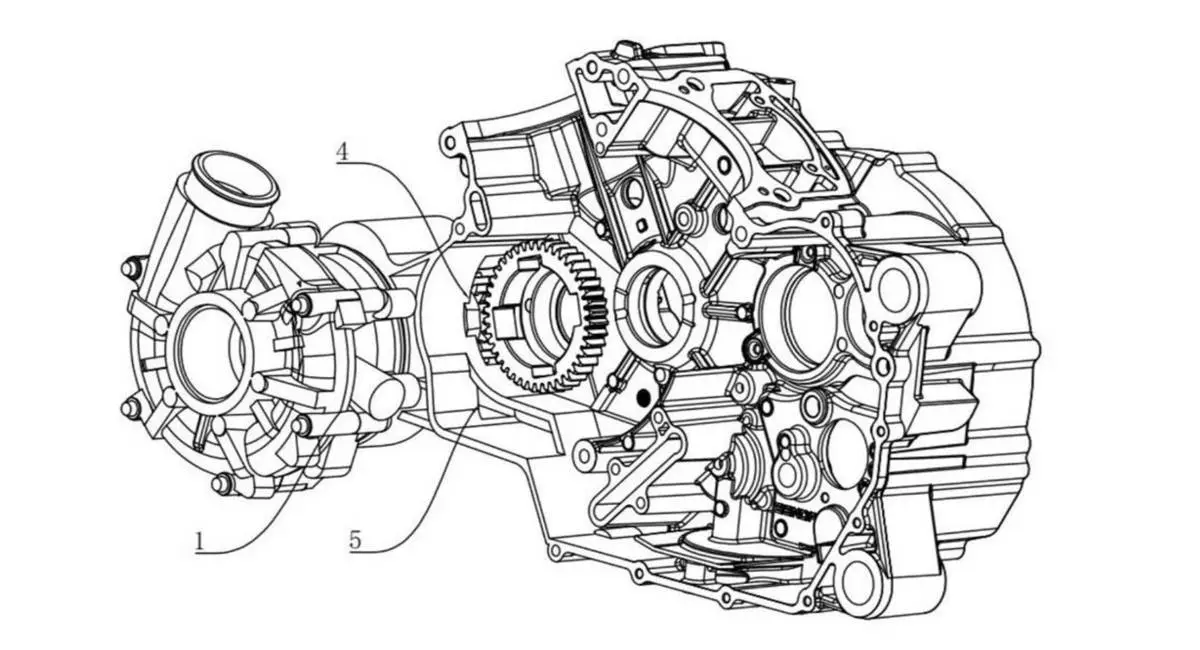
In describing the cylinder head’s exhaust ports, one of the documents specifies that, in the case of a turbocharged engine, the exhaust connects to a turbine mounted directly on the head. In other words, someone in Hangzhou has already looked into how to pair this V4 with forced induction.
It’s best not to get ahead of ourselves, though. A patent is not an announcement, and manufacturers often use them to protect ideas that may never leave the drawing board. Among superbikes, forced induction is almost exclusively Kawasaki territory: its H2 models use a crankshaft-driven centrifugal supercharger, not a turbo. CFMoto, however, is already familiar with turbines: its 998 cc turbocharged three-cylinder has been powering the brand’s UTVs for some time.
Besides, the naturally aspirated V4 doesn’t seem to need any help.. The manufacturer claims over 210 hp with the bike weighing less than 200 kg, and on June 15 in Shangrao it reached 315 km/h, setting a speed record for a Chinese motorcycle with an internal combustion engine.
The engine as a stressed member and variable-length intake trumpets
The rest of the documents describe how the bike is built. The V4 is a stressed member, as on the Ducati Panigale V4: up front, a short cast-aluminium frame is bolted to the cylinder heads, while air reaches the airbox through the steering head.
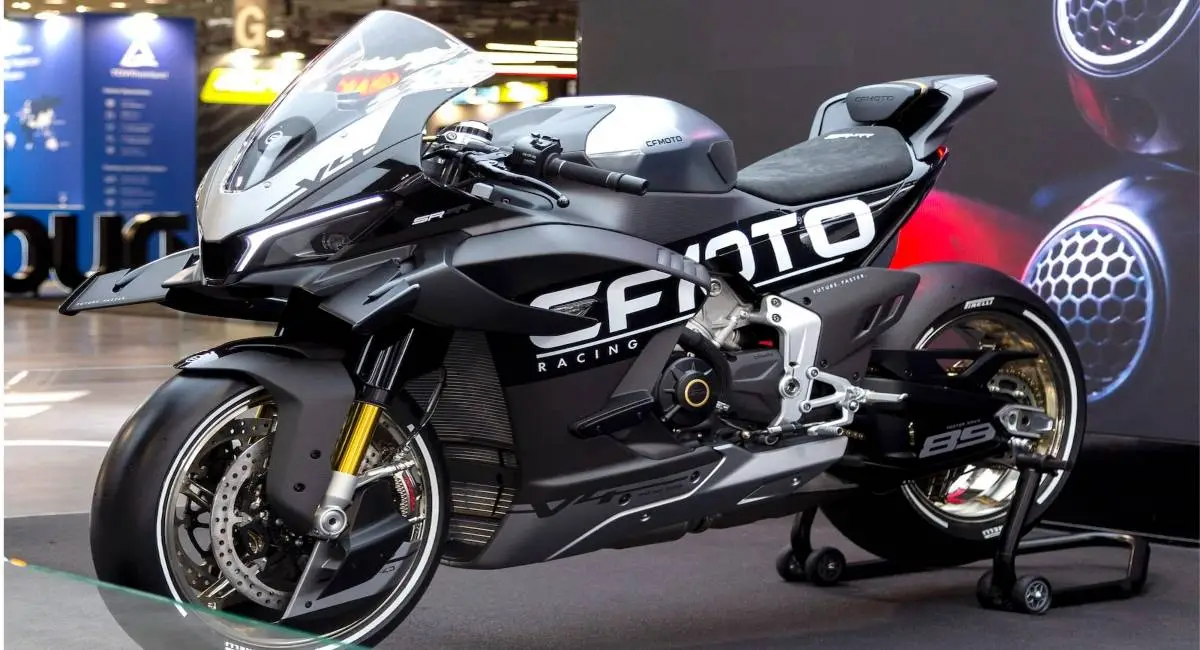
Another point of contact with Borgo Panigale is the variable-length intake, absent from the prototype displayed at EICMA 2025 (pictured above). The trumpets are split in two: the longer lower section is fixed inside the airbox above the throttle bodies, while the shorter upper section is mounted on a movable subframe actuated by a small electric motor. At low revs, the upper trumpets lift, allowing air to enter through the gap as well, which benefits torque. At high revs, they lower again to form a single, longer duct which, according to the patent, boosts peak power.
Valve train and technical specifications
The valve train uses a conventional layout: the front cylinder bank is driven by a chain on the left, and the rear bank by a chain on the right. According to CFMoto, shorter chains are easier to tension, deliver more precise valve timing and last longer.
The remaining figures are those revealed when the engine was unveiled at EICMA 2024: a 90° V angle, a counter-rotating crankshaft, peak power at 14,500 rpm, 114 Nm at 12,500 rpm and an engine-only weight of 61.5 kg.
With EICMA 2026 just around the corner, the production version of the SR-RR could arrive within a few weeks. As for the turbo version, assuming it ever sees the light of day, we’ll have to wait years.
-> Follow us on Instagram too: @Corsedimoto
Continue reading
You might also like
More news
Popular articles

Loading