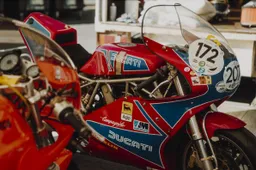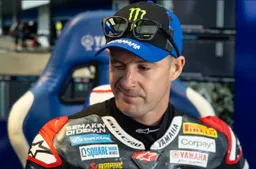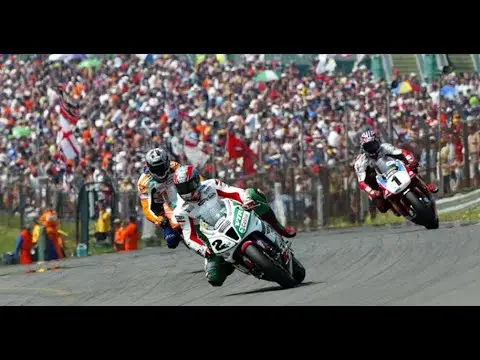
In Jerez, a World Superbike season of highs and lows comes to a close, in front of a sparse crowd. Once upon a time there were 120,000 at Brands Hatch: the great Giovanni di Pillo takes us back in time.
On the occasion of the release of Giovanni di Pillo’s long-awaited biography, in bookstores from October 31 on our YouTube channel CorsedimotoTV we will offer you an exciting video journey through the stages of the most beloved motorsport commentator’s career. Above I’ll preview a short snippet here below: the great Gio talks to us about Superbike from a few years ago and its flagship events. In particular, Di Pillo recounts and immerses us in the atmosphere of Brands Hatch, on the outskirts of London. A thrilling, old-school track, stormed by 120,000 spectators. The comparison with today’s World Championship reveals a completely different reality. Why has Superbike, in recent years, instead of moving forward, gone into reverse?
Shooting yourself in the foot
This mid-October weekend marks the end of a championship lived almost entirely on the showdown between Toprak Razgatlioglu and Nicolò Bulega. A stellar duel, no doubt, with BMW and Ducati involved at the highest level. But where did everyone else end up? By now it’s a constant to see the third-place finisher getting 15-second gaps, and that’s not to mention the rest. The technical regulations were written to determine performance balance at the table. But they achieved the exact opposite effect. Neither the engine rev limits nor the current fuel control have brought back the “wild bunch” we fondly remember.
The lesson from British Superbike
While Razgatlioglu and Bulega will fight for the title in the near-desert of Jerez, this same weekend the final round of British Superbike takes place at Brands Hatch. It’s a national series, albeit a prestigious one. The event will draw 60–70 thousand spectators: imagine how many people would show up to enjoy a World Championship spectacle. Abandoning its historic venues, the temples of motorsport like Brands Hatch or Monza, is one of the most glaring own goals of Superbike in this era. It’s far worse than adopting a technical rulebook that fans don’t understand and that seems tailor-made to stifle the category’s old spirit.
A World Championship that no longer “bothers”
Starting from nothing, Superbike became a cultural phenomenon by playing on its contrasting character with Grand Prix racing. Since 2013, when it came under the same promoter, the change began—meaning the decline. It couldn’t be otherwise, because Dorna has no interest, for a number of justified reasons, in allowing Superbike to shine on its own, competing with MotoGP. So it’s managed with the handbrake on. Think about the calendar: eleven rounds in Europe, with Australia as the only exception, erasing the global scope it once had. Moreover, a quarter of the championship takes place on Iberian soil (Aragon, Estoril, Jerez), where even in the glory days Superbike didn’t have much following. Let alone now.
The low profile suits everyone
The World Superbike Championship today, in Dorna’s plans, is a bit like JuniorGP: it’s essential that it exists, but there’s no need to promote it and make it soar. The key point is that it doesn’t fall into other hands, which could relaunch it again as an alternative to MotoGP. The monopolist’s strategy is fully understandable, as is the acquiescence of the International Motorcycling Federation, which collects hefty fees. Ultimately, this situation also plays into the hands of the manufacturers, who are engaged on two fronts—except BMW. The lower Superbike’s level drops, the less they spend and the more resources they save to invest in MotoGP.
Continue reading
You might also like
More news
Popular articles
Loading