If there’s a moment when the Superbike World Championship staked its claim to a pure, essential form of motorcycling, that moment is the two-year span of 1996–1997.
There had already been heated duels, and riders in the crowd could feel they were watching an authentic spectacle. Yet something was still missing. It needed an emotional short circuit to push the tension to the breaking point. It arrived with the rivalry—at times tipping into open sporting hatred—between Carl Fogarty and John Kocinski.
Opposing worldviews from two incompatible personalities: a single goal for both—victory—and tracks that became too narrow to hold them together without elbowing.
The people's king versus the ultra-professional
To grasp the essence of this rivalry, we need to sketch out (lightly and freehand, because their history and complexity would warrant two monographs) the profiles of the two protagonists.
Carl Fogarty, the king of production-derived bikes. A visceral, surly Brit. Foggy rode ’90s superbikes like no one else; competitive fury fueled him, multiplying his talent. He didn’t just want to win—he wanted to psychologically crush his opponents. If bikes require arms and legs, he rode with heart and gut most of all. Also (and especially) for this reason, combined with his boldness and total lack of filters, he was the fans’ idol.
John Kocinski, the former 250cc world champion raised in Kenny Roberts’ school. Obsessive to the point of paranoia—his cleanliness mania is well-known—endowed with an icy temperament and unshakable self-belief. Kocinski arrived in Superbike with the air of someone doing the championship a favor, convinced his talent alone outweighed that of everyone else on the grid.
1996: lighting the fuse
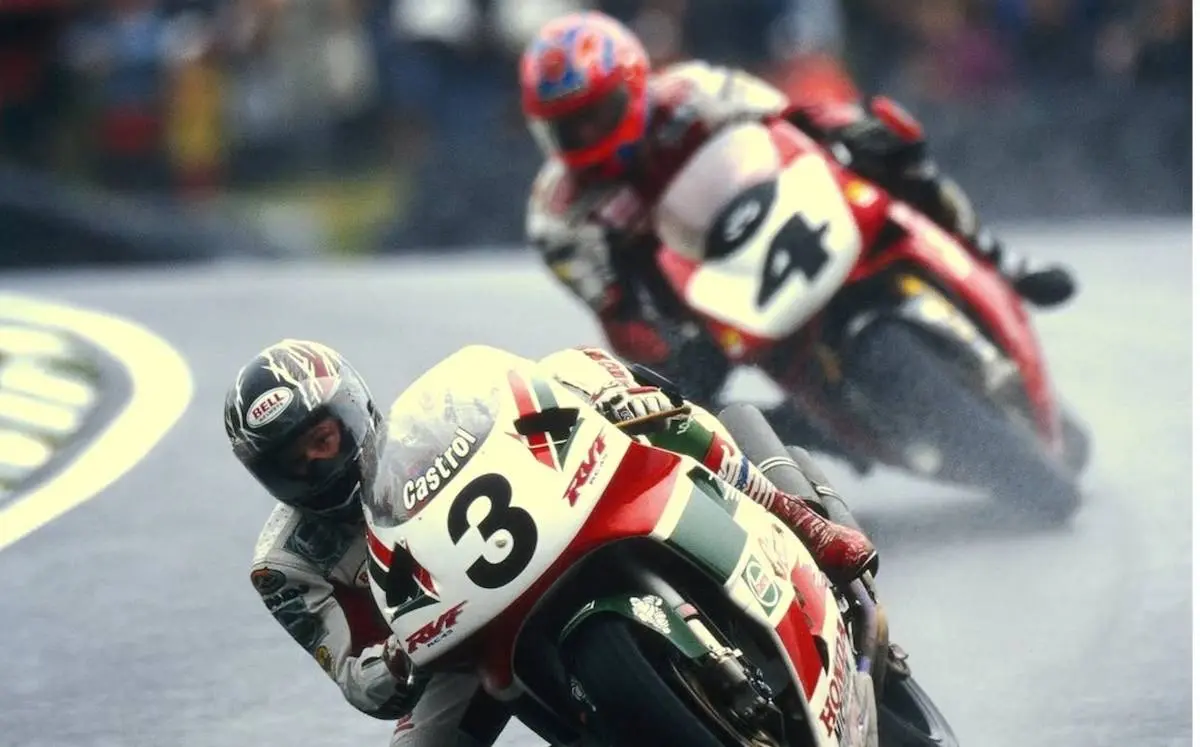
In 1996, after two consecutive titles, Fogarty left Ducati for Honda to take the RC45 to victory. Stepping into his shoes on the Ducati 916 was none other than Kocinski: on paper, two champions on the two best bikes on the grid; in reality, the start of a war that defined an era. The King could barely tolerate the American’s coldness and air of superiority, publicly accusing him of being an arrogant man with no respect for anyone. Kocinski didn’t flinch and brushed it off, saying the only thing that matters is lap times, not words. His classic response.
On track, the rivalry quickly erupted into edge-of-the-limit duels. At Assen the two showcased their full repertoire, ratcheting up the tension all the way to the Geert Timmer chicane: Kocinski shocked Fogarty—already certain he’d sealed the win—by lunging desperately up the inside. Foggy got unsettled but kept enough cool to square it off, even as the move allowed Troy Corser to join the fray; he survived the three-way melee and snatched it in a drag to the line by mere centimeters.
Over the long run, though, the one to benefit from the grinding Fogarty–Kocinski war was the third dog in the fight: the 1996 World Championship surprisingly went to Corser on Ducati.

1997: the reckoning
1997 was the second chapter of the showdown, and also its finale. Fogarty and Kocinski swapped bikes: the Brit returned home to Ducati, the American became Honda’s spearhead. The title chase turned into a private matter that peaked with a fairing-to-fairing clash in Austria, where Kocinski came off worse. No strategy, no championship math—only the need to finish ahead of the other. Kocinski ultimately won the World Championship, but the rust built up between the two was bound to last. The following year, even though his rival had left Superbike to return to the 500cc class, Fogarty commented in an interview with the Independent: “I have a lot of respect for Kocinski as a rider, but as a person I don’t like him at all. He treats others like servants. I’d never do that. On track, though, we’re the same: neither of us cares about finishing second. For me, ending up behind is a disaster, and I’m sure it’s the same for him.”
The Fogarty–Kocinski rivalry wasn’t built on mutual respect, like—for example—the one that would later define the Edwards–Bayliss duel. It was a clash between two riders with different characters but equally fierce pride, driven by a mutual and genuine dislike. With one shared trait, as Fogarty himself later admitted: “On track, Kocinski and I are similar because, like me, he doesn’t care about finishing second. For me it’s a disaster, and I’m sure it is for him too. Many riders are happy to bag a couple of decent finishes and head home. If I do that, I’m unbearable for a few days.” And it’s precisely in these words that the narrative power of the Fogarty–Kocinski duels lies: in the awareness that neither would roll off the throttle early, even at the cost of throwing away the race; in the sense that every braking zone could explode into a brawl, that the technical limit was constantly being overruled by the personal one. Without this dualism, Superbike’s golden age would have shone a little less brightly.
-> Follow us on Instagram: @Corsedimoto
Continue reading
You might also like
More news
Popular articles
Loading