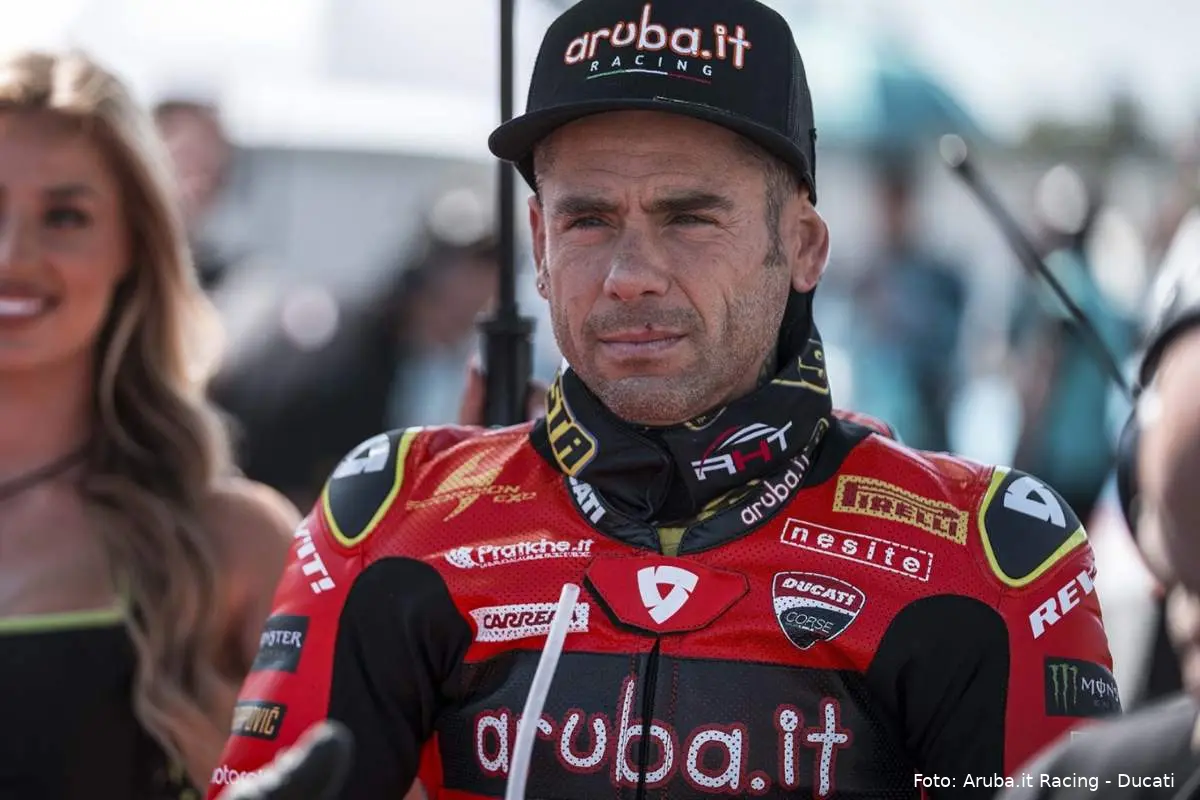
Escamez spoke about his experience as Honda Superbike team manager and also about the debated minimum weight rule.
Honda returned to the Superbike World Championship with its own factory team in 2020 and has not yet achieved the desired success. Since then it has claimed only 6 podiums: 3 with Alvaro Bautista, 2 with Iker Lecuona and 1 with Xavi Vierge. The last victory dates back to 2016, when Nicky Hayden won Race 2 at Sepang (Malaysia).
Next year it won’t just be the riders changing, with Jake Dixon and Somkiat Chantra replacing the Vierge-Lecuona duo. The HRC team’s manager will also be different: José Manuel Escamez, in office since 2024, will be replaced by Yuji Mori.
Superbike, Escamez recounts his experience as Honda team manager
Escamez began working for Honda towards the end of 2019 and, interviewed by journalist Manuel Pecino’s PecinoGP YouTube channel, explained what the switch to Superbike in 2024 was like: “The ones I clashed with the most were the Japanese, but for a reason. The team manager should not make certain technical decisions, but he still has the moral responsibility to put pressure on them so that they react. If you let them be, generally, they go at their own pace. When you put a bit of pressure on them, then they react. But many times it was difficult and frustrating. Little by little we improved.”
The Spaniard tried to put his stamp on the team manager role and explained one aspect on which a lot of work was done on the CBR1000RR-R Fireblade SP, which also changed in terms of the sound it produced: “We began working hard from late 2024 on the exhaust valve. This valve is present on all Superbikes, but when I arrived in the team in 2024 we didn’t have it, because they had tried it and it didn’t work well. Nothing you’re given the first time works right; this happens almost always. But you have to work and understand. The change in sound was one of the big differences you can notice from the grandstands. It took us months to make it work.”
SBK, would a CBR1000RR-R with a V4 engine be better?
The Honda engine has proven fast in terms of top speed, but it has shown difficulties with low-end acceleration: “The riders were frustrated,” Escamez recounts. “They always had to brake late, because when accelerating they couldn’t do anything. I know where you can improve, but Honda is very involved in MotoGP and there isn’t the same development capacity in Superbike. This year I tried to set up a base in England, but for the factory-team mechanism to work, a lot is still missing.”
The Spanish manager was asked whether Honda would do well to adopt a V4 engine, thus putting itself on par with Ducati. His answer is clear: “I would say yes, with my eyes closed. Superbikes are derived from production models; you need to make sure people buy them and that they work well on track too. When you go to the dealership, what’s the first thing that attracts you? When they start it up and you hear the sound. Starting from that, I’d say that strategically and commercially a V4 would be better. Even in MotoGP everyone has gone the V4 route. But in Japan there must be something strategic that I don’t know which leads them to continue with the inline-four. I don’t know what they have in mind. If it were up to me, I’d make a V4.”
Bimota and the anti-Bautista rule
The former HRC team manager admitted he has great confidence in the future of Bimota, with a project that Kawasaki debuted positively in 2025 and which seems to have the potential to grow significantly in 2026: “I expect a lot from Bimota. The team is excellent; it comes from the Kawasaki era. I think the strategic move they made was very wise and will give them what they’re looking for.”
Finally, Escamez was also asked about the debated minimum weight rule introduced in Superbike in 2024, which Alvaro Bautista would gladly do without, given that he’s practically the only one affected by it with a full 6 kilos of ballast: “They complained about Bautista’s weight,” the Spanish manager admits, “and it seems silly to me. Alvaro didn’t win because he weighed less. People don’t realize how much he suffers trying to put weight on the rear wheel and heat it up. I don’t see any reason to put ballast on him. But one thing needs to be made clear: fans point the finger at Dorna, which bears no blame. These things are decided by a group called the MSMA. His own team approved that rule, after the other manufacturers proposed and supported it. Then I think Bautista would have done the same with or without extra weight: let’s not forget he finished third behind two very strong riders. He surely could have fought more. Anyway, it seems like a stupid rule to me, but it must be said that Ducati itself approved it.”
That’s correct. The MSMA is the manufacturers’ association and inside it, obviously, there is Ducati as well. The latter voted in favor of the minimum weight rule, perhaps underestimating the problems Bautista would face. The two-time WorldSBK champion was “stung” by the very brand for which he raced and will race in 2026 too, albeit moving to the private Barni Spark team.
Continue reading
You might also like
More news
Popular articles
Loading