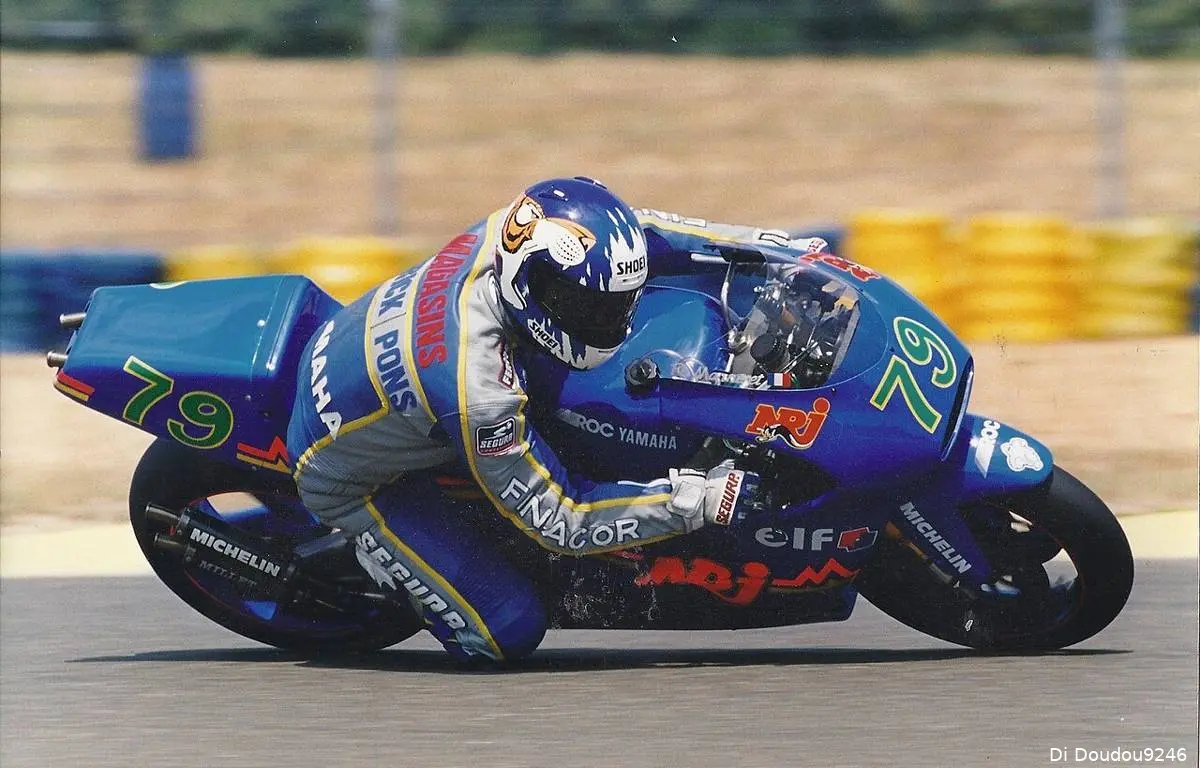
In the 1990s, there was still room for imagination and craftsmanship in Grand Prix motorcycle racing. The ROC Yamaha 500 was born in a transitional era, when the 500 class was changing its skin, grids were thinning out, costs were rising, and the major Japanese manufacturers had the courage to take unusual paths.
After the 1991 World Title won with Wayne Rainey, Yamaha decided to make a “tamed” version of its two-stroke V4 available to private teams. Not an official replica, but an engine sufficiently close to allow the best European chassis builders to construct something competitive around it. The key difference lay in the details: aluminum crankcases instead of magnesium—less refined, heavier, but infinitely more sustainable economically. For this operation, Yamaha turned to two names: Harris in England, and ROC in France.
ROC: a French vision of the 500
ROC (Rosset Organisation Competition) was no newcomer. Led by Serge Rosset, it had already proven it could build real motorcycles, not just token frames. Its private Hondas had made their mark, ridden by the likes of Dominique Sarron and Pierfrancesco Chili. Moreover, its connection with ELF provided technical and logistical solidity rare for an independent outfit.
When ROC got its hands on the Yamaha engine, it didn’t just adapt it—it interpreted it. They built a rational frame: stiff where needed, communicative at the limit. The result was a bike designed for real riders. Between 1992 and 1997, around thirty examples of the ROC Yamaha 500 were built, entrusted to various teams and riders, who often had to cobble together their race weekends with limited means but clear ideas.
In 1993, the Japanese manufacturer acknowledged the value of the project. Wayne Rainey, Yamaha’s factory rider, repeatedly used a YZR 500 fitted with a ROC frame. A privateer became a true benchmark for the factory team!
That same year brought the most important result in the racing career of the ROC Yamaha: Niall Mackenzie’s third place at the British GP. ROC finished the season fifth in the Constructors’ Championship with 104 points.
A second life, past its time
Like many two-strokes, the ROC Yamaha seemed destined to remain a romantic memory. Instead, it returned to the track in 2003, in the MotoGP era.
The Harris WCM team, left without its own bike due to homologation issues, dusted off the old 500 two-stroke for three Grands Prix, entrusting it to Chris Burns. It was an uneven, almost symbolic challenge: against larger, more powerful engines that were technologically light-years ahead, the ROC could only bear witness to an era that no longer existed. Results didn’t come, but just being on the grid was already a moral victory
The ROC Yamaha proved that with design intelligence and vision, even an independent European team could hold its own against Japanese engineering.
Continue reading
You might also like
More news
Popular articles
Loading