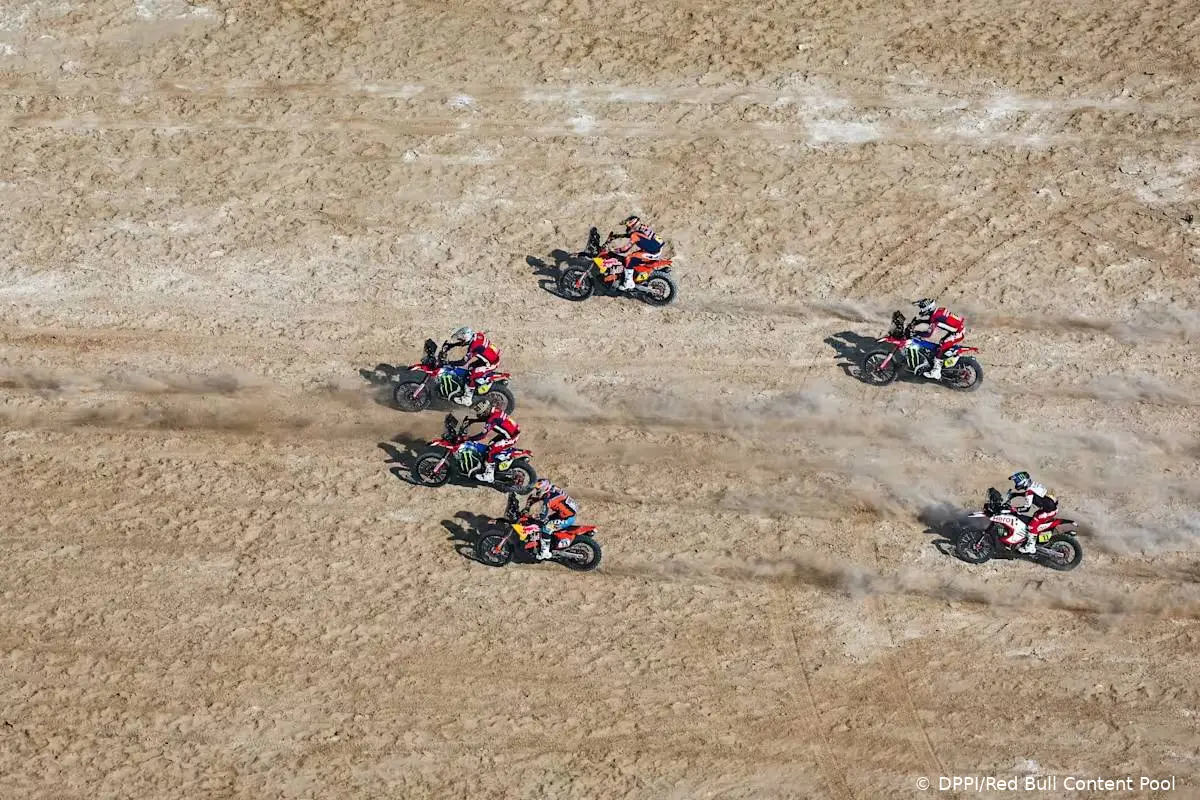
Dakar 2026 promises to be one of the toughest and most evocative editions in recent years. From January 3 to 17, crews will cross Saudi Arabia on an 8,000 km loop from Yanbu to Riyadh and back, designed by sporting director David Castera to showcase not only driving and navigation skills, but above all the competitors’ endurance.
The event will kick off on January 3 with the Yanbu Prologue, a short desert teaser mainly useful for setting the starting order.
The following day, the rally will immediately get serious with a stage that once again forms a large loop around Yanbu. It’s a wild, varied 305-timed-kilometer route, packed with rocks and spectacular valleys. Here one of the novelties of 2026 will debut: the mid-stage service point, as valuable as it is unprecedented.
On the third day, competitors will head from Yanbu to Al Ula, and this is where the Dakar really starts to bare its teeth. Over 500 kilometers in total, with 400 of special stage, across mixed terrain alternating rocks, sandy stretches, and the first true dunes of this edition.
On January 6, the caravan will remain in Al Ula but take on one of the toughest and at the same time most beautiful stages of the entire rally. With its monumental canyons and vast expanses of flat sand, Al Ula represents the quintessence of Saudi Arabia. Competitors will face more than 400 timed kilometers that will severely test navigation.
The next day brings the first of the two feared Marathon Stages. Cars, buggies, and trucks on one side, bikes and quads on the other, on separate routes. It’s a long and demanding 451 km special leading to a remote bivouac, with no assistance. A night in the silence of the desert, wrapped in stars: fascinating, but grueling.
On January 8 the Marathon continues with a slightly shorter stage to Hail. Waking up in the bivouac is always tricky: the vehicle must be checked, any damage patched up as best as possible, and then off you go again. The 372 km special is less difficult than the day before, but mainly serves to prepare for the mountain awaiting them the next day. On January 9, in fact, comes one of the hardest days of the entire Dakar 2026: 920 km from Hail to Riyadh, with a 331 km special immersed in an ocean of dunes.
After this marathon in the truest sense, January 10 is the classic Rest Day in Riyadh. When the Dakar resumes on January 11, it will do so in grand style: nearly 900 km in total and 462 of special, from Riyadh to Wadi Ad-Dawasir amid endless dunes and navigation traps, where every choice can become either an advantage or a black hole of lost minutes.
The next stage, on January 12, will be one of the most spectacular of the edition: a mass start like in the days of the classic Paris–Dakar and a large 481 km loop around Wadi Ad-Dawasir.
On January 13 it’s back to Marathon mode. The special is not too difficult, but it will take competitors to a new isolated bivouac: 410 timed kilometers where avoiding mistakes is more important than attacking. And in fact, the following day, January 14, brings one of the emblematic stages of 2026: over 400 km of special, with a full 300 on continuous dunes. On January 15, from Bisha to Al Henakiyah, the special will be shorter but treacherous. On January 16, from Al Henakiyah to Yanbu, the penultimate stage will keep the tension high: 310 km of special where anything can still happen.
Finally, on January 17, Dakar 2026 will conclude where it began, in Yanbu. The last special will be short, just 105 km, but after 8,000 kilometers of adventure, every meter could make the difference.
Continue reading
You might also like
More news

Popular articles



Loading