Let’s be clear: the fact that Sportbike replaces Supersport 300 already speaks in its favor. The new entry-level class for the World Superbike circus will forcefully become part of the world championship calendar next year, replacing the 300 which, in light of the recorded incidents and the data on hand, proved to be a dangerous and not very formative category. On paper, Sportbike looks promising, although the 2026 regulations raise several eyebrows.
33 ENTRIES IN THE SPORTBIKE WORLD CHAMPIONSHIP
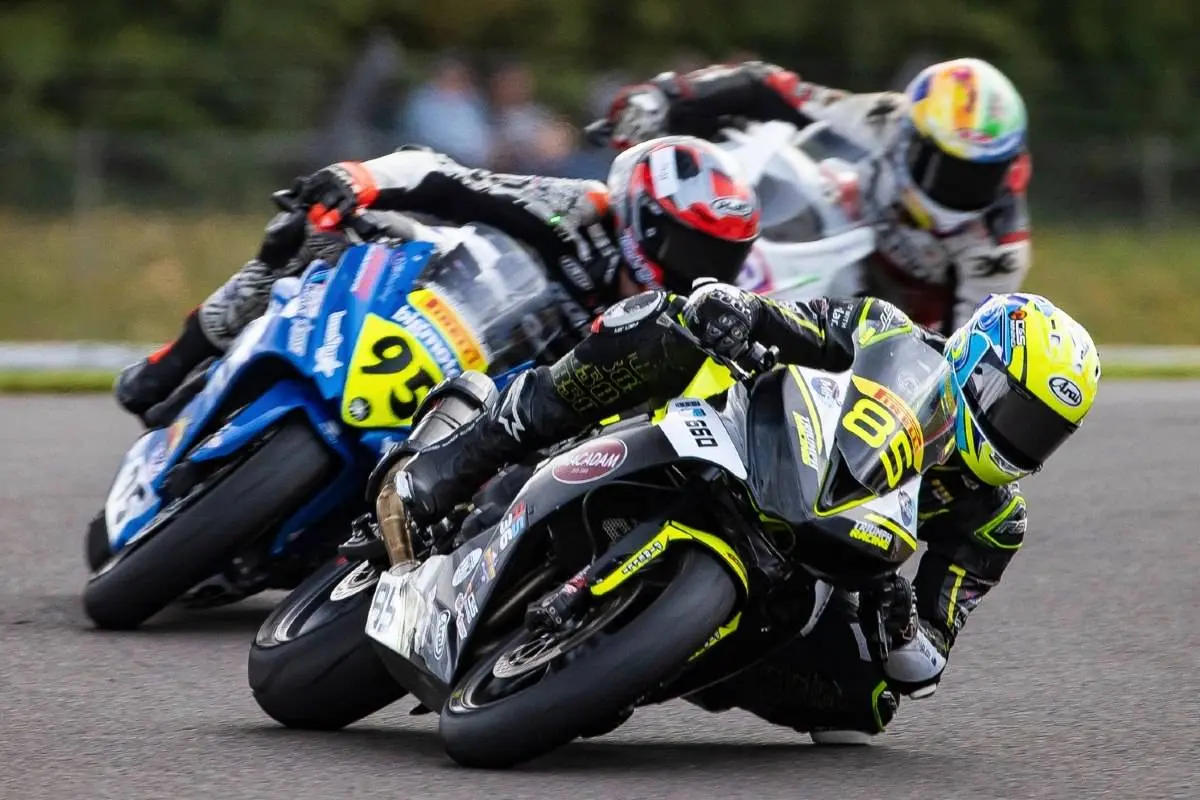
Starting with the positives, the inaugural season of the Sportbike World Championship will welcome a starting grid of 33 entrants. Not bad at all, with riders of varying caliber and technical-competitive backgrounds, quality teams, and the interest of manufacturers. Some of them are already involved in national championships that have led the way in the past experimental seasons (British Sportbike, CIV Sportbike, MotoAmerica Twins Cup), although the world series regulations will differ quite a bit.
8 BIKES ALLOWED ON THE GRID
One of the first points is the list of bikes allowed to start. A total of 8: in strict alphabetical order, Aprilia RS 660, CFMOTO 675 SR-R, Kawasaki ZX-6R 636, KOVE 450RR, Honda CBR 600, Yamaha R7, Triumph Daytona 660, and Suzuki GSX-8R. Five of these (Aprilia, CFMOTO, Yamaha, Triumph, and Suzuki) are essentially “pure Sportbikes,” while the remaining ones are allowed even though they deviate from the original formula of 650cc (or thereabouts) four-stroke twins. The KOVE with a 450, but what’s surprising is that the Honda CBR 600 (none will actually line up) and, above all, the Kawasaki Ninja 636 have been admitted. Essentially the same bike as in the Supersport World Championship, although it will be subject to specific constraints to equalize performance.
90 HORSEPOWER TARGET
Kawasaki and Honda are, in effect, Supersport machines brought into Sportbike. Although both, particularly the green machine with the Z650 engine (a benchmark in Supertwins in recent years, especially in road racing), could offer alternatives in a category that, by regulation, sets a maximum power target of around 90 horsepower. For this reason, the FIM and DWO have introduced several corrective measures: to balance bike performance, they will adjust minimum weight, engine, rev limiter (and torque) with a BOP not too dissimilar from what we’ve seen in recent years in Superbike and Supersport. The same will apply in the newly minted Sportbike, with evaluations every 3 rounds.
COLOSSAL DIFFERENCES
Right from the start, there will be distinctions in minimum weight among the various bikes (bike only and combined bike plus rider). The “heaviest” will be the Suzuki GSX-8R, the “lightest” the KOVE 450RR. The disparity in minimum weight and other limitations will be divided across three different “subclasses”: bikes from 400 to 600cc, from 601 to 799cc, and 800cc and above. Quite a mixed bag.
SPEC SINGLE-MAKE PARTS
On the tires (Pirelli) and electronics (Mectronik MKE7 ECU WSS600_A version, essentially the Supersport World Championship unit), everyone will run on equal terms. In this area as well, adjustments will be made to find compensatory measures to level performance, with the understanding that the first rounds will be almost a step into the unknown. Some bikes, on paper, should already have an advantage by virtue of their very nature and the technical specifications of the production model.
Continue reading
You might also like
More news
Popular articles
Loading