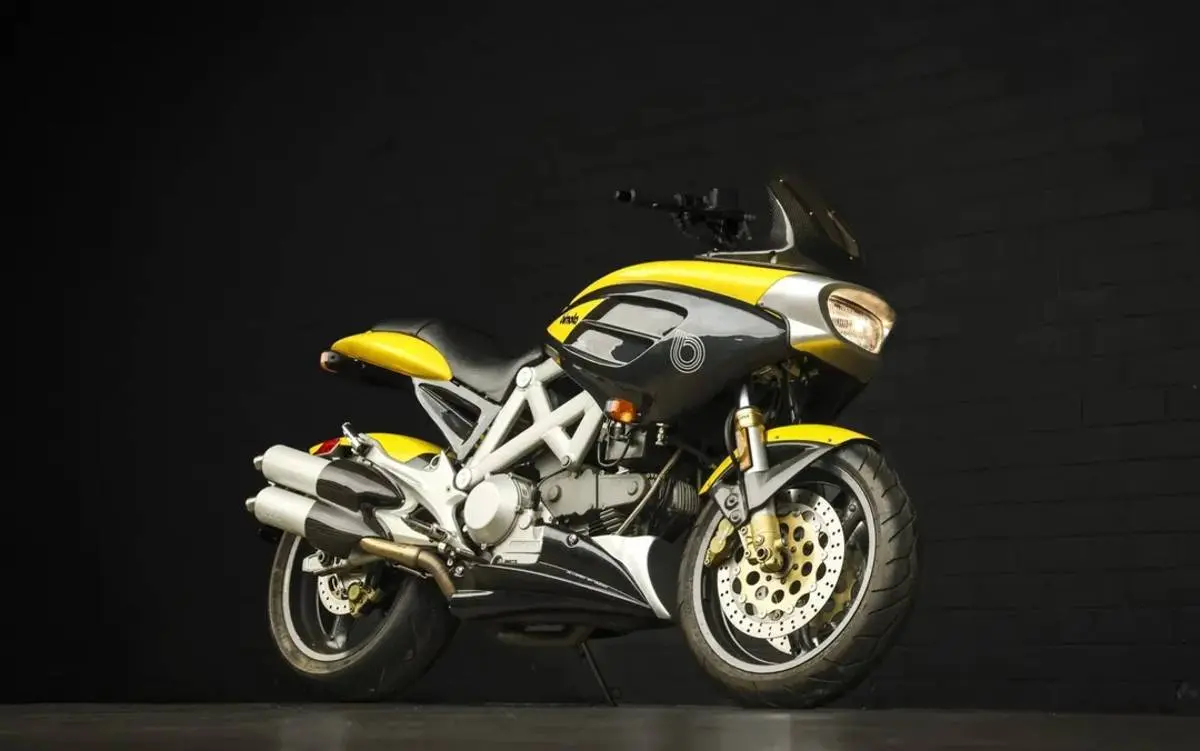
A futuristic work of art or pure madness? Bimota DB3 Mantra is a bike you don’t forget, for better or worse. When it first appeared at the 1994 Cologne Motor Show, it sparked mixed reactions.
Sacha Lakic’s signature on the design was immediately recognizable, a stroke that didn’t aim to reassure: it wanted to provoke, open unexpected spaces, free the imagination. The Mantra didn’t worry about being liked, it didn’t dress up to seduce. It presented itself as it was, with that front end that looked like a tribal mask and the tank sculpted like an organic, almost living work.
Beneath that unconventional bodywork beat the well-proven 904 cc Ducati twin, the same as the Monster 900. A classic air-cooled L-Twin, fed by two 38 mm Mikuni carburetors and capable of delivering 86 hp at 6000 rpm, with a hefty 9.2 kgm of torque at 5700 rpm. Figures that may seem modest today, but in the ’90s guaranteed a full, gritty, and engaging delivery—exactly what the Bimota audience was looking for.
The aluminum frame, with those oval-section tubes, almost looked hand-drawn, yet it was one of the stiffest and most refined structures of its time. Marchesini wheels wore then-modern tires: 120/70 ZR17 up front, 180/55 ZR17 at the rear. Paioli suspension and Brembo brakes completed the technical package.
The Mantra, despite its concept-bike lines, was precise, effective, and communicative. After the first impact, after a few corners, that world of strange shapes faded into the background, and what remained was the feeling of riding something profoundly different from everything else.
When, in 1997, an updated version was introduced with a softer front end and a few tweaks to the tail, it was as if Bimota had decided to caress the audience a little, to extend a hand to those who hadn’t had the courage to fall in love with the first version. Yet, despite the changes, the substance didn’t change: it was still the Mantra—an uncompromising, strong idea.
Looking at it today, you can smile at its sharp angles, its excesses, the bold choices that made many frown at the time. Yet it’s precisely that difference that allowed the DB3 to outlast time. Not everyone understood it, not everyone loved it, but no one ever forgot it. Perhaps that is the true magic of the Mantra: not perfection, not consensus, but the courage to be something others were not.
Continue reading
You might also like


More news
Popular articles


Loading