Volkswagen under pressure, Ducati a coveted jewel: the offer is on the table
DreamsFriday, 14 August 2026 at 19:00
by André Lecondé/paddock-gp
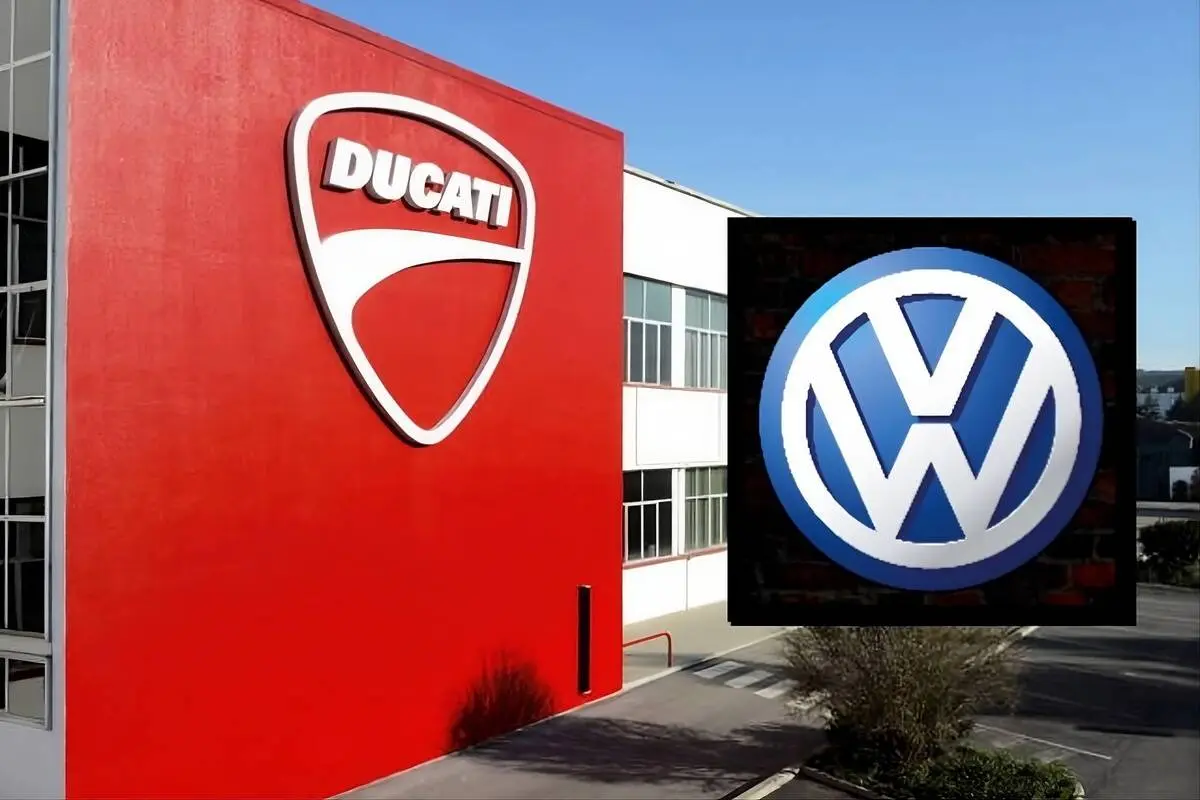
The delicate situation of the Volkswagen Group, worsened by Porsche Holding’s heavy losses, is putting Ducati under pressure again.
Ducati is doing well. And perhaps that’s precisely why the Italian brand could be sold. In Borgo Panigale, Ducati enjoys an exceptional global image, has dominated MotoGP for several years, is investing heavily in its technological future, and has just announced a research and development program worth 121 million euros, about 33.5 million of which is funded by the Italian state. But a few hundred kilometers away, in Germany, the atmosphere is radically different.
Volkswagen is facing a restructuring that could prove to be one of the most significant in its recent history. And, crucially, its main shareholder, Porsche SE, is starting to lose patience. This is where Ducati’s situation takes on a new dimension. Note the name: it is not directly connected to the sports car maker Porsche AG. Porsche Automobil Holding SE is the holding company controlled by the Porsche and Piëch families, which holds over 53% of Volkswagen’s ordinary shares. It therefore represents one of the main centers of power within the Volkswagen empire.
Porsche SE has just announced a net loss of 2.2 billion euros for the first half of 2026, mainly due to accounting impairments of its stakes in Volkswagen and Porsche AG. More importantly, the Porsche and Piëch families are now publicly asking Volkswagen to accelerate its restructuring.
The Porsche, Volkswagen, Ducati question
According to international sources, Porsche SE’s chairman, Hans Dieter Pötsch, is calling for swift decisions, as Volkswagen considers a significant reduction in costs and production capacity. Reuters reports that up to 50,000 jobs could be cut and that four German plants could be at risk, although these measures remain extremely controversial at the political and social levels.
It is precisely in this context that Ducati must be analyzed. Volkswagen is not on the brink of bankruptcy, but its business model is under pressure. It would be an overstatement to describe Volkswagen as a group needing to liquidate assets to survive.
In the first half of 2026, the group nevertheless generated revenues of 158.1 billion euros and operating profit of 5.93 billion euros. However, that figure was lower than the 6.71 billion euros recorded in the first half of 2025, and the operating margin fell from 4.2% to 3.8%.
The problem lies elsewhere. Volkswagen must simultaneously finance its technological transition, defend its position in Europe, confront extremely fierce competition from China, and restore the profitability of some of its activities.
In China in particular, the shock has been especially severe: the group’s sales plummeted by 31.6% in the first half of the year. Volkswagen has simultaneously revised down its revenue forecast for 2026. In this context, the strategy is no longer necessarily to sell off struggling companies. Instead, it can focus on selling high-value ones. And Ducati fits perfectly into this category.
The Ducati paradox
The numbers clearly illustrate the scope of the issue. In 2025, Ducati generated revenues of 925 million euros, operating profit of 52 million euros, and delivered 50,895 motorcycles. For a high-end motorcycle manufacturer, that’s a significant share. But at Volkswagen’s scale, it’s tiny. The German group nonetheless generated revenues of 321.9 billion euros in 2025.
Ducati’s annual operating profit is thus a drop in the ocean compared to Wolfsburg’s consolidated accounts. But its asset value is considerable. Volkswagen can keep Ducati and pocket tens of millions of euros in operating profit each year. Or it can potentially sell Ducati and immediately pocket several billion euros. In normal times, keeping such a prestigious asset is perfectly justifiable. In a restructuring of this magnitude, however, the equation changes. Audi acquired Ducati in 2012 for around 860 million euros. Fourteen years later, Ducati is valued at 2.5 billion euros.
However, extreme caution is needed on this point: unlike Porsche SE’s results or Ducati’s accounts, we do not yet have sufficiently solid confirmations to state that Volkswagen has formally agreed to evaluate a binding offer of 2.5 billion euros. The Italian company Patritalia has publicly expressed its interest in acquiring Ducati and says it wants to bring Italian brands back under Italian control, but the financial feasibility and potential success of this initiative remain to be verified.
In other words, 2.5 billion currently represents more of a stated valuation than an actual sale price. But this figure gives an idea of the equation that could be taking shape in Wolfsburg. With an annual operating profit of 52 million euros, 2.5 billion corresponds to almost 48 years of Ducati’s operating profit in 2025.
Ducati’s value
Obviously, a company’s value isn’t determined this simply. Ducati has a brand, technology, a sales network, patents, an extremely loyal customer base, and considerable potential for the future. The question is no longer: “Is Ducati profitable enough for Volkswagen to keep it?” The real question is: “Is Ducati strategic enough for Volkswagen to turn down several billion euros when its main shareholder is calling for a far more drastic restructuring?” These are by no means the same thing. And sentimental arguments will carry very little weight.
Ducati is Italian, legendary, and winning in MotoGP. It is probably one of Audi’s most successful acquisitions in recent decades. But Volkswagen has to think in terms of capital allocation. Just as speculation intensifies about a possible sale, Ducati announces investments of 121 million euros in research, development, and innovation. This program, called Ducati Raise the Bar, is intended to support the technological development of the next generation of motorcycles.
A company preparing for its long-term future
This is not contradictory. A company can very well invest large sums while changing shareholders. This can even increase its value.
And Ducati has a particularly important characteristic: Claudio Domenicali has already explained that the company is largely able to finance its own development and does not structurally depend on its shareholder to secure its investments. This, in theory, would make a separation from Volkswagen less traumatic than it might seem.
The Ducati brand is small compared to Volkswagen, profitable, globally renowned, technologically sound, and sufficiently independent to theoretically change ownership. And above all, it could be worth several times the price Audi paid in 2012.
The new pressure exerted by Porsche SE on Volkswagen does not mean that Ducati will be sold. However, it makes the question we previously raised much more plausible. The danger for Ducati is not that it has become dead weight within the Volkswagen empire. It’s almost exactly the opposite. In a group that thinks in billions, Ducati may have become attractive enough to be acquired.
Continue reading
You might also like
More news
Popular articles

Loading